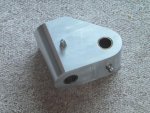
repairing the goose neck.

Birdseye

Well-Known Member
Joined
9 Mar 2003
Messages
28,796
Location
s e wales
Visit site
my boat is turning 20 and the Kemp gooseneck has worn oval where the stainless pin runs in the alloy castings. There is enough meat to ream out circular and sleeve maybe with phosphor bronze. Anyone done this?

 
I don't think phosphor bronze or any yellow metals go with aluminium, why not ream out and sleeve with aluminium, or alternatively take it to someone with a TIG welder who can fill it with aluminium then you can redrill.
 
Yes. I have done it. Bronze bushes are perfectly OK in aluminium, after all the gooseneck is not immersed in the sea. I wrote the article on this that appeared in PBO (August 2012, page 73) Unfortunately the gooseneck casting was very poor quality and broke in half as a result of an enforced gybe after a sudden 40 knot gust forced the boat towards a rocky coast leaving me no option except to gybe away. The break revealed a very crystalline structure. The final solution was to replace it with a new one machined from solid alloy bar, and bushed with the bronze bushes recovered from the broken part as shown below.

tn_DSCF1884.jpg
 
I replaced mine earlier this year, the replacement is stainless I think. I was intending to refurbish the old one and keep it as a spare. The intention is to bore/ ream out the hole and sleeve it either with an Oilite bush, or high density plastic tube.
 
There are three parts to wht I call the gooseneck - the bit thats rivetted to the mast, the bit thats rivetted to the boom and the casting inbetween that the stainless pins go through.

Did you replace all the bits Danny? Are they all stainless? Were the rivet holes in the mast the same? And do you have a part number?
 
The only bit I replaced was the bit in the middle. To be honest it seemed to be the only bit that was worn, but I am worried about having a stainless part between two alloy parts, which is why I'm looking to refurbish and refit the original. I have fitted a PTFE washer, between the riveted on mast piece and the swivel part, to reduce any wear. My original had a groove worn on the bottom by the washers, to the point where the washers were no longer keeping the fixed and moving parts apart, I thought I had lost the washers somehow but when I took it apart, there they were embedded in the base of the triangular bit. Sorry I don't have a part number, and I'm not going out on deck in this wind, not when it's dark anyway. I can check it tomorrow.
I just checked and the number appears to be 528031 although it's not easy to see, the numbers on the old black one were clearer.
 
Last edited:
Yes. I have done it. Bronze bushes are perfectly OK in aluminium, after all the gooseneck is not immersed in the sea.
View attachment 55095
I don't think I'd trust those two together, quoted from,
http://www.engineersedge.com/galvanic_capatability.htm
"For harsh environments, such as outdoors, high humidity, and salt environments fall into this category. Typically there should be not more than 0.15 V difference in the "Anodic Index" and from their tables an average bronze and average aluminium mix would give about 0.5V.
I once stood a couple of aluminium spreaders against the wall in my shed with a length of 15mm copper tube touching one of them, about 18 months later I found a corrosion pit about 3mm dia x 1mm deep in the spreader exactly where the copper had been touching it, and the shed although a bit damp is about a mile from the sea.
 
Last edited:
Yes. I have done it. Bronze bushes are perfectly OK in aluminium, after all the gooseneck is not immersed in the sea. I wrote the article on this that appeared in PBO (August 2012, page 73) Unfortunately the gooseneck casting was very poor quality and broke in half as a result of an enforced gybe after a sudden 40 knot gust forced the boat towards a rocky coast leaving me no option except to gybe away. The break revealed a very crystalline structure. The final solution was to replace it with a new one machined from solid alloy bar, and bushed with the bronze bushes recovered from the broken part as shown below.

View attachment 55095
:encouragement: :encouragement:
 
The original gooseneck, of cast aluminium lasted more than 18 months before the casting broke. It had no sign of galvanic corrosion, nor is there any sign of it on the new one. I did not have the new one anodised, so it has the usual dull surface corrosion layer that bare aluminium always develops. In both cases the bronze bushes were a good hand push fit into the alloy, assisted with a smear of loctite bearing adhesive.
 
The original gooseneck, of cast aluminium lasted more than 18 months before the casting broke. It had no sign of galvanic corrosion, nor is there any sign of it on the new one. I did not have the new one anodised, so it has the usual dull surface corrosion layer that bare aluminium always develops. In both cases the bronze bushes were a good hand push fit into the alloy, assisted with a smear of loctite bearing adhesive.
The Loctite will help.

It can also help to make the pins move only in the 'triangular bit' so the other bits don't wear.

On my dinghy, the 'triangular bit' is plastic.
I have an ebay titanium offcut earmarked for it.

For smaller boats, Igus plastic bushes might be a good solution instead of bronze?
 
I repaired the identical part on my Sadler something like five years ago. I reamed out the holes in the fixed part attached to the mast and the vertical hole in the gooseneck casting and inserted short lengths of PVC water pipe. I used 15 mm pipe that was rather large in diameter for the biggest hole I could ream, so I slit it lengthways and took a piece out. Not only has it been highly successful in eliminating the need for lubrication and the squeaking that always occurred, it has also been long lasting. I took a length of the PVC pipe out to Greece expecting replacement to be an annual event but it remains in the spares box, I am still on the original ones.
 
http://www.getrigged.co.uk/boom-toggles-21-c.asp
These parts don't seem to be prohibitively expensive. Why go to the trouble of a time-consuming and possibly unreliable bodge?

They are not expensive, but the new one is cast stainless I think, my concern is whether this presumably harder material may cause wear on the alloy parts. There is the other issue, if whether a simple repair such as boring out and sleeving the holes, is more environmentally sustainable (see the thread about repair vs buying new)
I just realised that thread is in the lounge http://www.ybw.com/forums/showthread.php?446077-EU-say-we-should-REPAIR-NOT-THROW-AWAY
 
Last edited:
http://www.getrigged.co.uk/boom-toggles-21-c.asp
These parts don't seem to be prohibitively expensive. Why go to the trouble of a time-consuming and possibly unreliable bodge?

I bought a new one but didn't use it because my time-consuming bodge was a far better solution. Plus, if replacing the whole thing to eliminate wear it would be necessary to drill out the pop rivets attaching the fixed part to the mast, a load of work and expense for no advantage.
 
my boat is turning 20 and the Kemp gooseneck has worn oval where the stainless pin runs in the alloy castings. There is enough meat to ream out circular and sleeve maybe with phosphor bronze. Anyone done this?
I've got this.Does it suit you?

gooseneck.jpg
 
The replacement part for mine was quoted at over £100, and on a lengthy delivery delay. It would still just have been cast aluminium of doubtful strength.

When I break something, I often want to replace it with something stronger!
Selden kept making RS400 dinghy booms to the exact same design for a very long time after the first ones started to break after a few years normal use.
 
Top