Repair of Stem at Forefoot Advice please

Redfox226

Well-Known Member
Joined
7 Aug 2012
Messages
206
Location
Me: Wakefield; Boat: Gibraltar Point SC
Visit site
Hi
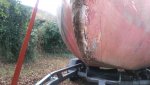
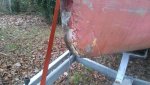
My Red Fox Trailer Sailer has suffered damage at the forefoot initially I think when loading onto the old trailer, but increasing despite fairing with filler. I think you can see from the pics that there are some exposed glass fibres....
Stem Foot2.jpg
Stem foot1.jpg

I have read the Gougeon Bros documents and have done some epoxy work in the past, however bearing in mind the possibility of repeated 'trailer' damage, I have a couple of requests for the wisdom of the Forum.......
  • Do I reinforce with aluminium/Brass strip?
  • will a 12:1 bevel be needed using woven rovings

Thank you all for your forbearance.
 
A metal rubbing strip would guard against scratches but will not provide immunity from the crushing that results from a severe bump.
Grind the existing damage back to sound glassfibre and rebuild for strength. Alternate layers of CSM and thick rovings being careful to roll out any air bubbles and excess resin. Personally I have always rebuilt such areas with 'ordinary' thixotropic resin once the dry glass fibres are exposed; others insist that epoxy is essential...
Re future unscheduled 'trailer - forefoot contact' I would try to arrange things so that the forefoot meets a sloping section of the trailer so that it is guided upwards; should not be too difficult to add.
 
A metal rubbing strip would guard against scratches but will not provide immunity from the crushing that results from a severe bump.
Grind the existing damage back to sound glassfibre and rebuild for strength. Alternate layers of CSM and thick rovings being careful to roll out any air bubbles and excess resin. Personally I have always rebuilt such areas with 'ordinary' thixotropic resin once the dry glass fibres are exposed; others insist that epoxy is essential...
Thank you - bevel the grind?
Re future unscheduled 'trailer - forefoot contact' I would try to arrange things so that the forefoot meets a sloping section of the trailer so that it is guided upwards; should not be too difficult to add.
Have 'improved' the trailer with a swing beam trailer - have added extra keel rollers in the 'V' of the beams and now winch carefully on.....
 
Thank you - bevel the grind?

Yes, of course, and do go deep at the very front. It is not uncommon to find weak (empty) areas there because it is sometimes very difficult to reach inside there in a mould and do a proper job of laminating. I don't know about the Redfox but I have come across such defects in old boats with a 'sharp' stem.

Have 'improved' the trailer with a swing beam trailer - have added extra keel rollers in the 'V' of the beams and now winch carefully on.....
That is certainly the best way! :encouragement:
 
Do you have access to the inside?
If so, I would consider reinforcing the inside if necessary.
Then cut away the damaged GRP outside and fill.
Half a kilo of extra weight won't matter, and you would make the tip of the bow more or less sacrificial so that next time it gets damaged, it just needs a bit of filling.

If you can look at the inside, you may find the designer has predicted the bow will get bumped and beefed up the area.
If possible, I would avoid grinding off big areas of sound GRP in 12:1 tapers, as you risk losing the shape. Reinforce inside instead, there is little penalty in having extra material in this area. That's notmally only a bad thing when you want the repair invisible inside, or you want the panel to flex evenly.
 
If possible, I would avoid grinding off big areas of sound GRP in 12:1 tapers, as you risk losing the shape.

In practical terms 8, 10, 12 does not really matter much outside of a laboratory.
Re "losing the shape" one notes that there are no complex curves around that forefoot. If the OP keeps both eyes open and a straight edge handy he can check for symmetry as he goes along adding small 'patch' layers as necessary to fill out any major discrepancies between the sides. Final fairing will eliminate those that remain.
All IMHO, of course.
 
Perhaps i need to get my eyes tested (or someone does) but i still cannot see any amount of damage to the stem that requires a repair as drastic as grinding out and re-laminating. Looks to me like most of the "damage" is confined to the antifoul. Being able to see the odd bit of CSM doesn't necessarily mean he's done more than chip a bit of gelcoat.
 
Perhaps i need to get my eyes tested (or someone does) but i still cannot see any amount of damage to the stem that requires a repair as drastic as grinding out and re-laminating. Looks to me like most of the "damage" is confined to the antifoul. Being able to see the odd bit of CSM doesn't necessarily mean he's done more than chip a bit of gelcoat.

I think you're probably right Paul, but previous (PO?) repairs there have left quite a soft area, and I am (possibly unnecessarily) concerned about the exposed CSM. I will be conservative with any grinding....
 
Being able to see the odd bit of CSM doesn't necessarily mean he's done more than chip a bit of gelcoat.

The only way to be sure is to take an angle grinder to the damaged area. No amount of looking from the outside can tell how deep is the damage or whether there has been any separation between the underlying layers.
 
Unfortunately a buoyancy compartment in there with no access........

I might not rule out creating access. Either a hatch to work through or a drain bung fiting to insert and endoscope or even just a light source.
If your bow damage does go right through, even as a fine crack, you might have trapped water in the compartment.

I think what I would do in your position is to firstly remove all paint etc for 1ft back from the bow.
Then explore the damage initially with a scalpel and a dremel.

What we have seen so far does not really tell us if the damage is trivial or significant.
Another useful thing to do is to squeeze the two sides of the bow together a couple of inches behind the damage. That may show movement if the damage is significant.
Also, GRP which is cracked and degraded tends to stay damp.
You might drill 3mm hole and see if the swarf comes out damp?
It's also more opaque, if you can remove the gel coat and shine a light through it, you will see the difference. Provided you are not looking at filler or reinforcement that is. Because getting glass into a tight corner of a mould can be awkward, the bow is sometimes filled and the later layers of glass are laminated inside whatever is used to fill the sharp stem.

Don't panic, GRP is almost infinitely fixable! And GRP cruising boats are usually more than strong enough.
 
Don't panic, GRP is almost infinitely fixable! And GRP cruising boats are usually more than strong enough.

That's right! People new to GRP work seem to forget that production boats are moulded in a factory - often by semi-skilled labour in the case of 'older' boats - and not in a laboratory, ;)
 
Yes, of course, and do go deep at the very front. It is not uncommon to find weak (empty) areas there because it is sometimes very difficult to reach inside there in a mould and do a proper job of laminating. I don't know about the Redfox but I have come across such defects in old boats with a 'sharp' stem.


That is certainly the best way! :encouragement:

GRP boats can be made by hand laying layers of glass cloth. But certainly for production lay, up a chop strand gun is used.
One could imagine that the bow area might be difficult to lay cloth by hand in the narrow point area but more likely using the chopper gun the narrow area will be filled with resin and strands of glass. (making it very thick)
It may be possible guess at the construction by looking at the prow area near the deck to guess at lay up thickness.
OP should however try to find if the compartment behind the bow has any water in it. Try rocking the boat listening for slosh sound or making a small hole in bulkhead to check for water. If water is found it may not be via the bow damage but check anyway.
In the end I would just grind it clean and fill with epoxy and glass as seems appropriate. Not worth a steel strip when it is so easy fix again if necessary. olewill
 
OP should however try to find if the compartment behind the bow has any water in it. Try rocking the boat listening for slosh sound or making a small hole in bulkhead to check for water. If water is found it may not be via the bow damage but check anyway.
I will certainly be doing that....
In the end I would just grind it clean and fill with epoxy and glass as seems appropriate. Not worth a steel strip when it is so easy fix again if necessary. olewill
Thank you Will - compromise answer is good.
 
Top