Renewing Blake's seacocks - how to get the old ones out ?

Boo2

Well-Known Member
Joined
13 Jan 2010
Messages
8,603
Visit site
Hi,

Following on from the other current seacocks thread, I'm thinking of renewing my Blake's seacocks like-for like this winter and am interested to know how to remove them ?

The current seacocks are probably original equipment (ie 40 years old) and are very corroded, particularly the 1.5" heads outlet, and although I have ground them in and greased them with Blake's seacock grease they seem to get rather "bindy" even with just a season's use. They are of the older type without grease nipples so need the hull to be lifted for servicing too...

Mine are retained in the makers' recommended way with what look to be bronze coach bolts (they're not glassed over at all or anything) but I am not expecting removal to be as simple as undoing the bolts and easily lifting the seacocks out of their holes in the hull.

Anyone done this and have any little tips or tricks for getting the old ones out ? Also, I am assuming ther modern ones are direct fit and form replacments for the old style, is that actually true does anyone know ?

Finally, do the replacements want sealing in place with Sikaflex or what ?

Boo2
 
Don't know what access you have but would tapping grease nipple thread be possible? The price of new ones in bronze being so expensive if boat out of the water you' d still have the option to replace later.The position of he nipple may be important so reference to a new one for this location may help.


ianat182
 
Don't know what access you have but would tapping grease nipple thread be possible? The price of new ones in bronze being so expensive if boat out of the water you' d still have the option to replace later.The position of he nipple may be important so reference to a new one for this location may help.
Interesting idea but it doesn't get around the corrosion issue. Also, I am refurbing the heads this winter and replacing the pipes and installing a new holding tank at the same time so think I will just man up and swallow the costs.

Boo2
 
Don't know what access you have but would tapping grease nipple thread be possible? The price of new ones in bronze being so expensive if boat out of the water you' d still have the option to replace later.The position of he nipple may be important so reference to a new one for this location may help.


ianat182

I intended doing this and bought the nipples to take out to Greece. Unfortunately the wall thickness is too small to take sufficient thread turns. The modern ones with nipples have a thick boss cast in for the purpose.
 
I haven't removed one, but I can't see why it shouldn't just be as simple as removing the bolts and knocking it into the boat. Maybe run a thin blade around under the inside flange to cut any sealant, if you have room to do it. Leave the cone in place, and put a short length of broom handle up into it through the outlet to push / knock on.

Personally I wouldn't refit Blakes type seacocks but something with a ball valve, which don't need all the fiddly adjusting and greasing and so on. The ideal would be one of the American-style ball-valve flanged seacocks:

$(KGrHqN,!qMFJlwk,MrjBSd,))kCPQ~~60_35.JPG


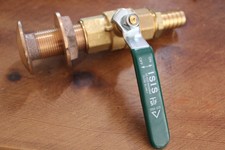
...but they come at a hefty price, so in practice it might be the conventional DZR skin fitting and screw-on valve:

s-l225.jpg


Pete
 
I seem to remember that the coach bolts are threaded into the flange - the nuts double lock the bolts. When I tried to do this (many moons ago...) I could get the nuts off easily enough but getting the coach bolts undone was the devils own job. Eventually ended up grinding the heads off. Then had to get the remaining bolt stub removed from the seacock.
 
I seem to remember that the coach bolts are threaded into the flange - the nuts double lock the bolts. When I tried to do this (many moons ago...) I could get the nuts off easily enough but getting the coach bolts undone was the devils own job. Eventually ended up grinding the heads off. Then had to get the remaining bolt stub removed from the seacock.

Surely that is not possible? Coach bolts have squares beneath the head to prevent them from rotating, usually in wood, but in a brass strainer if fitted over a skin fitting. They could not be installed if they screwed into the internal flange. Mine are simple flanges with bolts passing through clearance holes, held on my nuts.
 
Surely that is not possible?

That was my thought too. I took the internal nuts off , expecting to knock the bolts through but they would not budge. There was not enough room to get two nuts on the remaining bolt as a lock nut to screw them out, so grinder on the heads it was. It was quite some time ago, though.

I am afraid the, next time the problem cropped up, I took the wimps way out and got the yard to remove them.
 
I think this page is helpful:

http://www.blakes-lavac-taylors.co.uk/blakes_seacocks.htm

I have just looked at an old 1 1/2" body and it seems that the 4 holes on a 73mm (2 7/8") Pitch Circle Diameter is unchanged. So I would guess this is the same with the smaller valves but worth checking.
I have swapped cones from old to new bodies so a lot of the engineering seems untrammelled by metrication.

PS
The bolts are very expensive indeed. Lots of manufacturers fitted stainless ones and omitted the external fixing/strainer plate. This seems to have stood the test of time. I would fit fibre washers against the brass to insulate things.
 
Last edited:
I haven't removed one, but I can't see why it shouldn't just be as simple as removing the bolts and knocking it into the boat. Maybe run a thin blade around under the inside flange to cut any sealant, if you have room to do it. Leave the cone in place, and put a short length of broom handle up into it through the outlet to push / knock on.

Personally I wouldn't refit Blakes type seacocks but something with a ball valve, which don't need all the fiddly adjusting and greasing and so on. The ideal would be one of the American-style ball-valve flanged seacocks:

$(KGrHqN,!qMFJlwk,MrjBSd,))kCPQ~~60_35.JPG


...but they come at a hefty price, so in practice it might be the conventional DZR skin fitting and screw-on valve:

s-l225.jpg


Pete

Would go for a straight replacement as when you cost up all the fittings to install a ball valve the price differential shrinks. May well find (as I did) that the size of a valve and fittings is higher than a Blakes and the take off is vertical, although of course the tail could be a bend. You also have to remake the hull to do away with the bolt holes.

Removing difficulty depends on the sealer used, particularly round the spigot. The bolts should come out easily as they are coach bolts, so just remove the nuts and knock them through. Then drift on the spigot end to knock the valve in.
 
I did this a few yrs ago, as the heads outlet seacock plug was corroded badly. As I recall it was just a matter of removing the bolts and then removing the seacock - this needed a bit of brute force, as the 28 yr old sealant was still holding it quite well, but it really wasn't too difficult. I guess it helped that a) I was replacing the toilet at the same time, and so that was out of the way and b) as I was replacing the seacock, I wasn't worried about damaging it.

The new replacement blakes seacock was a direct fit once the old sealant had been cleaned up.

Note, it's not recommended to use SS bolts to hold a blakes seacock in place, as this can lead to galvanic corrosion, in the same way that a bronze prop on a SS prop shaft is at risk, and needs an anode to protect it. If you use the supplied bolts, it won't corrode, and won't need to be connected to an anode.
 
The current seacocks … although I have ground them in and greased them with Blake's seacock grease they seem to get rather "bindy" even with just a season's use.
In the previous thread a Compass Marine (mainecruising) how-to was linked: http://www.pbase.com/mainecruising/tapered_cone_seacocks

It advises you "rotate the cone fully in a 360 degree fashion roughly ten times in the same direction" when lapping. Did you do this?

The reason I ask is that the same guide says "folks often assume they want you to use the handle in a simple back and forth motion to lap fit. This is NOT the case and can result in ridges and uneven lapping," which sounds a bit like what you've got.
 
Would go for a straight replacement as when you cost up all the fittings to install a ball valve the price differential shrinks. May well find (as I did) that the size of a valve and fittings is higher than a Blakes and the take off is vertical, although of course the tail could be a bend. You also have to remake the hull to do away with the bolt holes.

Removing difficulty depends on the sealer used, particularly round the spigot. The bolts should come out easily as they are coach bolts, so just remove the nuts and knock them through. Then drift on the spigot end to knock the valve in.

+1. I replaced Cockpit drain seacocks, and finished up using Blakes for two reasons: 1. There was limited height in the location 2. it cost about very little more than the price of skin fittings, valve and hose tails....
 
Note, it's not recommended to use SS bolts to hold a blakes seacock in place, as this can lead to galvanic corrosion, in the same way that a bronze prop on a SS prop shaft is at risk, and needs an anode to protect it. If you use the supplied bolts, it won't corrode, and won't need to be connected to an anode.

If your Sadler is the same as mine, all three Blakes seacocks and the P-bracket are attached using stainless steel bolts. They are countersunk into the hull, fitted with plenty of sealant, and there is no galvanic corrosion because the two metals and seawater are never all in contact (unless the boat happens to be full of water :) ) My bolts are all in excellent condition after 30 years in service, no anodes.

The Blakes bolts are phosphor bronze, a very expensive solution. A few years ago they were priced at £50 for four but I was informed a couple of weeks ago that the price is now £75.
 
If your Sadler is the same as mine, all three Blakes seacocks and the P-bracket are attached using stainless steel bolts. They are countersunk into the hull, fitted with plenty of sealant, and there is no galvanic corrosion because the two metals and seawater are never all in contact (unless the boat happens to be full of water :) ) My bolts are all in excellent condition after 30 years in service, no anodes.

The Blakes bolts are phosphor bronze, a very expensive solution. A few years ago they were priced at £50 for four but I was informed a couple of weeks ago that the price is now £75.

I too have Blakes seacocks attached with A4 stainless CSK bolts countersunk into the hull surface. This method gives a more streamlined finish with no bolts heads or keeper plate on the outside of the hull. My 12 x Blakes have been there for 33 years and I've seen no problem with using stainless steel bolts; I usually draw the bolts on one two of the seacocks each year but have always put the same pristine bolts back in.

Regarding the OP's original question, I have only had cause to replace one seacock - the heads outlet. I couldn't shift it at all and had to resort to the angle grinder and hacksaw blade to cut it to pieces and to slot the outlet fitting and knock it out in pieces.
 
If your Sadler is the same as mine, all three Blakes seacocks and the P-bracket are attached using stainless steel bolts. They are countersunk into the hull, fitted with plenty of sealant, and there is no galvanic corrosion because the two metals and seawater are never all in contact (unless the boat happens to be full of water :) ) My bolts are all in excellent condition after 30 years in service, no anodes.

The Blakes bolts are phosphor bronze, a very expensive solution. A few years ago they were priced at £50 for four but I was informed a couple of weeks ago that the price is now £75.

She's an 84 model Sadler, and I'm sure the bolts I removed when taking out the old seacock were brass or bronze, not SS. When you buy a new blakes seacock, it comes with bolts (I assumed they were DZR brass, same as the seacock - they looked like brass!), and so I used these when fitting the new one.
 
She's an 84 model Sadler, and I'm sure the bolts I removed when taking out the old seacock were brass or bronze, not SS. When you buy a new blakes seacock, it comes with bolts (I assumed they were DZR brass, same as the seacock - they looked like brass!), and so I used these when fitting the new one.

My Sadler is also 1984. The toilet seacock is shown well down the page at https://coxengineering.sharepoint.com/Pages/BrassandBronze.aspx, clearly stainless steel bolts. I have never bought a new one.
 
She's an 84 model Sadler, and I'm sure the bolts I removed when taking out the old seacock were brass or bronze, not SS. When you buy a new blakes seacock, it comes with bolts (I assumed they were DZR brass, same as the seacock - they looked like brass!), and so I used these when fitting the new one.

The bolts that come with a new unit are bronze, but as suggested stainless can also be used.
 
Top