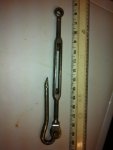
Removeable forestay fitting

Otter

Well-Known Member
Joined
23 Nov 2004
Messages
10,926
Location
Norfolk
Visit site
We have a baby stay that's not required for winds under F5/6 and it really gets in the way. A witchard type is - gulp - £350. So I thought about using a snap shackle but are they strong enough for the loads on a rigging? I'm happy to tighten and loosen using the bottle screw but would like an alternative. Any ideas? Thanks.
 
Seateach (I think it's them, anyway) sell a storm forestay that's attached using a Wichard snap-shackle. So they obviously think it's strong enough.

If going this route, I would definitely recommend using a name brand shackle (or at minimum one with a stated SWL) rather than whatever's cheapest.

Pete
 
Highfield Leaver

Leaver.jpg
 
My cheap(ish) option is a pelican hook and a turnbuckle. It is not possible to get the pelican hook tight enough on its own, so a lever is needed to tighten the turnbuckle. Quite easy to do, a screwdriver or any convenient bar is good enough.

If going the Wichard snap-shackle route, try to get one in 17/4 PH. They certainly do shackles in that material, I use them for my anchor chain. Far stronger than 316 and just as corrosion resistant. Not sure if they do the snap shackles though.
 
A witchard type is - gulp - £350. So I thought about using a snap shackle but are they strong enough for the loads on a rigging? Any ideas? Thanks.
£3 sounds like better idea? ;)
I would not trust any snap shacles and fancy levers or any fancy fitting with many small parts - it's for a forestay...

We use such in here, for main forestays on boats with lowered rigs. Simple, cheap, strong and quick to set. Pelican hook type of fitting, can be tightened on its own (but this shape important), joined to your existing turnbuckle. http://www.szopeneria.pl/environmen...oductGfx_e1128c8a413fd997048ef91fe9d470aa.jpg.

Works like this http://i.archiwumallegro.com.pl/2028262549_1/

The price is equivalent of 3 pounds and a bit (£ 1 = 5 Zł Polish). http://www.szopeneria.pl/pl/p/Szpilka-zaczep-sztagu-8x200mm/4648

Hook has pivot not on down low, but above a half-circle loop so closing you drag this loop through the deck fitting eye (better a rounded, or shackle) tensioning the stay. Never seen anything else giving this quick and simple operation. Just put into, close and drop the ring down :D
Turnbuckle is only set initially, regulated so to make it tight closing. No adjustment necessary later on if set right.

Better with closed type turnbuckle, with hole in middle - as shown in photo above - after closing this is additionally secured with shackle, inserted into turnbuckle middle hole, so to prevent accidental opening. Not that I ever have seen this opening by itself, but who knows what can happen in stormy weather?
 
Last edited:
If you have sufficient spares, there's nothing wrong with a block and tackle system, which could be permanently attached to the end of the babystay with a pelican hook to fasten it to the deckeye when in use. Mind you, unless you already have them, blocks are one hell of a price for what they are! I'd advise you to set up your babystay once the wind reaches F4, though, the lumpier it gets the less simple anything is to attach and tension!

Incidentally, we use to catch the genoa clew regularly on the babystay of a T24 - guaranteed if short tacking with an audience. We slipped a length of plastic conduit over the stay to act as a roller and it cured the problem 90% of the time - at least sufficient that it was then more common for the lazy sheet to snag a mooring cleat.

Rob.
 
A classical solution

I enclose an original drawing made in 1969 by Rod Stephens of the well known S&S studio that speaks for itself. Handy and extremely simple do DIY.

Daniel
 
It was fitted by the previous owner to allow a cutter rig. Useless, the staysail would be smaller than my pants (I have big pants)

Then it is probably not a babystay but an inner forestay. A babystay is to support the mast where there is only one lower. If you have forward and after lowers you probably don't need it at all. Perhaps you need to get the original rigging diagram to see if it is required.
 
Then it is probably not a babystay but an inner forestay.

Indeed, especially if it's to set a sail on (the size of your pants notwithstanding). The triangle enclosed by a babystay would be far too small to set anything useful, even a storm jib.

Pete
 
Then it is probably not a babystay but an inner forestay. A babystay is to support the mast where there is only one lower. If you have forward and after lowers you probably don't need it at all. Perhaps you need to get the original rigging diagram to see if it is required.

I don't agree in that to me a baby stay and an inner forestay are 2 names for the same thing. ("one lower" what does that mean?)
The middle of the mast must be supported both side ways and fore and aft. This is typically done on mast head rig by 3 stays 2 intermediate side stays (from chain plates aft of the abeam the mast) and one inner forestay or by 4 stays 2 intermediate sidestays going to chain plates aft of the mast and 2 similar going forward.
Masts typically have a greater dimension fore and aft than sideways (oval cross section with added material in the track) This means that the mast can support itself in the middle fore and aft direction better than middle sideways. Hence under benign conditions the mast may be safe to remove the inner forestay for easier tacking of headsail.
However OP should be very conservative in wind strengths where it is deemed safe to dispense with inner forestay. Actually not so much wind strength as load on the rig. A moderate wind and large jib can be worse than strong wind small jib. Do not under estimate this crumpling load on the mast exacerbated by the tensions of the intermediate side stays which will tend to pull the middle of the mast back putting a curve in the normally straight mast before you apply the huge loads of forestay and cap shrouds pulling downward.
it will take OP a lot of self discipline to apply the inner forestay before any real load is applied to mast . Any mistake will be the end of the mast.
I would recommend he try the plastic tubing on inner forestay. Or if he must remove inner forestay consider 2 more intermediate side stays to new chain plates forward of abeam mast or even fitting aft swept spreaders. Both of which provide support (push forward) to the middle of the mast.
My mast fractional rig relies on aft swept spreaders to push middle of mast forward. A long time back the base of one spreader failed allowing spreader to tilt forward result mast broken in milliseconds. The location of the middle of the mast is very critical. good luck olewill
PS a high field lever is the best attachment device. I use one for forestay. Home made of plates of SS. Try making one out of cardboard to get dimensions.
 
More complex than I thought. The spreaders are not swept back, there are two lowers each side plus single cap and twin backs.
 
More complex than I thought. The spreaders are not swept back, there are two lowers each side plus single cap and twin backs.

Then it is probably not a babystay but an inner forestay for a storm jib or a staysail and an addition to the original rig.
 
Just to clarify:
Babystay is from lower spreaders to deck in place of forward lowers to stabilise the mast.
Cutterstay is from higher up the mast designed to carry a staysail at teh same time as a headsail.
Inner forestay is a stay inside the forestay to carry sail instead of using headsail e.g. storm jib or blade jib. Usually removable.
Forestay is main forward support designed to stay the mast and for primary headsail.
Headstay is a stay foreward of the forestay designed to carry light weather canvas.
 
Top