Reinforcing

zoidberg

Well-Known Member
Joined
12 Nov 2016
Messages
6,990
Visit site
....the hull in way of bolts.

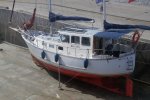
I'm in process of 'bolting on' the hull-mountings for a pair of yacht legs.... the white wedge-shaped bits, shown as example.
49851724948_357369fbbf.jpg


Each of those has a pair of 16mm machine screws which pass through the hull and are secured using hex nuts of some form ( cue a nearby thread, of and by nuts! :D ). Some form of 'beefing up' of the 10mm grp laminate is warranted.

The question is 'How best to do this?'

Would a circular reinforcing pad, or a rectangular one, be best? And how best to orient it..... symmetrically about the through-bolts or with more surface area above, or what?
I have thick plywood and thin plywood, thick and thin grp sheet.... and teak. And lots of luvverly epoxy.
 
On my boat I have a rectangular piece of I think 15 mm ply on the inside of the hull. I could take a picture but I am 100 miles away from it until tomorrow. I never use the legs, I have my middle mooring line through there at the moment.
 
When I fitted mine, I used a big slab of 25mm tufnol, something like 200x300mm, mounted to take both studs. I cut a bevel arund the edge to facilitate glassing it in to the hull, and I bonded it down to the abraded hull surface with thickened epoxy. There might be easier ways but it's not something you want to go light on.

Vyv Cox had a very good write up on his website from when he fitted legs to his Sadler 34.

I've sold the boat now, but I loved having legs, and never felt that they were unsafe.So long as the keel takes 99% of the weight and you don't allow the legs to be dragged about putting lateral loads on them, there's not much that can go wrong.
 
My boat has two bronze thru-hull fittings (about 3/4" or maybe smaller) either side that were used to mount beaching legs - no reinforcement inside I believe . They have since been decommissioned and I never saw these in action so I'm afraid I don't know how the legs were secured.
 
When I fitted mine, I used a big slab of 25mm tufnol, something like 200x300mm, mounted to take both studs. I cut a bevel arund the edge to facilitate glassing it in to the hull, and I bonded it down to the abraded hull surface with thickened epoxy. There might be easier ways but it's not something you want to go light on.

Vyv Cox had a very good write up on his website from when he fitted legs to his Sadler 34.

I've sold the boat now, but I loved having legs, and never felt that they were unsafe.So long as the keel takes 99% of the weight and you don't allow the legs to be dragged about putting lateral loads on them, there's not much that can go wrong.

Thanks, Kelpie, for reminding me of 'The Oracle'. I've fired a query to Vyv.
I've drilled the holes, now, and have all the bits, but - as Eric Morecambe says - 'Not necessarily in the right order'.
 
Last edited:
I would suggest that the backing plate be symetrical to the bolts. You are going to get pressure upwards from the legs so need backing plate above and below the bolts. You may also get pressure fore and aft of bottom of leg giving a twisting force at the bolts so need plate extending fore and aft. But much depends on what shape/sized plate you can fit inside. Bigger the better. ol'will
 
Our legs are attached with a similar type of bayonet fitting. Each hull pad is fitted with 4 M10 bolts and a 30cm x 20cm 18mm ply backing plate and large washers. The ply was bonded to the hull with epoxy. The loads on the legs are actually quite low - two adults walking from side to side are enough to make the boat switch legs. As the leg pivots in the fitting there are no twisting forces on the attachment bolts which are, for all intents and purposes, loaded in shear only.
We've had this set-up for ten years now, use our legs quite often and never had any problems drying out.

legs.jpgSAM_0487 (2).JPG
 
I bought some thick Tufnol sheets from DirectPlasticsOnline. Good service and prices. If sanding, don't breath the dust..
Consider the loads: The fore and aft ones are taken by the stays/ropes and the leg pivots on the pin, so not a problem. The lateral one could be much larger, so maybe moulding the inner reinforcements to spread the load verticaly, as in an extra rib.
 
Last edited:
Nothing that cannot be put right by adding a pair of wheels , a towbar & hooking up behind a landrover cannot cure.?

Not many floating caravans, 38' cruisers racers or even 45' cruisers racers (about the same 'size' as our 38' cat) can achieve an average of 10 knots over 100nm, with a crew of 2, one off watch. But if you like being pedestrian there is room for you and yours in the slow lane leaving the fast lane for those who are not prematurely aged :)

Jonathan

Its very crude but a 45' cruiser racer and our cat have the same windage (I've measured it) and if you strip off excess weight, I think its called ballast or a keel, then our cat and a 45' yacht are a similar weight - basically rig, fibre glass, engines - so the 'accomodation' is similar - except ours will beat the 45' - hands down. Laugh your socks off - dream for as many days as you like - but believe it :)
 
Last edited:
I bought some thick Tufnol sheets from DirectPlasticsOnline. Good service and prices. If sanding, don't breath the dust..
Consider the loads: The fore and aft ones are taken by the stays/ropes and the leg pivots on the pin, so not a problem. The lateral one could be much larger, so maybe moulding the inner reinforcements to spread the load verticaly, as in an extra rib.
To be sure, the leg will buckle under a lateral force long before the bolts or the hull fail. Whatever backing material you use (ply is perfectly adequate), be fairly generous in size and bond it to the hull to prevent it from shifting. If possible attach the leg close to the deck joint to benefit from the inherent stiffness of the deck.

Legs have been used for centuries, are plenty well understood, or used to be at least. Much of the time they were simply lashed to the chainplates or the rail. I have seen fishingboats of well over a hundred tons propped up by no more than a 4x4 and attached by a couple 3/4" bolts. Certainly, twin keels and bilge keelers have also gotten into trouble drying out and are, for what it's worth and should they fall over, at a much greater risk of down-flooding when the tides comes back in.

I spent a considerable time calculating loads on our legs (which I built myself) for our 8.5t. boat and we never had any structural issues, including the time when we refloated off Gorey with a bit of a swell that had snuck up and were treated to a thoroughly unpleasant performance of the jarring hippo dance.
 
if that is a real wooden boat with ribs and frames then you will need to take that into account. MG reinforced the side of the waterwitch by way of the leaboards with a thick fillet 10" x 12" x 2.25" tight between two frames and a leaboard stringer 4.5" x1.125" extending across the two adjacent frames. Perhapse the loads are higher there, but maybe worth butting the fillet against the adjacent frames. There again it might be a plastic yacht.
 
Top