
Regulated power supply blocks VHF

dgadee

Well-Known Member
Joined
13 Oct 2010
Messages
4,682
Visit site
converter.jpg

http://www.ebay.co.uk/itm/WaterProo...632851?hash=item25ad42e713:g:PIcAAOSwofxUdJ2v

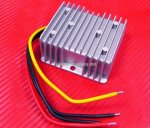
I installed one of these 12v to 12v regulated power supplies to provide power to a mini PC and a TV thinking this would stop damage via power surrges. Now I find that when this is powered up no signal can be got on the VHF. I presumed being in a metal case that the noise generated would be minimal. What should I do. Take it out? Replace it with another? If the latter how do I know I won't have the same problem again.
 
View attachment 55708

http://www.ebay.co.uk/itm/WaterProo...632851?hash=item25ad42e713:g:PIcAAOSwofxUdJ2v

I installed one of these 12v to 12v regulated power supplies to provide power to a mini PC and a TV thinking this would stop damage via power surrges. Now I find that when this is powered up no signal can be got on the VHF. I presumed being in a metal case that the noise generated would be minimal. What should I do. Take it out? Replace it with another? If the latter how do I know I won't have the same problem again.

Make sure the case is earthed, ie connected to negative. Use some ferrite cores on the input and the output.
 
I have used several of these to power my Mini DC PC and a satellite decoder right next to one of my VHF radios with no problem without a metal box.

Yes, I had something of that sort before and it worked ok (slight effect on 12v TV I use as a monitor) but thought the one in the metal box would be an improvement.

I will try the ferrite cores and adding an earth to the box itself.
 
Just back from the boat and tried earthing the power supply and adding ferrite. No change - when I switch on the supply (even without it supplying power to any item) it blocks the VHF. The odd thing is that I have a similar 12v to 24v regulator which works perfectly.

I suppose it's back to the old non waterproof device I was using before? Or might there just be a fault with this unit?
 
Last edited:
More and more power regulators are using switching technology (buck regulators), and the frequency of switching, the oscillation rate, is also getting higher. These devices, which are used extensively in powering LED clusters and in many small power supply units, cause interference at VHF frequencies, some more devastating than others.

The advantages to the manufacturer are lower cost, compact size and more efficient operation, but the effect on VHF transmission is quite serious.

All you can do is check that the unit you're using - LED light cluster or power supply to your PC - is VHF-safe. If not, don't use it. It's a good idea to check that any systems on the boat that use switching type power regulation have no effect on your vhf systems. For instance, does your VHF radio work alright when your masthead anchor light is switched on? Do your saloon lights interfere with VHF?

This problem is with us to stay, so be careful when installing LEDs and other other regulated DC power systems.
 
The flip side of this is that the VHF may be unduly susceptible to either conducted interference on its supply, or radiated interference outside the channel it is supposed to be tuned to.
Does a handheld VHF have the same issue?
 
I have posted previously, and had a letter in YM, about the effect that a USB power supply has had on my VHF. No problem on Ch.16 but no other channels will receive. The USB supply was bought from Force Four, so good quality and not a cheap Ebay version (one would hope).
 
Unfortunately the problem doesn't seem in any way related to cost.
The component manufacturers, such as Motorola, are aware of the problem and give warnings on their application data sheets, but the manufacturers of the LED cluster or power supply don't seem to pass on the warning.
 
Simple tricks to identify the nature of the interference. Disconnect the VHF antenna at the radio. Is the interference still there? Turn the offending power supply on and off and compare the squelch control settings to quieten the set.
If interference is still there then interference is coming into the VHF via the power line. Try ferrites and capacitors on the battery supply line to the VHF or connect it temporarily to an isolated battery.
If interfence is coming in via the VHF antenna then check (quick check) the antenna cable for likely corrosion or similar on the shield of the coax. Try running the power supply temporarily from an isolated battery source. If this fixes the problem then go back to more capacitors and ferrites on the power supply supply.
If it does not point to the source coming out via the power line then look at the output line of the power supply. It may need ferrites and capacitors although they should be built in as with the input line.
Ferrites are a material usually black in the form of tubes or rings which increase the inductance of a wire or coil. So passing a wire through a ferrite tube will increase the inductance of the wire. If you wrap the wire through the ferrite multiple times you increase inductance so much more. Now an inductance in a wire tends to inhibit voltage spikes (interference) from passing along the wire. Ferrites are often found in computer equipment and computer cables key boards for example on the connecting cable. Or buy from electronics store. http://www.altronics.com.au/search/all/?sr=Ferrite+core
You should add capacitors from pos line to ground both before and after the ferrite. Capacitors should be in the about .01 microfarrad in ceramic and perhaps 10 microfarrad in electrolytic capacitor in parallel. The small C has less internal inductance than the big C. The capacitor acts like a tiny battery absorbing the voltage pulses then giving out the energy smoothly a bit like springs on a car. The small C can act on very fast pulses while the big C can soak up large pulses.
good luck olewill
 
I reckon it will be the input wires to the PSU. A 12v battery has quite a high impedance at higher frequencies.

As an experiment try twisting them together and connecting them direct to a battery. You could even use the engine starting battery if you have one.

You may have to use a capacitor AND a ferrite core at the input. But this can cause more problems!
 
Thanks all. I now understand the problem with which I am faced. I may just go back to the cheap regulator I had before - it worked ok. I thought I was going to improve things when I spent slightly more money. The antenna and cable were new last year from Salty John so I presume everything is fine there.

The boat is in the very far north, so VHF transmissions are not frequent - only the weather forecasts rather than the usual Solent chatter - so it actually took me a while to realise what was going on.
 
Top