Recut a Genoa into a Yankee?

Tim Good

Well-Known Member
Joined
26 Feb 2010
Messages
2,888
Location
Bristol
Visit site
Has anyone ever had a Genoa re-cut to have a higher clew and as such making a yankee?

The reason is that my boat (Seastream 43) came with a set of very heavy Hood Sails. Main, Staysail and Genoa. The Genoa, amazingly, remains unused since the first owner immediately put on a reduced 470sq ft yankee cut to go down wind well.

The Genoa (675sq ft) is a beast and as a cruising couple we want to be able to see under the sail. However the Yankee we have is light, cut for off wind sailing and small for our displacement (16t).

So I was thinking of seeing if it could be recut to bring the foot up at an angle with a high clew, thus creating a yankee. We'd basically want to create what a Rustler 44 has since it is a similar boat in many respects. Here's a pic of a Rustler 44 with Yankee. Not a very high clew but much higher than a Genoa.

What do you think? I know I just need to ask a sailmaker but thought I'd ask and see if someone has done this with any degree of success?
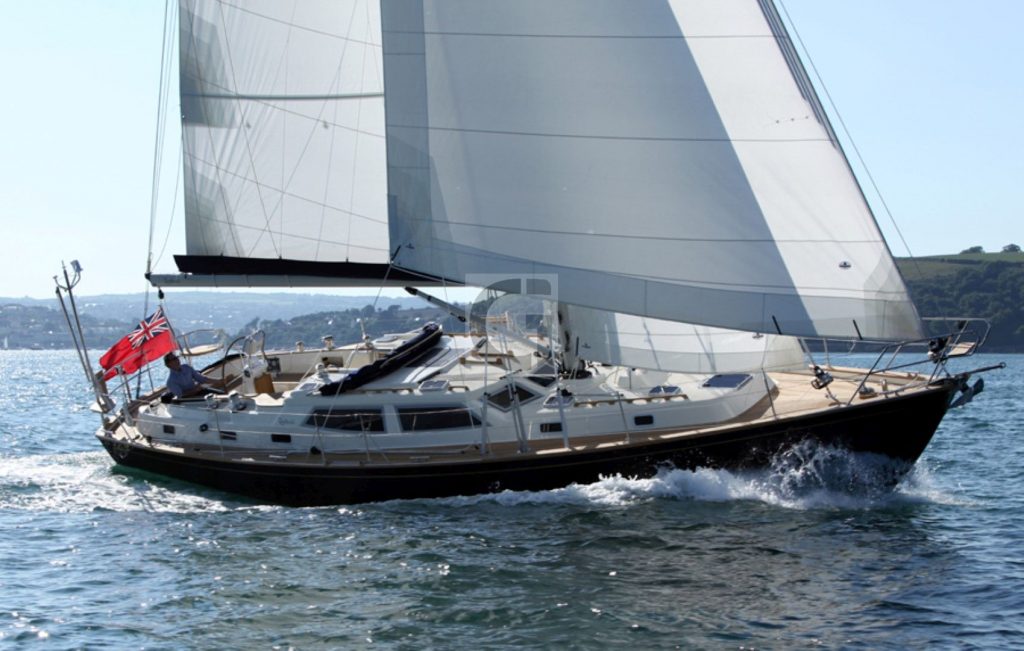
2010-Rustler-44-DS-PEAT-SMOKE-for-sale-002-1-1024x651.jpg
 
Last edited:
k7dovxkaupfkkadhzsa.png
What is a Yankee sail? A Yankee sail is a jib with a high-cut clew of about 3' above the boom. A higher-clewed jib is good for reaching and is better in high waves, preventing the waves crash into the jibs foot. Yankee jibs are mostly used on traditional sailboats.
 
Only a question a good sailmaker can answer but normally mucking about recutting gives bad results and especially as it will be a well used sail,but very good idea low cut Genoa’s should have no place on a proper cruising boat..........!
 
especially as it will be a well used sail

It's not used. Its still in its bag from 1996. Looks like it was made yesterday. The reason I'm considering it is because a Hood sail made to this weight, size and standard nowadays would be astronomic.
 
It's not used. Its still in its bag from 1996. Looks like it was made yesterday. The reason I'm considering it is because a Hood sail made to this weight, size and standard nowadays would be astronomic.
No I was commenting that the “new” sail will be used a lot so a badly cut down sail will be a souce of pain!
 
Sounds like a great idea. My new to me boat came with a 140% monster and was swiftly changed to 100% Yankee. I think 120% could have been better for lighter air. I think 110 or 120% jib that is 'high cut' is called a 'high cut jib' not a Yankee?
 
Basically the two lower panels are not at the correct angle ,if you want the clew lifted .
It means a new lower section ,with the weave running along the foot tabling .
Finding a matching fabric after this period of time, is going to be unlikely.
if bottom panels were removed and tripped round with a new seam line ,there would be cloth missing in the lower luff .
So it would look a bit of a bodge even if the missing bit was disguised under new tack reinforcement .
 
Basically the two lower panels are not at the correct angle ,if you want the clew lifted .
It means a new lower section ,with the weave running along the foot tabling .
Finding a matching fabric after this period of time, is going to be unlikely.
if bottom panels were removed and tripped round with a new seam line ,there would be cloth missing in the lower luff .
So it would look a bit of a bodge even if the missing bit was disguised under new tack reinforcement .

Can you just take a wedge off the Luff, accepting that the luff will be shortend a little. This would raise the clew leaving the rest of the panels as laid out, not quite at the angle orgionally intended but a much simpler cut and replacement of the luff only, possibly new reinforcement at the head at the thick end of the removed wedge.
 
If you want this new sail to work when going to windward will you be able to sheet it properly? The genoa car would have to move aft considerably due to the raised clew.
 
Can you just take a wedge off the Luff, accepting that the luff will be shortend a little. This would raise the clew leaving the rest of the panels as laid out, not quite at the angle orgionally intended but a much simpler cut and replacement of the luff only, possibly new reinforcement at the head at the thick end of the removed wedge.
Yes, you can recut the luff , but the foot also ends up shorter aswell .
Unfortunately that way it’s usually quite a chunk off the luff and often ends up with the sheet lead well aft.
I had assumed that the yankee would be around full hoist and sheeting to the aft third of the track.
 
What Wilkinson sails says is probably quite correct depending on the cut of the genoa. A genoa is usually cut so that the warp and weft re in line with the load on the jib. ie to resist stretch. So panels of cloth will be square to the leach (Back edge) so that they arrive at the luff at an angle (on the bias) which can stretch. The line horizontal from luff to lrach then is also on the bias giving stretch which gives the camber or curve of the sail. The foot of the sail is often cut so that it is aligned with the weave so minimum stretch but is wedge shaped to accommodate the panels above. So the problem is to get those panels correctly aligned with the new shape. Now I may have all this wrong and there are many designs of genoa. OP should firstly unroll the genoa on the lawn and look at the bottom of the genoa with the alignment of the panels in mind. ol'will
 
Can you just take a wedge off the Luff, accepting that the luff will be shortend a little. This would raise the clew leaving the rest of the panels as laid out, not quite at the angle orgionally intended but a much simpler cut and replacement of the luff only, possibly new reinforcement at the head at the thick end of the removed wedge.
Yes, you can recut the luff , but the foot also ends up shorter aswell .
Unfortunately that way it’s usually quite a chunk off the luff and often ends up with the sheet lead well aft.
I had assumed that the yankee would be around full hoist and sheeting to the aft third of the track.

Seumask's suggestion does not result in shortening the foot. Draw a straight line from the tack to a point on the leach a little way below the head. This line is your new luff. This approach has the advantage that panel shape and orientation is preserved at the foot and the leach. The disadvantages are that hoist is lost and the head must be rebuilt (though you will always have to redo one corner).

A yankee must have its sheet lead further back than a full genoa (for the same foot length) because the clew has been raised. This is true regardless of the modification used to make the yankee.
 

Other threads that may be of interest

Top