Rechargeable batteries revelation

lustyd

Well-Known Member
Joined
27 Jul 2010
Messages
14,326
Visit site
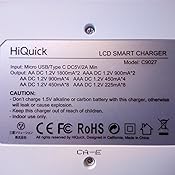
Having been binge watching solar and battery channels on YouTube of late I just had a bit of a thought to check my rechargeable batteries at home which seem to have deteriorated somewhat. What I learned is quite interesting - the voltages differ wildly despite being "fully charged". So I tried charging individually and swapping things about a bit. Long story short it turns out most AA/AAA chargers will only charge in pairs, so as soon as you get any discrepancy between the pair your batteries will start to get worse and worse, in the same way as unbalanced cells do. I've now ordered a better charger that has 8 isolated slots to individually charge the batteries, but having manually charged them all to a consistent state the whole lot of them are performing better. If you have rechargeables which are behaving badly, or a partner who has a light needing three batteries then it might be worth getting the volt meter out!
 
the 1.2s are 1.48 when charged from what I can see and go as low as 0.8 when they're abused badly!
 
I’ve ordered this, but don’t take that as recommendation as I don’t have it yet!
https://www.amazon.co.uk/gp/aw/d/B08HLRP6GM
Looks like it's a 1.2v o/p charger.
71siKYvmocL._CR204,0,1224,1224_UX175.jpg
 
1.2V rechargeables are generally NiCd and NimH's which are generally charged with a fixed current.
So it makes no difference to charge a convenient number in series.
It is generally good to treat all the cells in a string the same, use them together and charge them together.
That way, they all go flat together and you don't get the stronger cells reverse charging the weakest one.

If a string of cells isn't working well, you probably have a duff cell. Often means the whole pack is on its way out.

These days, most things are moving over to Lithium. I recently sent my last NimH's to the dump recycling centre.
There is an unlimited amount of ill informed halfbakery on Youtube.
 
TernVI part of the issue was O/H has a device that takes three and runs them until they’re flat which then means one battery is left discharged in the standard pair chargers. If I then charge it with another one which is less discharged it makes the situation worse. It’s not YouTube halfbakery it’s something that can be demonstrated quite easily.
 
If you use 3 in series, charge 3 in series.
Or charge them slowly at the rate where they are allowed to be continuously on charge, often about C/20.
Problem is, Ni cells are old hat now, not many good ones are made any more and the quality ones are dying of old age.
Your shouldbe able to charge a string of 3 in series with either a charger intended for 4 (it's constant current and just needs enough volts) or a source of say 6V and resistor to set the current.
Are they Nimh or NicD?
 
I feel like you missed some of the points. Most chargers will charge either two or four cells but not one or three, and they charge the sets of two in parallel.
 
We're talking about domestic AA and AAA chargers here in case that wasn't clear, just standard Duracell type stuff
 
I can recommend one like this <-click here

They come under different brand names but the controls are all the same. My first lasted many years. I’m now on my second. It takes AA or AAA batteries, from one to four, and they can be mixed. Each charges individually. For each lot you can. load and walk away or choose charge rate, measure capacity and refresh through automatic charge/discharge cycles.
 
All of my AAs are rated 1.2 so we’ll see what happens :)
If you put a voltmeter across a rechargeable AA it will show about 1.2 volts. If you do the same with non rechargeable battery it will show about 1.5 volts.
Under load however, they will both show around 1.2 volts. It's all down to the battery chemistry and internal resistance.
 
I am a bit confused by all this thread. Assuming we are talking about rechargeable NiCad or NIMh batteries nominally 1.2 volts there are some peculiarities you should be aware of. They love to be completely discharged to the extreme of 24hrs with a dead short across them after slow discharge. That can help to get all cells in a pack equal charge state. I don't believe it matters if they are charged in parallel.
When used in series as is usual they have a real problem that if one discharges before the others the continued drain through the discharged cell will try to charge it in reverse. This creates "dendrites" crystal like growth between plates that short circuits the cell. Measures very low resistance on ohm meter and can not be recharged.
The moral is do not run the cell string to near discharge. Always check individual cells if you can get at them or give a bit of charge then check voltage which may be down by 1.2v.
There is a fix for this short involving forcing 10 amps or so through the cell for a second or so. If this fixes the short you will immediately see some voltage. Recharge as normal but be aware the cell has probably nearly reached use by date.
It is difficult to determine full charge state for these cells when being charged. fast chargers try to detect a slight change of voltage at full stage. Cheap chargers will specify 10 to 24hrs to recharge. The charge current predicated on a rate which if continued will not harm the cell. less than 10% of claimed AH rating. ol'will
 
If you put a voltmeter across a rechargeable AA it will show about 1.2 volts. If you do the same with non rechargeable battery it will show about 1.5 volts.
Under load however, they will both show around 1.2 volts. It's all down to the battery chemistry and internal resistance.
1.43 fully charged and 0.8 fully dead for my Duracell AA ones. Checking voltage and balancing them is the only way to make them all charge properly on the standard charger which was the point of the thread. Hopefully the new charger will sort it which is similar to the one LiftyK linked to and charges them individually
 
I can recommend one like this <-click here

They come under different brand names but the controls are all the same. My first lasted many years. I’m now on my second. It takes AA or AAA batteries, from one to four, and they can be mixed. Each charges individually. For each lot you can. load and walk away or choose charge rate, measure capacity and refresh through automatic charge/discharge cycles.
I have one but it has the flaw (unless I am missing a trick) of not being able to recharge a fully flattened battery. In that case I firstly have to give it / them a 30 minute blast on a normal charger and then tranfer the batteries to the more 'intelligent' charger... two steps forward one step back.
 
These days, most things are moving over to Lithium.
Do you have a link to some lithium AA cells of 2500mAh or more for a reasonable price? I can't find any. To answer your other question, mine are NiMh and generally reliable and long lasting with the exception of this aannoying charger bahaviour
 
Top