Raymarine Wind Transducer

trapezeartist

Well-Known Member
Joined
4 Sep 2009
Messages
1,890
Location
Portishead
www.littlehotels.co.uk
I have a Raymarine ST60 system on my boat. Recently the wind direction part has been giving me wrong results. Instead of close hauled being +/- 35 degrees, it is about +0 -60 degrees. Not only that, part way through last weekend it seemed to move to the other side ie instad of showing a port tack as dead-on-the-nose, it switched to starboard tack.

Before going up the mast I'd like to have some idea of what might be wrong when I get there. That way I have a better chance of taking the right stuff up with me, and I'm more likely to be able to fix it. But I've no idea what the thing looks like up close. How likely is it that either the wind vane is slipping on the transducer, or the transducer is slipping in the housing? If one of those options is the most feasible, will I need to tighten some screws, re-glue something, or what?
 
There are two types of ST60 transducer: the old one has a vertical metal tube on the end of a stick, the new one has a thing that looks like an egg instead. If you search on eBay you will find pictures of each. Note that you will get more hits for the old type if you search for ST50 wind (transducer, mast head, MHU)

See here for a possible solution: http://www.raymarine.co.uk/knowledgebase/index.cfm?view=4635

However, I don't think it is likely for anything to slip, it is more likely a poor contact on one of the sine or cosine signals coming from the transducer, on the green and blue cores WRT ground. See her for how to test: www.raymarine.co.uk/knowledgebase/index.cfm?view=4254

For some reason Raymarine refer to these signals as "port" and "starboard" on the above page, totally meaningless in this context. They are two varying voltages that peak at 90° apart, hence sine and cosine.
 
Last edited:
I have a Raymarine ST60 system on my boat. Recently the wind direction part has been giving me wrong results. Instead of close hauled being +/- 35 degrees, it is about +0 -60 degrees. Not only that, part way through last weekend it seemed to move to the other side ie instad of showing a port tack as dead-on-the-nose, it switched to starboard tack.

Before going up the mast I'd like to have some idea of what might be wrong when I get there. That way I have a better chance of taking the right stuff up with me, and I'm more likely to be able to fix it. But I've no idea what the thing looks like up close. How likely is it that either the wind vane is slipping on the transducer, or the transducer is slipping in the housing? If one of those options is the most feasible, will I need to tighten some screws, re-glue something, or what?

I had similar weirdness with mine at 13 years old. It wasn't the transducer, it was the stepper motor that drives the needle in the display head. Can you view wind data on a chartplotter or some other device on your system to confirm whether it's the transducer or the instrument head?
 
I have a Raymarine ST60 system on my boat. Recently the wind direction part has been giving me wrong results. Instead of close hauled being +/- 35 degrees, it is about +0 -60 degrees. Not only that, part way through last weekend it seemed to move to the other side ie instad of showing a port tack as dead-on-the-nose, it switched to starboard tack.

Before going up the mast I'd like to have some idea of what might be wrong when I get there. That way I have a better chance of taking the right stuff up with me, and I'm more likely to be able to fix it. But I've no idea what the thing looks like up close. How likely is it that either the wind vane is slipping on the transducer, or the transducer is slipping in the housing? If one of those options is the most feasible, will I need to tighten some screws, re-glue something, or what?

The old design of transducer was liable to slip on the shaft - mine used to do it and has since been replaced by one of the new ones. I found it hard to believe but the Raymarine service people told me that the new ones have a flat on the shaft to stop this happening. The old one used to drive me to distraction as I would set it up carefully one weekend only to find the zero was off when I came back to the boat the next weekend.

Currently I have (touch wood) a working system but over the 12 or so years that the system has been on the boat both the display head and the masthead transducer have been replaced. A bit like Trigger's broom!
 
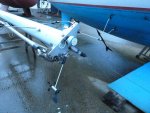
Sorry if this is covered elsewhere but when mine malfunctioned it turned out it was the cable in the mast that had worn through and needed replacing, and the Raymarine people predicted that this was the fault as it is very common. I am not sure if it helps but for anyone wondering what they look like on the masthead here is mine when the mast was down a couple of years ago

P1020422.jpg

There are a number of problems you might face working on it at the mast head. On mine the mounting black was screwed to the aluminium mast mast head using stainless steel self tap screws that had corroded solid and even an impact driver did not shift them.

The other tricky part is that the connector is held in place with a very small Allen screw so you need the right key, and for me this had also failed.
 
Last edited:
+1 on cable. It's definitely worth having the new type transducer but the fault could be in the cable, I have had this problem.
 
+1 on cable. It's definitely worth having the new type transducer but the fault could be in the cable, I have had this problem.
Yes typically even if here is separate channel for cables in the mast they still flap around. The official Raymarine cable was pretty expensive as I remember.

I also have the problem of adjusting it as well so this has been a useful thread.
 
Last edited:
There are two types of ST60 transducer: the old one has a vertical metal tube on the end of a stick, the new one has a thing that looks like an egg instead. If you search on eBay you will find pictures of each. Note that you will get more hits for the old type if you search for ST50 wind (transducer, mast head, MHU)

See here for a possible solution: http://www.raymarine.co.uk/knowledgebase/index.cfm?view=4635

However, I don't think it is likely for anything to slip, it is more likely a poor contact on one of the sine or cosine signals coming from the transducer, on the green and blue cores WRT ground. See her for how to test: www.raymarine.co.uk/knowledgebase/index.cfm?view=4254

For some reason Raymarine refer to these signals as "port" and "starboard" on the above page, totally meaningless in this context. They are two varying voltages that peak at 90° apart, hence sine and cosine.

Thanks to everyone who has replied.

I haven't yet tried the calibration procedure because the book says that is just to allow for any misalignment of the transducer assembly on the top of the mast. As I can see the arm is in line with the boat even when the wind direction reading is at least 30 deg wrong, I don't think that is my problem. I'll keep it in mind though.

I'm going to start with the voltage test from the knowledgebase, mainly because that is an easy test to do, though I'm not sure what reading to expect if that is where the problem is. Some sort of eletrical problem between the top of the mast and the console does seem quite plausible, though that might mean a replacement cable which doesn't sound fun.

There is wind information displayed on the chartplotter but I didn't really pay attention to how accurate it was because it is "ground wind" so not easy to immediately see if it is wrong.
 
I'm going to start with the voltage test from the knowledgebase, mainly because that is an easy test to do, though I'm not sure what reading to expect if that is where the problem is...
The peak voltage of the sine and cosine signals should be about the same, but 90° out of phase with each other. You have to rotate the vane (or the boat) to find out.
 
I'm going to start with the voltage test from the knowledgebase, mainly because that is an easy test to do, though I'm not sure what reading to expect if that is where the problem is. Some sort of eletrical problem between the top of the mast and the console does seem quite plausible, though that might mean a replacement cable which doesn't sound fun.

There is wind information displayed on the chartplotter but I didn't really pay attention to how accurate it was because it is "ground wind" so not easy to immediately see if it is wrong.

If you compare the wind direction on your chartplotter when the boat is not moving visually with the wind arrow at the top of the mast it will tell you if the problem is in the instrument head or the transducer/cable. Seems like the obvious place to start before climbing the mast and dismantling things.
 
Thanks to everyone who has replied.

I haven't yet tried the calibration procedure because the book says that is just to allow for any misalignment of the transducer assembly on the top of the mast. As I can see the arm is in line with the boat even when the wind direction reading is at least 30 deg wrong, I don't think that is my problem. I'll keep it in mind though.

I'm going to start with the voltage test from the knowledgebase, mainly because that is an easy test to do, though I'm not sure what reading to expect if that is where the problem is. Some sort of eletrical problem between the top of the mast and the console does seem quite plausible, though that might mean a replacement cable which doesn't sound fun.

There is wind information displayed on the chartplotter but I didn't really pay attention to how accurate it was because it is "ground wind" so not easy to immediately see if it is wrong.
The arm / spar position is somewhat irrelevant, its the VANE that need to be midships when the alignment is set up
 
Top