Raymarine autopilot sail to Wind

CAPTAIN FANTASTIC

Well-Known Member
Joined
15 Jul 2009
Messages
3,311
Location
Bristol Channel
Visit site
I have a Raymarine autopilot (ST6000 ??) which I use to sail to compass bearing and it works well. However, I would like to sail to wind, so I would need a wind instrument. At the moment I have a wireless Nasa wind instrument which I presume it is incompatible with the Raymarine.
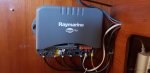
Is it worth adding the necessary instruments to be able to use the Autopilot to sail to wind? what do I need? The pictures below show what I have at present. In the instrument picture, the second instrument from the right is the Raymarine Autopilot. Thank you in advance.
Raymarine Autopilot Instrument200710_1600.jpgRaymarine Control unit 20181026_154203.jpg
 
I think you’re in luck, actually. As far as I can tell from NASA’s website, your wind instrument consists of a radio receiver box with an NMEA 0183 output, and a display unit which accepts and displays that output. NMEA0183 is officially point to point, but in practice you can connect more than one receiver in parallel. And I believe your autopilot control head has an NMEA 0183 input on the back. So it could be as simple as two six-inch lengths of wire between the two.

Pete
 
On further perusal of the Nasa manual, it looks like the cable to the display is captive, there are no terminals there. So while you could certainly cut into the cable and splice onto it to connect to the autopilot head, it may be more convenient to connect the receiver box to the autopilot computer instead. Depends where things are on your boat and how easy the wire runs are, really.

You‘ll need to connect from the Nasa’s blue wire (either spliced directly to it, or from the terminal it’s connected to on the radio box) to the Raymarine NMEA + terminal (labelled as such on the back of the control head, on the computer box it’s to the left of the cable with the white tape on its cores), and from the Nasa’s black or bare wire to the Raymarine NMEA - . The terminals on the control head take mini spade crimp terminals, the ones on the computer accept bare ends. The wire can be anything, really.

Pete
 
That's brilliant. The NASA and the Raymarine Instrument heads are physically next to each other on the cockpit (shown on top picture); the NASA receiver box is in the same position, directly behind the instruments; so the are all together. The Raymarine computer box is inside the boat. So, it will be easier to connect the NASA receiver to the Raymarine Instrument.

To select the Autopilot to sail either to Bearing course or to Wind, I could put a simple ON/OFF switch on the Nasa's blue wire, to isolate the Nasa receiver and therefore will automatically sail to Bearing course again; Am I correct?. Many thanks
 
I've tried to get my smart pilot to sail to wind direction with no success and that is networked with my raymarine eS9 mfd using the latest seatalk. The pages on the pilot control display which seems to be the same head as the OP's are I find confusing. If the OP gets his to work using the new cables I will have ago at rewiring mine.
 
Doesn’t the actual sailing mod get switched on the ST6000 in the menu options? So no need for hardwired switch, don’t think it’s just a case of alternative input but completely different operating mode, that’s how is it on my P70 display
 
The NASA NMEA outputs is the MWV sentence which is one of the two sentences the system recognises. You wire the NASA into the back of the control head on a permanent basis, no switching. To use the wind to steer to, you engage auto as normal and then press both auto and standby: that turns on the vane steering option. To alter the heading to wind, use the + and - buttons to adjust the course to wind as required.
 
My experience of using the Raymarine sail to wind function on a TP4000 is that there's little benefit. If the wind is free, then it's best to sail a compass course, otherwise a variable wind direction merely puts you off course to the waypoint. If sailing close-hauled, then the chosen course needs to be considerably below optimum, otherwise a slight heading of the wind will often back the sails because the system response is slow. Nowhere near as good as a helm- person. Raymarine advice in their user manual is to sail below the best course, so you might as well sail to compass.
I occasionally used this system because it was there, but I wouldn't have spent money to specifically upgrade
 
Last edited:
Agree sail to wind is very poor we all try these things and work out whats best for us. I dont use the track option either except when motoring as the wind changes and course changes dont work well.
 
I have a Raymarine Linear drive M81131 type 2 short with an S3G corepack, E12092 and an ST6002 Control Unit E12098-P and it's always performed very well. Maintains a close course and sails to wind very reliably.
 
I have a Raymarine Linear drive M81131 type 2 short with an S3G corepack, E12092 and an ST6002 Control Unit E12098-P and it's always performed very well. Maintains a close course and sails to wind very reliably.
I have the same setup and it works surprisingly well. The only irritation is the alarm when the wind shifts more than 5deg. (Note to self: check to see if it can be turned off!)
 
Just on the topic of how well it works, I recently crossed the Atlantic using a Raymarine Autopilot (don’t know which model, but not all that recent). We used it in vane mode for the whole crossing and it kept us nicely matched to the wind going downwind all the way. If we’d tried to use it to steer a compass or track course, it would have needed constant adjustment to match minor shifts in the wind.
 
Sail to wind works very well with my Raymarine Evolution pilot. I'm not sure whether I can do better than it to windward for a short period when I'm concentrating, I know it's definitely better than me over an extended time when I'm also thinking about other things.

The OP's older system might not be quite as good, but I still think it's well worth doing. Especially since the cost is two bits of wire, two spade crimps, and five minutes to connect them.

Agree that when off the wind it might be better to steer a compass course - that's why both options are there. But even then, if the wind is very variable I sometimes prefer to steer to the wind and have us average the proper direction, rather than constantly trim the sails.

Pete
 
Top