
PV I don't think I should worry??

Dave100456

Well-Known Member
Joined
11 Oct 2005
Messages
1,071
Location
Yorkshire England
Visit site
Hi
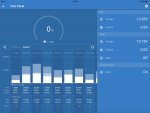
The two pics show data from my port solar panel. For those not familiar with Victron bluetooth controller, the 3 shades represent Bulk, Absorption and Float times.

I have had 10 weeks living aboard with new batts and no charge or capacity problems. An independent battery monitor has shown the house bank capacity 100% in the day on float and down to a low of 85% in the morning after a night at anchor. This equates correctly to the loads that have been drawing power during the night.

I am curious why the data from the Victron log of batt voltage shows a low of 11.58 (which would indicate sub 20% capacity). Is this low voltage figure captured as it happens for a just a millisecond or so when a high load consumer is switched on or is it something else?

Thanks
Dave
 

Attachments

  • fullsizeoutput_21d2.jpeg
    fullsizeoutput_21d2.jpeg
    235.8 KB · Views: 0
  • fullsizeoutput_21d5.jpeg
    fullsizeoutput_21d5.jpeg
    290.9 KB · Views: 0
I am curious why the data from the Victron log of batt voltage shows a low of 11.58 (which would indicate sub 20% capacity). Is this low voltage figure captured as it happens for a just a millisecond or so when a high load consumer is switched on or is it something else?

Thanks
Dave
Could be a fridge or diesel heater starting, so it's not a "real" battery voltage.
 
I'm not familiar with that particular controller, but suspect Paul's suggestion is right...although 11.58V suggests a fairly hefty load. Wouldn't it be possible to switch on assorted loads with someone observing the display to see how the unit responds, and whether that's reflected in the historical data?
 
Having looked closer at the logs, some questions.

1) What battery monitor do you have ?
2) What high load devices (fridge, heater, etc) ?
3) What size battery bank ?
 
Is there any chance it's voltage drop in the controller-battery circuit, caused by a load sharing the same cables?
 
Having looked closer at the logs, some questions.

1) What battery monitor do you have ?
2) What high load devices (fridge, heater, etc) ?
3) What size battery bank ?

Thanks for the info.
In answer to Qs
1 Battery monitor is Philippi
2 High load devices 12v freezer, diesel heater and 230v washing machine heat element, 1500w kettle, compressor all working via Quatro 3000w inverter
3 House 645Ah (3x 12v 215AGM)

I only just noticed the sub 12v voltage recordings and I'm now 2000M away from boat but back on her in 3 weeks
Cheers
 
Last edited:
I'm not familiar with that particular controller, but suspect Paul's suggestion is right...although 11.58V suggests a fairly hefty load. Wouldn't it be possible to switch on assorted loads with someone observing the display to see how the unit responds, and whether that's reflected in the historical data?

Thanks
Yes will test but just noticed it and now away from boat for 3 weeks.
 
I think a 3kW inverter might just count as a high load ;)

Yes agreed and it may well be this that causes the low voltage spike if that is what it is.

Whilst the inverter has a 3000w capability I do not load it to that level. The 230v consumers are half that and I only use these when its sunny and then two panels can provide significant input to the 12v house circuit so that the drain on the batts is reduced.
 
There will be an in rush at switch on so a brief spike up or down is nothing unexpected.

Thanks
That appears to be the general consensus of the forum.

I'm not a software writer and have zero knowledge of the Victron data logging system but speaking as a user, if we know that voltages are subject to very brief 'spikes' up as well as down, you'd think they'd design the software to monitor average max/min voltages over say a 1 second time interval which may eliminate spurious readings like this. No doubt someone will explain why this is not possible.
 
I'm based in Greece so high input during the day but big load from the fridge. Early morning in the summer my Victron Bluetooth shows the low point of the batteries much lower than the "at rest" level. Never been below 12.18v yet but I don't have a big inverter to cause such a trough. I find the Victron Bluetooth registers a high or a low voltage if the batteries stay at that level for about 3 seconds. During a peak load from something such as the inverter as it starts up it may well get down to the figures you see but the underlying voltage is over 12v.
 
I'm based in Greece so high input during the day but big load from the fridge. Early morning in the summer my Victron Bluetooth shows the low point of the batteries much lower than the "at rest" level. Never been below 12.18v yet but I don't have a big inverter to cause such a trough. I find the Victron Bluetooth registers a high or a low voltage if the batteries stay at that level for about 3 seconds. During a peak load from something such as the inverter as it starts up it may well get down to the figures you see but the underlying voltage is over 12v.

Because the data is a screen capture image from the summer I can't recall what was on or off at the time. When Im next out at the boat, I'll try to replicate the situation by turning big consumers on one day and seeing the resultant figures next day.
 
The Victron controllers do have a fairy long averaging period (several seconds) before recording a new voltage reading.

Therefore the 11.58v was not a brief spike. However, battery voltages at this sort of level are not unusual, or anything to be worried about, probiding the load at the time was reasonably high. They are not a sign that the battery is unhealthy or at a low state of charge.

A voltage of 11.58v only indicates the battery is at low state of charge when it is a resting voltage, with no discharge or charge current supplied for some time (preferably 24 hours or more).

The graphs in photos indicate a very short absorption time, so this setting should be checked, preferably by noting a typical end amp reading at near the end of absorption cycle.
 
Nolex
Thank you for the input, regarding the brief absorption time observation:

I have set the charge algorithm to match the spec of the batts. Are there other parameters to adjust the absorption duration and if so where?
 
The Victron controllers do not use a normal absorption time. They do have a user adjustable parameter called “maximum absorption time”. This is not the same as the absorption time (not even close), but it does provide a parameter that can be used to alter the real absorption time.

The Victron default setting for the “maximum absorption time” is 6 hours, which is likely to give around 1 hour of real absorption time, but every system will be different.

The best way to set the absorption time is too look at the current entering the batteries (not the current from the solar panels) near the end of the absorption time. The battery must be at the absorption voltage and held steady at this voltage. If this current is too high the absorption time should be longer. If the current is too low the absorption time should be shortened.

The ideal current to aim for is dependent on the size of the batteries and the battery type. The range is (0.5% to 3%). Around 1% is a good average. This means with a 400 Ahr battery bank the current at the end of the absorption cycle should be 4A (1% of 400).
 
Last edited:
1.8.1. Bulk
During this stage the controller delivers as much charge current as possible to rapidly recharge the batteries.
1.8.2. Absorption
When the battery voltage reaches the absorption voltage, the controller switches to constant voltage mode.
When only shallow discharges occur, the absorption time is kept short in order to prevent overcharging of the battery. After a deep discharge the absorption time is automatically increased to make sure that the battery is completely recharged.
Additionally, the absorption period is also ended when the charge current decreases to less than 1A.
1.8.3. Float
During this stage, float voltage is applied to the battery to maintain a fully charged state. When the battery voltage drops below float voltage during at least 1 minute a new charge cycle will be triggered.

The controller adjusts the absorption time as required. It's a lot smarter than just leaving the battery to stew for a few hours as some other controllers do.
 
Nolex, Buck
Thanks, I understand now about the Absorption time parameter and how for example 6 hrs absorption does not necessarily mean 6 hrs.

I have two 330w panels each with their own controller. I have been impressed with the PV performance and have never seen my battery 'capacity' below 82% since build in April. Even on foggy days with <100m viz in the CIs I have seen the panels charging well, due perhaps to their 67v rating.

Perhaps this 80% start point is why the actual Absorption period is so short as its duration is determined by the battery voltage at start up. In my case with a 80% charged battery the multiplier will reduce the set "maximum absorption time" to a 1/3rd or 1/6th of that value.

All makes sense now!
Thanks
 
The controller adjusts the absorption time as required. It's a lot smarter than just leaving the battery to stew for a few hours as some other controllers do.

Not quite, very likely the battery won't be really fully charged when it switches to float if the battery is getting cycled every day. The only way round this I could find was set float voltage to absorption voltage otherwise the victron switches to float too soon. It takes a very long time to fully charge batteries. Battery monitors aren't much help either as often the criteria to mark "full" is set too low giving a false impression that all is well when often all is almost well but the batteries get to nearly charged but not full.
 
Top