Propellor Taper to Shaft Grease - If Any and Castellated Nut Grease or Thread Locking Compound

  • Thread starter Thread starter Deleted member 36384
  • Start date Start date
D

Deleted member 36384

Guest
I am fitting a new propellor and wondering if the taper should be greased lightly to facilitate future removal, or should both be dry when fitted. The nut was difficult to remove, backing off all the way, to the very end required significant effort with a 24" Stilson wrench, is there a grease I could apply to make that easier in future; nut is castellated. Would lock tight or other such thread locking compound produce a white residue that made backing off the nut stiff? The propellor has been on for 10 years.

The propellor came off easy with a few firm taps on the front face of the boss.
 
So long as the castellations are good and you use a new split pin properly bent over I would use white grease on the taper and the thread.
 
I generally use Copper Slip for things like that. Had the main prop on and off a couple of times with this and makes a hell of a difference.
 
I am fitting a new propellor and wondering if the taper should be greased lightly to facilitate future removal, or should both be dry when fitted. The nut was difficult to remove, backing off all the way, to the very end required significant effort with a 24" Stilson wrench, is there a grease I could apply to make that easier in future; nut is castellated. Would lock tight or other such thread locking compound produce a white residue that made backing off the nut stiff? The propellor has been on for 10 years.

The propellor came off easy with a few firm taps on the front face of the boss.
First year apprentice stuff. Lightly grease. The nut concerns me, is it stainless to stainless? If so some thread chasing required.
 
First year apprentice stuff. Lightly grease. The nut concerns me, is it stainless to stainless? If so some thread chasing required.

The nut is a bronze material, the shaft stainless. A few dried out barnacles which were picked off but I didn’t have a wire brush to clean up the tip of the shaft Also no lubricant or penetrating oil applied to the exposed threads before removing.

The reason for the post is a google search provided conflicting advice suggesting both grease and don’t grease. The taper looks good on both the shaft and propellor boss and it was only a few firm taps to release.

It’s the nut that I am more worried about. Would you think that bronze on stainless should gall? Are these nuts designed to have a slight interference fit to give security? I was surprised that right up to the last couple of threads it was very stiff. Threads on shaft look good, threads on nut are very polished and don’t look as defined as the shaft threads, they look a bit of rounded. The nut is castellated and had a pin through it.
 
The nut is almost certainly brass, not bronze. Brass will not gall on stainless steel. It may be that one of your threads is UNC and the other Whitworth. They are very similar and it is possible to fit them together but the thread angles are different.
 
Stillsons will crush some nuts onto te thread making removal harder than necessary.
A drop of oil and a proper tool...
Putting the nut back on, I'd consider a weak threadlocker between dissimilar metals?
Grease on the taper will squeeze out if the taper is perfect, but avoid any crevices for corrosion, hopefully.
 
Stillsons will crush some nuts onto te thread making removal harder than necessary.
A drop of oil and a proper tool...
Putting the nut back on, I'd consider a weak threadlocker between dissimilar metals?
Grease on the taper will squeeze out if the taper is perfect, but avoid any crevices for corrosion, hopefully.

I'm wondering why you would use any thread-locker with a castellated nut? :unsure:

Richard
 
An interesting thread as I will shortly be reinstalling my shafts. The inner half couplings were damn tight, having likely not been removed sine the boat was built. The props would have been tight were it not for the 10 tonne hydraulic puller that wasn't taking any prisoners. I shall fit the tapers dry, with a light grease on the nuts, with new nylocs (1" BSW) on the inner ends and new lock tabs on the prop nuts.
 
I have a s/s shaft and nut, and a bronze propeller.

I never ever grease the taper. (Where is the sense in lubricating something that isn't supposed to move?!!)

I apply an anti-galling compound to the threads.
 
Mmmmm, a 2001 post, big supporters of not greasing, apparently greasing is advised by Calder and disagreed with Vyv Cox!

Prop Shaft - To grease or not to grease ?

These are results of my search. In general they come down on the not to grease side but also plenty of grease supporters.

Anti-seize compound on tapered hub / axle ends?
To lube or not to lube....(prop taper)
Anti or Never-Seize on crank/clutch tapers????
Slightly OT- should I use anti seize on a tapered shaft with no key
StackPath

One thing that is clear is that the key way is not the device that transfers the torque, its the taper fit that does that, hence the friction is needed. I think it does not matter, at the sort of toques and power my Perkins 4236 will produce, so long as the taper on the shaft and hole are a good fit, the correct torque is used and any lubrication is very light, as previously suggested. In one of the forms, a tip to remove the propellor is to simultaneously tap both side of the boss with hammers frequently and the propellor will pop off without much effort.

First task will be to measure the threads and make sure that I order the correct castellated nut, TS Norris sells bronze nuts..

Thanks everyone for your input.

BlowingOldBoots
 
I would no more think of greasing a propshaft taper than I would of greasing the headstock and tailstock tapers of my lathe.

As you rightly point out, the torque is transmitted by the friction between the mating surfaces.

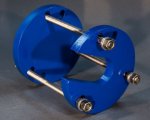
To remove my propeller I use a puller like this, which you can easily make yourself ( or buy ):

propeller puller.jpg


Mine has a brass cone set into the centre of the rear disc which engages in the centre-drilling in the propshaft.

Tip: Loosen but don't remove the propshaft nut until the propeller comes free. You don't want it dropping onto your foot or worse, onto the ground! ;)
 
Take the opportunity before fitting the propeller, of drilling and tapping a couple of holes in its aft face. A simple plate with matching holes can then be used for pulling the prop off. Saves all this business of hitting with hammers etc. I find it disappointing that all propellers don't have them.
 
Mmmmm, a 2001 post, big supporters of not greasing, apparently greasing is advised by Calder and disagreed with Vyv Cox!

Prop Shaft - To grease or not to grease ?

These are results of my search. In general they come down on the not to grease side but also plenty of grease supporters.

Anti-seize compound on tapered hub / axle ends?
To lube or not to lube....(prop taper)
Anti or Never-Seize on crank/clutch tapers????
Slightly OT- should I use anti seize on a tapered shaft with no key
StackPath

One thing that is clear is that the key way is not the device that transfers the torque, its the taper fit that does that, hence the friction is needed. I think it does not matter, at the sort of toques and power my Perkins 4236 will produce, so long as the taper on the shaft and hole are a good fit, the correct torque is used and any lubrication is very light, as previously suggested. In one of the forms, a tip to remove the propellor is to simultaneously tap both side of the boss with hammers frequently and the propellor will pop off without much effort.

First task will be to measure the threads and make sure that I order the correct castellated nut, TS Norris sells bronze nuts..

Thanks everyone for your input.

BlowingOldBoots


Good work, the upshot is that in this application it does not matter if you put some grease on the taper/threads or not, tho it might make the prop easier to remove in future. Although a joy for owners of old British motorbikes, thread locker is sometimes best avoided and pointless here.

The taper is there to centre and align the shaft, the key prevents rotation. It is common practice not to put grease on these items because, if you are building a steam engine or summat, it leads to over torquing and fractures.


These threads always remind me of the old BBC panel game, Call my Bluff.
 
I wrote in the thread linked above by Blowing Old Boots that modern practice is to exclude the key and keyway altogether. At one time in the refinery I had the fractured parts of seven failed shafts on my desk, four of which were fatigue initiated at the keyway.

I dealt with machines whose power ranged from a few hundred kilowatts to 90 MW. The large ones and many smaller ones had taper couplings fitted hydraulically. None had keyways. Hydraulic oil would be present inside the tapers on assembly but very little remained once made up.
 
Top