Prop shaft vibration; some advice please

silver-fox

Well-Known Member
Joined
3 Apr 2006
Messages
1,215
Location
Sicily
yacht.silverfox.googlepages.com
I have a 30mm dia prop shaft approx 1500mm in length. It is attached to the gearbox via a flexible coupling, it then passes through a traditional stuffing box mounted in a flexible stern-tube and from there to a cutless bearing to the prop. The prop is a 17" two blade fixed prop. The engine is a Thornycroft diesel with a Hurth Gearbox all mounted on flexible mountings.

When the engine is running at cruising speed of around 2200 rpm, it appears to be rock steady as does the gearbox. Yet despite this the stuffing box/prop shaft is vibrating and deflecting around 2mm.

I have already done the following: -

1. Prop shaft checked as true
2. Engine/gearbox alignment checked
3. Replaced cutless bearing
4. Relaced packing in stuffing box
5. Cleaned prop

Is this vibration normal? Should I ignore it, or do I have a problem? If so what is it?
 
You have quite a long unsupported length of shaft which is flexible, and under thrust will bend and twist.

The less bearing support you have the greater the likley hood of shaft oscilation.

You may find the carrier is not aligned which doesn't help, and if you add up the angular deflection allowed at the bearing by clearance or rubber deflection this could end up being several mm at the through hull or coupling. Add to this the fact that the engine is free to bounce around as the boat moves and you have a less than perfect bearing system so much of the vibration is often a result of what is basically a very crude system.
 
I have a 30mm dia prop shaft approx 1500mm in length. It is attached to the gearbox via a flexible coupling, it then passes through a traditional stuffing box mounted in a flexible stern-tube and from there to a cutless bearing to the prop. The prop is a 17" two blade fixed prop. The engine is a Thornycroft diesel with a Hurth Gearbox all mounted on flexible mountings.

When the engine is running at cruising speed of around 2200 rpm, it appears to be rock steady as does the gearbox. Yet despite this the stuffing box/prop shaft is vibrating and deflecting around 2mm.

I have already done the following: -

1. Prop shaft checked as true
2. Engine/gearbox alignment checked
3. Replaced cutless bearing
4. Relaced packing in stuffing box
5. Cleaned prop

Is this vibration normal? Should I ignore it, or do I have a problem? If so what is it?


Recheck the coupling alignment however do not just do it in one position as
this tells you only part of the story. Having used your feeler gauge to confirm the faces are face to face with slack bolts then without turning the engine, turn the shaft 180 degrees and recheck. This will conform the face of the coupling IS at 90 degrees to the shaft axis. Sometimes they are badly machined and this causes the shaft to deflect in the way you describe.

If this is the case then give the shaft coupling to a machine shop to face true.
 
That annoying vibration

We had exactly the same engine and gear box and with the same vibration that could not be traced until the engine mounts were changed and there it was, one of them had snapped clean through. The break was so clean that it could not be seen with the weight of the engine on it. It only "chattered" at certain revs which made me think it was an alignement problem, a frequency of the shaft problem, anything but an engine mount.

It probably wont be this one but it is another thought
 
We had exactly the same engine and gear box and with the same vibration that could not be traced until the engine mounts were changed and there it was, one of them had snapped clean through. The break was so clean that it could not be seen with the weight of the engine on it. It only "chattered" at certain revs which made me think it was an alignement problem, a frequency of the shaft problem, anything but an engine mount.

It probably wont be this one but it is another thought


I know you guys have a near identical boat so can I ask a few questions?

1. When you had the problem did you find there was considerable noise and vibration in the aft cabin?

2. What if any deflection/vibration is taking place at your stern tube now the problem is cured?

A big thanks for all the response from everyone by the way:)

I am resigned to the next step being a new flexible coupling and engine mountings

Neil Y: you have made me rethink the information that I gave earlier. I think I have unintentionally exaggerated the length of the shaft, on more careful consideration 900- 1000mm is more accurate.

Bilgediver: I have checked the flanges as you recommended inmultiple positions and the flange is fine.
 
Last edited:
The problem with this kind of set up is that there are so many variables as nothing is fixed as you would get with a shaft that was supported either end. Noise in the aft cabin suggests more likely to be prop or P bracket related. An out of true P bracket or movement of the mountings is not unknown and difficult to diagnose, but often results in wear of the cutless. Suspect an out of balance 2 bladed prop might also create vibrations which would be amplified by the "space" in the aft cabin.
 
Sincere thanks everyone for some very valuable advice.

My progressive approach is going to be

1. Renew flexible coupling
2. Renew engine mounts (and of course re-align)
3. Renew prop (I have been hankering after a folding prop for some time)

I have considered and will consider the possibility of P Bracket problems too, but I am pretty confident that it is OK as the prop shaft slides so easily into position and the flanges align almost perfectly.

Thanks once again
 
I had a similar problem, although my setup is not quite the same. After changing the engine from a Bukh to a Yanmar, with far softer engine mounts, I experienced noise and vibration at around 2000 rpm. My shaft is about 1.4 metres, 1 inch. The noise seemed to be coming from the P-bracket. Over several years I replaced the propeller, P-bracket, cutless bearing, shaft seal, fitted an Aquadrive, all of which changed the characterisitics a little but did not eliminate it. The shaft was perfectly straight, virtually no run-out. Finally I changed the shaft, although wear in way of the cutless bearing was quite small. This solved the problem, although there is still a little more noise at 2000 rpm than at other revs, which I put down to the natural frequency of the shaft.
 
I had a similar problem, although my setup is not quite the same. After changing the engine from a Bukh to a Yanmar, with far softer engine mounts, I experienced noise and vibration at around 2000 rpm. My shaft is about 1.4 metres, 1 inch. The noise seemed to be coming from the P-bracket. Over several years I replaced the propeller, P-bracket, cutless bearing, shaft seal, fitted an Aquadrive, all of which changed the characterisitics a little but did not eliminate it. The shaft was perfectly straight, virtually no run-out. Finally I changed the shaft, although wear in way of the cutless bearing was quite small. This solved the problem, although there is still a little more noise at 2000 rpm than at other revs, which I put down to the natural frequency of the shaft.

Vyv

I am starting to think you have ESP as you posted just as I was drafting a PM to you.:D

I would add that this is not a problem related to RPM except that the greater the RPM the louder the noise!:confused:
 
It makes sense to re-check the engine / shaft alignment. Best way to tell if it isnt right is to leave the engine in forward gear when sailing - if the engine rocks and the shaft moves sideways then it cant be the pulses of the engine cos its not working and has to be alignment or shaft straightness.

If that isnt the issue then the next place to look is the engine mounts. The engine needs to be sat equally on all four - loosen off the top nuts and using a crowbar lift the front of engine a little to see which mount is unloaded first. They should both unload together. Do the same at the gearbox end.

I hyad this problem with a volvo once and it was only when we did this test that we discovered a hairline fracture through one mounting bolt - it had been invisible before that.

Some engine movement is inevitable, both under the pulses of the engine and because nothing is ever perfectly balanced, perfectly in line. Particularly in a boat which flexes.
 
IS tehre any gap between the P bracket and the prop ?

When I got my boat the shaft vibrated such that could not go beyond about 4.8 knots (not great for a 36 footer)

I had it checked at the end of the season and the local marine engineer noted that there was a gap of circa 2 inches betwen the P bracket and the prop. He advised this should be less than the shaft diameter. So he removed a flex coupling and brought the prop forward to within 1/2 inch of the P bracket. I polished the prop and we aligned the shaft.

Result was transformation. Can do 7 knots without vibration from shaft.
 
IS tehre any gap between the P bracket and the prop ?

When I got my boat the shaft vibrated such that could not go beyond about 4.8 knots (not great for a 36 footer)

I had it checked at the end of the season and the local marine engineer noted that there was a gap of circa 2 inches betwen the P bracket and the prop. He advised this should be less than the shaft diameter. So he removed a flex coupling and brought the prop forward to within 1/2 inch of the P bracket. I polished the prop and we aligned the shaft.

Result was transformation. Can do 7 knots without vibration from shaft.

Recognise that you say your boat now goes faster. However, very much doubt it was anything to do with the reduction of the gap between the P bracket and the prop. Why should there be any difference unless perhaps the back of the prop was right against a large rudder and severely interrupting water flow. 1/2 inch gap is the bare minimum to allow water to flow through the cutless and allow for movement fore and aft as you go into gear. More common on small shafts is a 15-20mm gap and if a rope cutter is fitted the gap is normally 40mm (all on a 1inch to 1 1/2 inch shaft). So your original 2 inches is nothing unusual. The rule of thumb is minimum as above and maximum 4*shaft diameter - not for performance reasons but for possible flexing of the shaft leading to wear on the cutless.
 
Recognise that you say your boat now goes faster. However, very much doubt it was anything to do with the reduction of the gap between the P bracket and the prop. Why should there be any difference unless perhaps the back of the prop was right against a large rudder and severely interrupting water flow. 1/2 inch gap is the bare minimum to allow water to flow through the cutless and allow for movement fore and aft as you go into gear. More common on small shafts is a 15-20mm gap and if a rope cutter is fitted the gap is normally 40mm (all on a 1inch to 1 1/2 inch shaft). So your original 2 inches is nothing unusual. The rule of thumb is minimum as above and maximum 4*shaft diameter - not for performance reasons but for possible flexing of the shaft leading to wear on the cutless.

Perhaps you guys have very different standards Europe than we do here in the States. In the US prop shafting is guided by SAE J-755 & J-756 and ABYC P-06.

Here is the wording on shaft over hang.

ABYC P-06

6.5.5.4 The distance between the forward end of the
propeller hub and the aft end of the last strut bearing shall
be limited to one shaft diameter.


There is very good reason for this. With long distances between gear box and cutlass bearings any excess over hang can cause excessive shaft whip, jump rope effect, especially if the prop blades become out of balance or un-equally cruddy with marine growth.

I have solved many vibration issues by reducing shaft over hang. The biggest culprits, in the US, are flexible couplings installed with no regard to excess shaft overhang.

Had one boat where the owner had spent thousands, new mounts, fitted and face coupling, shaft truing, new cutlass, prop re-built and balanced etc. etc.. I took one look at the 2" over hang on a 1" shaft and had it cut down by one inch. Problem solved....

Shaft whip at low speeds is real and can be the cause of many a vibration. Zincs can also play a role in shaft whip if not placed close enough the the p-bracket. When zincs are new often no vibration is noticed but as they wear away, un-evenly, the vibrations begin to show themselves. Shaft whip begets shaft whip meaning once it starts it exacerbates and tends to amplify itself the faster the shaft turns..

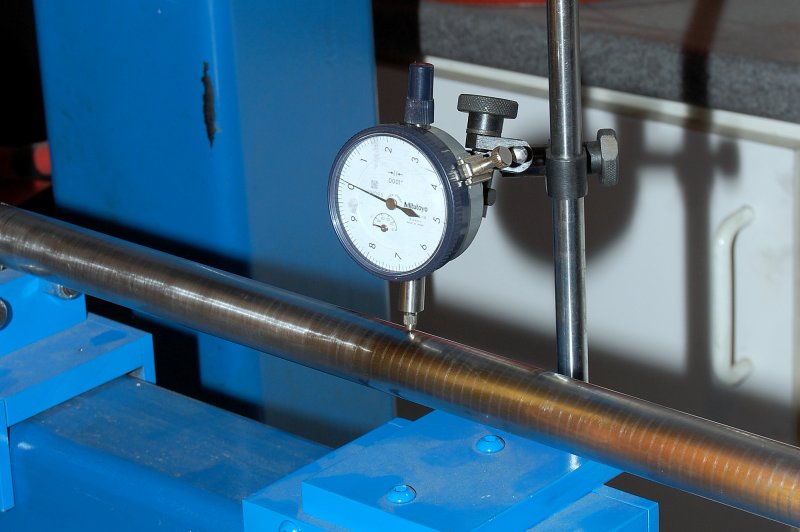
I would ask how the alignment was checked, with details, and how the trueness of the shaft was checked? A 1" dia shaft of that length, by our US standards, should have a max run out of .003". This can't be checked accurately when in the vessel.

Measuring shaft run out:

109130497.jpg


P.S. Does anyone have a copy of the standards used on that side of the pond for prop shafting??
 
I fully agree. A gap of more than one shaft diameter will magnify any imbalance in the propeller to unacceptable vibration levels. The function of the cutless bearing is to support the lateral forces arising in the propeller. If those forces are given extra leverage by an excessively large gap the result may well be shaft whip.

Incidentally, the same effect can be induced by placing a shaft anode in a position near the centre of the span between the cutless bearing and stern tube on a P-bracket installation.
 
Vyv

I am starting to think you have ESP as you posted just as I was drafting a PM to you.:D

I would add that this is not a problem related to RPM except that the greater the RPM the louder the noise!:confused:

Does this mean that the vibration increases with revs on a fairly continuous basis? This is very much a characteristic of out-of-balance forces. The most likely source is probably the propeller but the drive flange could also contribute. I assume you know that all the nuts and bolts are in place, so no silly possibilities. It might be worth checking that the drive flange is symmetrical, no need for anything high tech, just set up a reference point with a clearance of a millimetre or so and rotate the shaft, watching the gap. Do the same thing with the shaft in case the bore of the flange is not central.

One other easy thing to try is to turn the shaft flange 90 degrees relative to the drive flange and drive the boat to investigate any change.

I think you said the shaft had been checked for straightness?

Will reply to your PM later.
 
Perhaps you guys have very different standards Europe than we do here in the States. In the US prop shafting is guided by SAE J-755 & J-756 and ABYC P-06.

Here is the wording on shaft over hang.

ABYC P-06

6.5.5.4 The distance between the forward end of the
propeller hub and the aft end of the last strut bearing shall
be limited to one shaft diameter.


There is very good reason for this. With long distances between gear box and cutlass bearings any excess over hang can cause excessive shaft whip, jump rope effect, especially if the prop blades become out of balance or un-equally cruddy with marine growth.

I have solved many vibration issues by reducing shaft over hang. The biggest culprits, in the US, are flexible couplings installed with no regard to excess shaft overhang.

Had one boat where the owner had spent thousands, new mounts, fitted and face coupling, shaft truing, new cutlass, prop re-built and balanced etc. etc.. I took one look at the 2" over hang on a 1" shaft and had it cut down by one inch. Problem solved....

Shaft whip at low speeds is real and can be the cause of many a vibration. Zincs can also play a role in shaft whip if not placed close enough the the p-bracket. When zincs are new often no vibration is noticed but as they wear away, un-evenly, the vibrations begin to show themselves. Shaft whip begets shaft whip meaning once it starts it exacerbates and tends to amplify itself the faster the shaft turns..

I would ask how the alignment was checked, with details, and how the trueness of the shaft was checked? A 1" dia shaft of that length, by our US standards, should have a max run out of .003". This can't be checked accurately when in the vessel.

Measuring shaft run out:

109130497.jpg


P.S. Does anyone have a copy of the standards used on that side of the pond for prop shafting??

Don't disagree with what you are saying here - the normal overhang is 15-20mm. However thousands of boats are fitted with rope cutters where the distance is at least 40mm (on a 1 to 1 1/2 inch shaft size) with no ill effects.

As I observed in response to the OP it is difficult to diagnose vibrations on the flexible coupling, floating stern tube, P bracket set up because the whole lot is flexible.

However, my comments here are in relation to dunedin's claim that speed increased from 4.8 to 7 knots as a result of moving the prop approx 1 inch forward. Just suggesting that such a small change is unlikely to make that much difference - indeed any difference in speed.
 
basic rule is only 2 of these 3 items should be flexible coupling mounts sterngland
if all 3 are flexible then problems try the running without the flex coupling if you can you may need a spacer to take up the gap
 

Other threads that may be of interest

Top