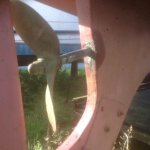
prop shaft TUBE movement .

ben lomond

New Member
Joined
31 Aug 2015
Messages
10
Visit site
Can any one offer advice on how best to repair and fix in place the "stern tube" through which the prop shaft rotates. The hull is GRP and the vessel is 24 feet, driven by Yanmar GM10.
Ben Lomond
 
Depends on how it was fixed in the first place. Some are glassed into place, but most are physically fixed with flanges at either end bolted or screwed to the hull. You need to identify what has failed. photos would help and you would do better with this type of question on the PBO forum.
 
Depends on how it was fixed in the first place. Some are glassed into place, but most are physically fixed with flanges at either end bolted or screwed to the hull. You need to identify what has failed. photos would help and you would do better with this type of question on the PBO forum.
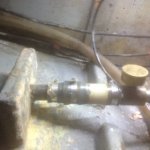
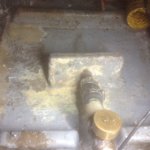
It certainly looks like it was glassed in at manufacture time. (1973) I`ve got photos showing both ends of the tube. It is a very thin walled tube and although angled through the boat , exits through a brass bush which presents a vertical face at the rear of the boat. Yesterday was my first ever post and I don`t know the PBO forum you refer to .How would I contact this . Photos will be supplied but need a visiting grand child to show me how. Thanks for replying.
 
Type of boat would help. Best way to post photos is to upload on Photo bucket and them share as images into your post.

There are several forums on this site and the best one for this type of question is the Practical Boat Owner Reader to Reader. It is the first one that comes up when you open YBW.com Forums
 
The Boat is a 24ft Balaton bilge keel yacht. Balatons were made at Lake Balaton in Hungary and imported in
by a company at Windermere. Mine dates from 1973. I`ll attempt to post photos now of the problem but if
not successful will send later.
 
OK. So where is it leaking or moving? suspect when it was installed it was just positioned in holes in the skeg and that transverse floor and glassed around. So if it is moving the GRP has failed somewhere so it needs re-glassing, probably after removing some of the existing to find where the damage is.
 
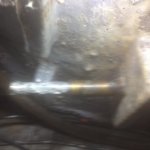
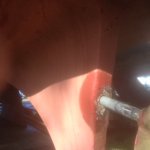
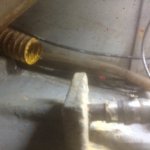
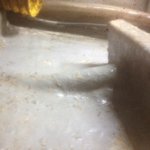
In picture 3 , the leak was considered to be there. A mound of fibre glass was applied there and for a few minutes seemed to have fixed it. It then appeared at the top of the wooden former , dribbled down the back and resumed as normal. the photos have been cleaned up with all the attempts removed . the 2 from the outside were taken several weeks after being onshore in good dry weather when the only wet spot on the boat was of water at the lowest end of the tube. I do not know how the tube is attached to the bearing . I should say that the only time I saw "movement" was when I was clearing the area of tubing, the Grease Box etc and whilst using a pair of grips to try to get the plastic tubing free from the stern tube, it moved about 5 degrees. I promptly moved it back 5 degrees but it did rotate. It nis clearly free of attachment to the surface of the tunnelmit bis in and I think also of the bearing.
 
Following what was post 9 , the as a result of posting the photos was "to expose where the failure had happened.
This suggests opening the tube to view along its buried length in the skeg but this makes me fearful of the strength / integrity of the skeg. I had been thinking of exposing 3 inches or so at the rear , exposing the tube and bearing and relying on welded/ brazed fins to the tube vertically above and below the tube and re glassing. The same idea of fins brazed on could be applied at the leading end by clearing away the wooden former and exposing where the tube enters the boat and dependent on what`s revealed , attach fins horizontally and re-glass above and below. I realise that this hangs the success of the project on the reliability of the weld/braze. I`d really appreciate that my sole correspondent has given an alternative to this but and would perhaps enlarge a bit on his suggestion to "expose and attach"
 
Looking at your photo 7 it is unclear whether that is the tube extending aft from the skeg or just the shaft. If it is the shaft then there is far too much overhang, but there is enough room to replace the tube with something much more substantial. That installation is a very "cheap" way of putting a stern tube it and I am not surprised that it has failed. My observation to expose and re attach was to indicate that you need to curt away all the GRP around the tube, rather than just putting extra over the top. You need to keep it located in the transverse floor as this is what keeps it in line.

However, don't think you are ever going to get a really satisfactory job because of the basic flaws in the method. Lot of work but the long term solution is to install a proper stern tube with a bearing carrier attached to the aft face of the skeg. You can see the sort of thing that would be suitable in the on line catalogue www.lakesterngear.co.uk
 
Looking at your photo 7 it is unclear whether that is the tube extending aft from the skeg or just the shaft. If it is the shaft then there is far too much overhang, but there is enough room to replace the tube with something much more substantial.

+1

Looking at at the moisture showing in pictures 6 and 7, I would suggest that you also have a skeg that is full of water.

Hard to tell from the photos, but I think I would be cutting a hole in the bottom or side of the skeg and taking a look at the state of the plywood inside before deciding to spend too much money on a stern tube repair.
 
Hello Tranona, just to clear up the tube length. Although I never numbered the photos I think they`ll appear to you in the same way as they present to me. ie the bottom left hand one showing the tube and shaft projecting to the left. The tube end is marked colour brass. the white part beyond that is the very greased up shaft, stopped in that position by the rudder , not atr that time removed allowing shaft and prop to be elsewhere. From memory the shaft protrudes circa 3". However that`s all by the by . You`ve given me a new lead for which I`m hugely grateful and will follow-up and come back to this Forum. Thanks very much.
 
Hello Tranona, I`ve got the downloaded catalogue in front of me and see on page 2 that they offer 4 types of stern tube assemblies. I confess to not knowing which end is fore and aft. Types 1 and 3 are brass tube water scoop outboard types and types 4 and 5 are epoxy glass tubes. The biggest question I have to get answered is: Will any new stern tube depend on "glassing in " as it`s main means of staying fixed or is there a "mechanical means" of fixing. Looking through the thread since post 1. I`m sure a post was there (which I can` ( a clue to the whereabouts of the boat)t see now) suggesting that the Skeg itself maybe a problem and be full of water and therefore not an ideal location to "glass in" . Unfortunately my boat winters 100 miles from where I stay so the next visit is important to get all the sizes needed. It would help the thinking greatly if I thougt that the Skeg would simply be the route through which the new stern tube would pass and that it could be fixed and sealed by mechanical means. Regards Ben Lomond
 
The epoxy glass tubes are intended to be glasses in much like your current set up. The conventional metal type rely on the end fittings being attached to the boat using a waterproof sealant. So the aft fitting with the bearing is screwed onto the tube and then attached to the skeg. The inboard end which carries the stuffing box is also screwed on and attached to that transverse floor. Very standard practice. Give Lake a call to discuss. They are the experts.
 
Hello .I`ve just found the missing posts and indeed post 15 from Tranona answers the question I posed in my latest post. So thank you and I will contact Lake stern and possibly return here if I`m stuck. Thank you , Regards Ben Lomond
 
Top