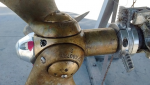
Prop anode advice - please?

RJJ

Well-Known Member
Joined
14 Aug 2009
Messages
3,159
Visit site
Hello

We've had the boat for two years. Set up is Volvo 130 saildrive with an EWOL "super duplex" stainless prop.

2019-20 season saw both the saildrive and conical prop anodes lose 5-10% of their weight, so I left them in place. 2020-21 season, and the prop anode is almost gone - about a teaspoon size left, secured by just one of the three bolts. (the saildrive anode is fine).

Trying to think what changed:
- The boat was in the water only a little longer - 10 months instead of 8
- she's on a mid-river pontoon with no shorepower; in both seasons we connected shorepower perhaps a dozen times
- changed the brass skin fittings and ball valves to Trudesign, but the originals weren't bonded anyway
- changed the saildrive gaiter

We're off to do an Atlantic circuit this year and will no doubt have more time on shorepower. I'm pondering whether to assume all's well and just replace it and keep an eye....I'm aware many people have issues with the speed of erosion of propeller anodes.

Or should I do something different? Galvanic isolator? Or should I be investigating for a more fundamental problem?

Many thanks indeed
 
Looking at the construction of the propeller, while it is billed as "stainless steel" it is actually mixed, with yellow metal (bronze?) bushes that the blade pivots run in. These 2 metals have different potential and the anode is there to protect the bronze. Really no different in mix of metals from other feathering and folding propeller that use bronze for the hub and blades and stainless for the gears and pivot pins. Both types have anodes which have variable life. The variability can be either between different makes - some are notorious for short anode life, others not; or variable for the same unit at different times or in different locations.

The prop is electrically isolated from the saildrive and therefore the boat so nothing you can do will alter the life other than increasing the size of the anode. It would be the same if you just left the prop in seawater unattached to a boat.

I guess the makers are anticipating the bronze bushes to be a wearing item, either through use or corrosion as they seem to be replaceable.

A galvanic isolator is worth fitting - many marinas (such as our club) make them compulsory, but won't affect the prop because of its isolation.

The fundamental problem is the construction of the prop - mixed metals in salt water. However as I suggested that is inevitable in a positively geared design. Simple 2 bladed props such as my Flexofold can sometimes get away with no anodes - mine is 10 years old and perfect, but even they fit anodes on the latest versions. With a bronze hub and blades you can reduce the erosion by painting the blades with Velox as this reduces the area exposed to seawater. However with your design the bronze is in the bearings and painting the stainless blades will not work. However it could be worth doing as Velox is a very effective antifoul.
 
Looking at the construction of the propeller, while it is billed as "stainless steel" it is actually mixed, with yellow metal (bronze?) bushes that the blade pivots run in. These 2 metals have different potential and the anode is there to protect the bronze. Really no different in mix of metals from other feathering and folding propeller that use bronze for the hub and blades and stainless for the gears and pivot pins. Both types have anodes which have variable life. The variability can be either between different makes - some are notorious for short anode life, others not; or variable for the same unit at different times or in different locations.

The prop is electrically isolated from the saildrive and therefore the boat so nothing you can do will alter the life other than increasing the size of the anode. It would be the same if you just left the prop in seawater unattached to a boat.

I guess the makers are anticipating the bronze bushes to be a wearing item, either through use or corrosion as they seem to be replaceable.

A galvanic isolator is worth fitting - many marinas (such as our club) make them compulsory, but won't affect the prop because of its isolation.

The fundamental problem is the construction of the prop - mixed metals in salt water. However as I suggested that is inevitable in a positively geared design. Simple 2 bladed props such as my Flexofold can sometimes get away with no anodes - mine is 10 years old and perfect, but even they fit anodes on the latest versions. With a bronze hub and blades you can reduce the erosion by painting the blades with Velox as this reduces the area exposed to seawater. However with your design the bronze is in the bearings and painting the stainless blades will not work. However it could be worth doing as Velox is a very effective antifoul.
Wow. Thanks for your very detailed and clear response.
 
Appreciate this is a different setup; protecting the thin walls of the screw holes on the anode can help stop it dropping off. This is my favourite Coral Pink nail varnish :)
1623752615641.png
 
  • Like
Reactions: RJJ
Top