
Prop and shaft corrosion

colind3782

Well-Known Member
Joined
18 Jan 2011
Messages
4,510
Location
Shropshire/Empuriabrava
Visit site
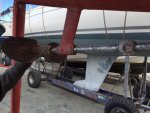
Just had the boat lifted and there's a fair amount of corrosion on the prop and shaft but the anode is almost as new. Assuming it was fitted correctly and isn't insulated from the shaft, any ideas about what could cause it?IMG_1512.jpg
 
check that the anode is not a chinese cheepo of the wrong material by buying a new one from a reliable source
Also it might be a fresh water anode not a salt water one ( or vice versa)
I assume you did not antifoul the anode or smear it in grease or similar
 
check that the anode is not a chinese cheepo of the wrong material by buying a new one from a reliable source
Also it might be a fresh water anode not a salt water one ( or vice versa)
I assume you did not antifoul the anode or smear it in grease or similar

If it looks like that on the part you can see, I suggest looking at it where it is in the cutless
 
I should say that I didn't fit the anode last time, it was done by the yard in Spain. I'm in the UK at the mo and the pic was sent to me by a friend. I'm out there in two weeks time so I can assess the problem better.

Thanks for the input all.
 
I should say that I didn't fit the anode last time, it was done by the yard in Spain. I'm in the UK at the mo and the pic was sent to me by a friend. I'm out there in two weeks time so I can assess the problem better.

Thanks for the input all.

What has been said about the anode material is important.
Zinc anodes are usually used in seawater but must be of the correct specification, crucially very low in iron content but also containing other alloying elements ( cadmium ??) which offset the effect of a small iron content

Aluminium anodes are also suitable for seawater use but again must be of the correct spec ( in this case containing, in particular, a very small % age of indium)

Anodes for freshwater are magnesium. They are too reactive and would therefore have a very short life in seawater.
 
I had 2 anodes on my prop shaft one next to P bracket and one next to stern tube. The one next to P bracket eroded more than the one next to the stern tube.

IMGP2588_zps28470770.jpg


This pic also shows the new anode just fitted.

IMGP2134_zps7c3b884c.jpg
 
I had 2 anodes on my prop shaft one next to P bracket and one next to stern tube. The one next to P bracket eroded more than the one next to the stern tube.

IMGP2588_zps28470770.jpg


This pic also shows the new anode just fitted.

IMGP2134_zps7c3b884c.jpg

This is what you would expect to see, with the anode closest to the prop, which they are there to protect, corroding fastest.
 
Just had the boat lifted and there's a fair amount of corrosion on the prop and shaft but the anode is almost as new. Assuming it was fitted correctly and isn't insulated from the shaft, any ideas about what could cause it?View attachment 54777

Not sure that is corrosion on the shaft. More likely to be deposits. Needs cleaning up. The prop shows some signs of pinkness and also needs cleaning . Then check for soundness by tapping with a small hammer. The blades should ring. What make is the prop and are there any anodes on it?
 
Not sure that is corrosion on the shaft. More likely to be deposits. Needs cleaning up. The prop shows some signs of pinkness and also needs cleaning . Then check for soundness by tapping with a small hammer. The blades should ring. What make is the prop and are there any anodes on it?

Agree about the shaft deposits but I won't know for sure until I check myself. Off the top of my head I don't know the make of the feathering prop as the manual is on the boat but I don't think there's an anode actually on the prop.
 
Guys , it has been said already , but I also keep telling people , put a zinc on the P-bracket .
Is your engine mass shielded ?
Meaning , is the negative to be found on the engine block . Hopefully not.
If it's a shielded one , have you recently renewded starter , alternator with a non-marinized replacement ?

Regards
 
Guys , it has been said already , but I also keep telling people , put a zinc on the P-bracket .
Is your engine mass shielded ?
Meaning , is the negative to be found on the engine block . Hopefully not.
If it's a shielded one , have you recently renewded starter , alternator with a non-marinized replacement ?

Regards

The P bracket idea is one I'll take on board. Haven't renewed anything like that and the DC neg is to the engine. I'm in the middle of rewiring the 240 AC shorepower which I'm planning to earth to the engine at the same point but via a GI.
 
I would only add that when fitting an anode make sure the shaft and anode are making good electrical contact. You would be surprised how many anodes are screwed on over corroded or dirty shafts. Check electrical continuity with a meter.
 
I would only add that when fitting an anode make sure the shaft and anode are making good electrical contact. You would be surprised how many anodes are screwed on over corroded or dirty shafts. Check electrical continuity with a meter.
i tighted the clamp screws then give the anode a "donk" on both halves, with a 6oz hammer to bed it, then tighten the clamp screws again having used loctite on the thread
 
Guys , it has been said already , but I also keep telling people , put a zinc on the P-bracket .

The P bracket idea is one I'll take on board.


What is the object of fitting an anode to the P bracket. It is insulated from the shaft by the cutless bearing.

An anode on the bracket might protect the bracket but that does not appear to be suffering from any corrosion !
 
As said previously, the first thing to check is that what can be seen is actually corrosion, it does look rather like fouling. Assuming it is, check the shaft with a magnet. Yours would not be the first shaft to be made in a 400 series stainless steel (particularly on Jeanneau boats), far less corrosion resistant than a 300 series.

Agree that an anode on a P-bracket is barely necessary. It will be made from manganese bronze in most cases, having pretty good corrosion resistance, and as VicS says it is not connected to the prop and shaft and thus not vulnerable to galvanic action. Sometimes the thinner section at the bearing is a little vulnerable to dezincification but this is a long-term issue. Painting it is probably better protection than an anode.
 
What is the object of fitting an anode to the P bracket. It is insulated from the shaft by the cutless bearing.

An anode on the bracket might protect the bracket but that does not appear to be suffering from any corrosion !


With all due respect Vic , I think you underestimate what stray currents can do.
Apparently Colin has a neg on the engine which is absolutely not a good thing.
Normally the engine is connected to the P-bracket with a separate lead to avoid electrochemical corrosion on engine parts.
There should not be stray current coming from the engine , but sometimes there is , that will run from the engine towards the P-bracket and will seek a ..." victim " , in this case the prop or propshaft depending of the composition of the metal.
A zinc on the strut will take the frontline fire.

Regards
 
With all due respect Vic , I think you underestimate what stray currents can do.
Apparently Colin has a neg on the engine which is absolutely not a good thing.
Normally the engine is connected to the P-bracket with a separate lead to avoid electrochemical corrosion on engine parts.
There should not be stray current coming from the engine , but sometimes there is , that will run from the engine towards the P-bracket and will seek a ..." victim " , in this case the prop or propshaft depending of the composition of the metal.
A zinc on the strut will take the frontline fire.

Regards

I suspect that you are falling into the common trap of assuming that seawater can be substituted for copper wire so far as conductivity is concerned. The reality is that it cannot, as electrons in water travel pretty much in straight lines and, so far as small voltages are concerned, not very far. There is no way that connecting a wire to the P-bracket is going to prevent corrosion inside the engine, the only way is an internal anode ( assuming we are talking about a raw water cooled engine).
 
With all due respect Vic , I think you underestimate what stray currents can do.
Apparently Colin has a neg on the engine which is absolutely not a good thing.
Normally the engine is connected to the P-bracket with a separate lead to avoid electrochemical corrosion on engine parts.
There should not be stray current coming from the engine , but sometimes there is , that will run from the engine towards the P-bracket and will seek a ..." victim " , in this case the prop or propshaft depending of the composition of the metal.
A zinc on the strut will take the frontline fire.

Regards

Methinks you have little understanding of the process of electrolysis and the role of anodes.

A P bracket should not be connected to your engine. An engine does not suffer corrosion from any source outside the boat, but only from seawater that is internal to the engine, and then only if there are dissimilar metals in the seawater circuit.

For electrolysis to occur the dissimilar metals must be in direct contact and immersed in an electrolyte (such as seawater). So there may be electrolysis between the yellow metal of the prop and the stainless shaft, and an anode which is zinc and has a lower potential will be eroded before the zinc in the prop. The anode can be either on the shaft as in this case or it can be a hull anode that is bonded to the shaft, often through the gearbox housing. This is connected to the engine, but it does nothing to prevent internal corrosion in the engine - it is simply a convenient electrical path to the prop shaft.

The only way a P bracket can suffer corrosion is if it is an alloy of dissimilar metals, but rarely is this the case as Vyv explained. A P bracket is not electrically connected to the shaft, being insulated by the non metallic cutless bearing, so an anode there will have no effect on corrosion of the shaft or prop. So, rather than being a first line of defence it is a waste of time.

Afraid your description of what "stray currents" are and what causes them is also wrong, but as it is irrelevant to the OPs possible problem I shall leave you to work out why.
 
With all due respect Vic , I think you underestimate what stray currents can do.
Apparently Colin has a neg on the engine which is absolutely not a good thing.
Normally the engine is connected to the P-bracket with a separate lead to avoid electrochemical corrosion on engine parts.
There should not be stray current coming from the engine , but sometimes there is , that will run from the engine towards the P-bracket and will seek a ..." victim " , in this case the prop or propshaft depending of the composition of the metal.
A zinc on the strut will take the frontline fire.

Regards

And to add to what Vyv and Tranona have said i'd point out that a negative connection to the engine is , except in the case of a fully insulated 2 wire DC system, normal. The connecting point will often, in fact, form what standards such as ISO 10133 call the "main grounding or earthing point" for the DC system

Also
Your suggestion to connect the P bracket to the engine will, if it is bronze or even stainless steel, lead to accelerated depletion of the nearby shaft anode if there is electrical continuity between shaft and engine.
 
Top