Project Twister 28 what to do with Decks/coachroof

steveeasy

Well-Known Member
Joined
12 Aug 2014
Messages
2,444
Visit site
s301004-moored3.jpg
deck.jpg,

Hi,
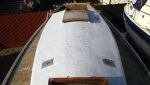
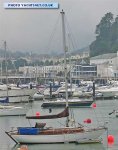
From one of the images below, Aeolis was once a nice looking boat. She seams to have taken a turn for the worse has been out the water for several years. nothing on deck and a new engine to install. Her teak cockpit and locker covers have lasted surprisingly well.

I need to recoat her decks and cabin roof and don't really know what to do. My understanding is if I use a flowcoat/polyester topcoat, do I have to rub down to do a second coat ?. Can I really get a reasonable finish with brush?. should I use a primer for this ?. or is there a better option, is there a product that can be sprayed that will give a better finish. Of course its limited by budget.

Any help or advice appreciated

Steveeasy
 
From what I can see the deck is wooden but sheathed in GRP? If so how smooth is the current finish? What is on the coachroof already, is it a flow coat or gel coat? I guess the simple answer is that flow coat can go straight on to GRP and will need to be applied in a number of thin coats before sanding down through the grades to get a good finish. If the final finish is to be non slip then the sanding is only to get a flat finish before applying a coat with non-slip additive. Could be quite a lot of work when something like Kiwi grip may be a more effective solution on a budget. More info on what is already there will help with advice.

Yoda
 
Hi Yoda,
Yes wooden sheathed in GRP. The Decks have a smooth textured finish as does the coachroof. Im not sure what is on the coachroof, I think it is a primer/filler coat, with a matt flat finish. If a flow coat is used, do I apply several coats then sand, or sand in between coats.

Steveeasy
 
Last edited:
Steve, I would use light grey internationals deck paint for the decks. I have applied this to 3 dive boats over the years. The colour doesn't fade and can be touched up in following years without being noticed. However, as always preparation is everything. The first time I went overboard scrubbing the deck 3 times with a scourer and jif. Two coats of paint gave a really good finish, easy on bare feet and not too hot during the summer. The last time I only cleaned a deck once and obviously missed something as the paint lifted in small patches, suggesting contamination was still present.

I have also used flowcoat on top of ply coated with chopped stand mat. It gave a ripply finish which didn't matter on a work boat, but would have to be long board sanded for a good finish on a yacht cabin top. It also faded yellowing slightly over the first years so I then painted it gloss white. If the white flowcoat is in good condition then either long board it, or use a belt sander then paint it white with several coats of good quality white paint.

Not a great picture, but the white engine box is plywood with CSM on top, then painted. The deck is light grey deck paint.

http://www.rib.net/forum/attachment.php?attachmentid=2116&d=1052885836

attachment.php
 
Hi Steve,
I had the pleasure of owning an all GRP Twister for 8 years. An incredibly seakindly/seaworthy 28' yacht.
https://sailingscotty.wordpress.com/

If the GRP sheathing has been done very well with none of the sheathing raising off the timber, then I would tape up small areas after priming the decks and use kiwi grip non slip.
https://www.google.co.uk/webhp?sourceid=chrome-instant&ion=1&espv=2&ie=UTF-8#q=kiwi grip

My son and I did his 26' I/F Marieholm with this and it looks very professional. Secret is to follow the directions in detail and practice on a small area first.

Not knowing the saloon top covering on your boat, it would be advisable to add some non slip there for when at the mast or boom. Most of the early all timber and composite (wooden top) Twisters, had a thick cotton covering over the timber that was then painted to seal.

I do know that a small number of Twisters suffered from the mast step supports collapsing the actual mast step.
If you have this problem, PM me and I can advise, as I rebuilt mine from below.

That hull of yours with the raised rubbing strip looks like an all GRP hull to me.
The main problem with those not well maintained or rebuilt is that area where the deck joins the timber uprights of the saloon often leaks. Sometimes not an easy problem to solve. On my Tradewind I have an identical type of build and a good feed of Captain Tolley's Creaping Crack Cure has definitely helped.
https://www.google.co.uk/webhp?sour...captain tolley creeping crack cure how to use
and then some Cuprinol wood sealer has completed the job. However, if your boat has been sheathed you may not have any drips.... you're a lucky man if not!

Is that deck sheathing over a teak deck that is on top of a GRP deck? Most Composite Twisters had a GRP deck, some with a teak covering.

If you are not already a member of the Twister Class Association then I can recommend you do join, as a great deal of good advice came to me from there.

Good luck
S.
 
Last edited:
Flow coat is essentially a polyester resin with wax to make it go hard and pigment. It is designed and used mostly to finish the inside (rough side) of a chop strand GRP lay up. It is applied when the GRP is hard but not really set. ie not old. It then makes a chemical bond with the GRP resin. It is not nearly so good at adhering to old GRP which is chemically inert.
Much better for bonding is (in theory) polyurethane 2 pack paint or just enamel oil type paint. ie deck paint. Having said that flowcoat will probably stick well enough anyway.
You will need as said non skid areas on the deck and cabin top. Hence deck paint might be best. good luck olewill
 
Hi Yoda,
Yes wooden sheathed in GRP. The Decks have a smooth textured finish as does the coachroof. Im not sure what is on the coachroof, I think it is a primer/filler coat, with a matt flat finish. If a flow coat is used, do I apply several coats then sand, or sand in between coats.

Steveeasy

If you go down the flow coat route then yes you apply several thin coats before sanding with an orbital then a long board to get the final smooth finish. If the starting base isn't smooth don't expect the flowcoat to sort out any imperfections. Be aware that going this way you are letting yourself in for some lengthy days of sanding!

Yoda
 
Hi All,
Thank you for your suggestions. Yoda, ill bin the flowcoat idea then, I am not keen on days of sanding. I am thinking awlcraft 2000 paint on deck and coachroof, followed by Awlgrip none slip on areas I wish to be none slip. Any views helpful.

Thanks

Steveeasy
 
Unless I've missed the point (not uncommon) you haven't said what the substrate is. Looking at your photo, I would hazard a guess that the decks and coachroof are plywood sheathed in GRP. In the early days of this type of construction, polyester resin was all that was available and it has a finite life. The adhesion to the ply is nowhere near as good as that of epoxy resin and in thin coatings its brittle nature reveals itself by cracking as the boat flexes. Some manufacturers did recognise these properties and laid up very thick coatings which will almost support themselves, even if they have delaminated from the ply! You may find that advice from members of the owners' association will help enormously in identifying the original materials and deciding on the finish that suits you best.

If it is polyester but sound, then I'd paint over it. A good finish can be had by applying with a roller and lightly tipping off with a brush or pad. The problems of adhesion and thin brittle coating if using flowcoat may cause heartache if all your hard work results in is a cracked surface! I'd hesitate to try it on a large surface, but I have been told that a chemical bond can be achieved on old GRP by softening the surface with acetone prior to applying fresh Polyester! I'd be happier to rub down for a good key and overcoat with epoxy which adheres very well.

There are myriad ways to paint on a non-slip finish. Commercial non-slip paints are available at a price, whilst others advocate sieving fine dry sand onto wet paint - excess is blown and brushed off after drying and a final coat of paint applied over it. Still others use textured masonry paint - cheap, perhaps a little coarse and some have had adhesion problems. Another ploy is to sprinkle sugar onto wet paint. It is washed off after the paint has dried, leaving depressions where the grains of sugar had been.

If you're feeling flush, you could paint the deck and coachroof to the highest standard you can achieve and then stick down a pattern of pads of non-slip, such as Treadmaster. Looks good, but pricey. A similar appearance can be had by applying your choice of non-skip paint system in a contrasting colour to the base paint layer.

Again, assuming that the substrate is plywood, if starting from bare wood I would suggest sheathing in glass cloth and epoxy resin - this will still allow the wood of the coachroof sides to be seen to best advantage - then paint the decks and roof with your chosen finish and varnish the sides so that the epoxy is not exposed to UV radiation which can destroy it. A lot of useful background reading can be had at the Gougeon Brothers website (West System Epoxy) amongst others.

Rob.
 
Another take on this. If all is sound then just do the decks with grey masonry paint and the cabin roof with white masonry paint !! The finish all looks a bit 'lumpy' as far as I can tell and you could spend hours and hours trying to get it all smooth. Spend time on the bits of wood trim getting them to look really smart and set off your new paint job! then enjoy the boat.

I had teak decks on one boat and spent a massive amount of time, replacing, chasing leaks and keeping them smart. Sold the boat to a guy who promptly sealed the decks and painted over the lot, I was horrified but it looked passably smart and didn't leak!
 
Agree with the suggestion for Kiwigrip, assuming the sheathing is sound. gives a good non slip finish and will cover the imperfections on the existing. Not worth using expensive paints like Awlgrip.
 
I have been aboard this boat in 2006 and the photo of her moored is mine. The decks were ply over timber deck beams with at that time brown Treadmaster covering. She was in pretty good order in 2006, but even then there was some doubt about small areas of delamination in the deck structure. It is possible that this has been addressed since then - or not! Overall she was a nice boat then.
 
Hi,
Well shes great with an open mind. Im not sure what has been done, but it all looks good. no lumps or bumps. the deck has been sheathed and an awful lot of effort was put in by a previous owner, after carrying out the deck and coachroof repairs he moved to Spain.

Whilst I want to do a thorough job on her she is going back in the water in late July. I set a target and if I don't stick to it, she will end up never being put back in the water. Ive got flowcoat to do the work, but Im going to bin that and if im correct from the posts, use whats described as 2 pack paint on the coachroof and decks. then finish with a nonslip product in areas. but do I need to prime?.

I am utterly amazed at her teak locker covers, they looked awful, and I was in two minds to discard them. however a little sanding and the teak is like new. I think ill skip varnishing them.

Steveeasy
 
I have used Teamac Suregrip paint on both the deck and coachroof of my Twister with success. It has grit in suspension so you have to keep the tin stirred. I sand down the previous layer with a coarse sandpaper before application. After a few coats the grit results in rather thick layer of paint.

Good luck.

David
 
Top