Powering a soundbar straight from boat DC: silly or what

MapisM

Well-Known Member
Joined
11 Mar 2002
Messages
20,658
Visit site
I am thinking to add a soundbar to the onboard TV, and I just realized that the one I'm considering is actually 24V DC powered, through an AC/DC Adapter.
Hence the question, as per title: do you think that a straight connection to the boat 24V DC circuit (whose voltage is obviously variable, from 25 to 28 or so, depending on the status of the battery charger) would be ok, or could that damage the internal amplifier/circuits?
Of course I could keep the supplied adapter, connecting it to an AC socket powered through an inverter, but I'm a fan of the KISS principle, whenever applicable... :)
 
Sound bar. Whatever next. An Cam? Under Water Lights?
LOL, good point, J.
Btw, I can't remember if we tried it while you've been onboard, but the DP already has a decent OEM audio system.
And even if originally it wasn't connected to the TV, I managed to do that through an unused aux input.
It's actually S who is more interested in the soundbar, because we had it on the old lady, and she liked to use it through the BT connection to her phone, particularly for music listening while cooking.
So, you can see why I do my best to please her... :rolleyes:
 
Indeed, only one step away from a BBQ!
OMDB, P. OMDB.
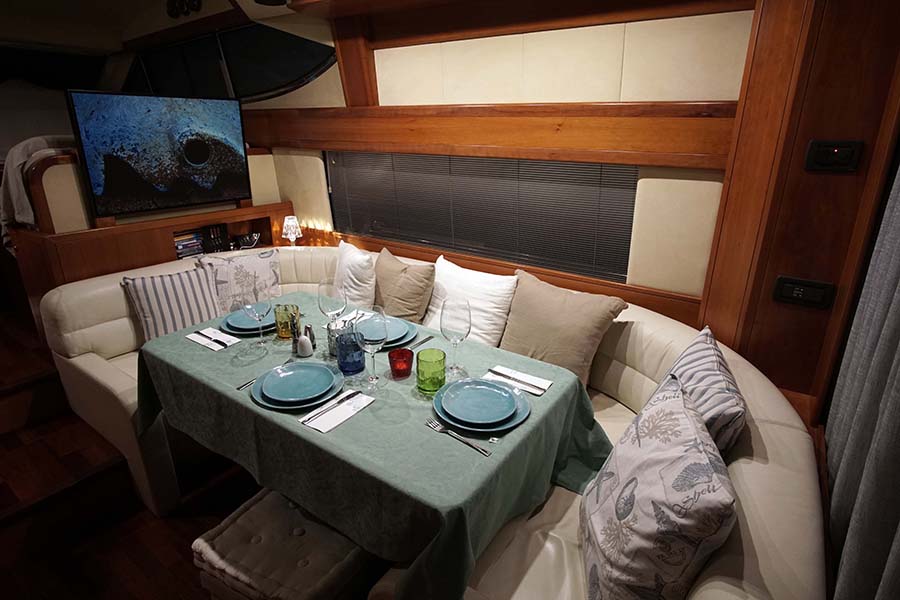
After all, would you dare serving BBQed sausages in this environment...? :cool:
sxzxa1Tu_o.jpg
 
OMDB, P. OMDB.
After all, would you dare serving BBQed sausages in this environment...? :cool:
sxzxa1Tu_o.jpg

You have obviously never sampled Boerewors.
On another note, I would be perhaps a bit more wary plugging a soundbar direct to battery without some sort of filtration. I suspect you may otherwise start picking up emi noises and other fluff.
 
Just be careful.

Some while back, Sky made just 1 model of satellite receiver that ran from "12V" they instantly became popular with caravan and motorhome owners. Almost as quickly it became apparent that 14V would fry them. So okay in a motorhome as long as you unplug it before starting the engine.

Your 24V is likely to be anything up to almost 28V with the engine(s) running which may or may not bother the sound bar.
 
No I wouldn't simply plug it in Mapis, as you say the DC is variable and they can be delicate or sensitive with over voltage or surges, but you do have simple options to make it viable and safe.

You need a regulated voltage and you can do this in several ways, with your AC to DC convertor it will be regulated with overvoltage protection using an on board detection system, or external detection system externally to the main circuit board chip.

These work I several ways and one is purely voltage protection, the other is current protection, while the other is a combined voltage and current protection, depending on the circuit board chip being used, I would suggest protecting voltage and current as the on board chipset can give both for little extra cost. Thermal overload is virtually standard these days, but check it has it especially if it is an Asian built unit as they do tend to skimp on occasions.

Other considerations, they have a maximum current/voltage rating and it is essential to check these as can vary wildly, they will have a maximum current rating and note this is only the maximum rating and is time limited such as for 10 seconds to allow whatever it is driving to power up and then there is the continual current rating which is the maximum continual current it can deliver and will be significantly lower then the time limited maximum current rating. Basically you may find a unit rated as a 10 amp rated current in its advertising and while it will deliver 10 amps for a limited time, its maximum continual current rating may only be around 6-7 amps so check its specifications carefully and if in doubt don't buy it.

One other thing to check is the maximum input voltage rating as these vary wildly, consider your batteries may provide slightly over 25 volts while at idle, but with your engines running or your shore power connected, you would be close to 30 volts across the batteries to charge them, so ensure your input voltage rating is around the 35 volts mark as this is pretty standard with power electronics used in DC/DC convertors as you wouldn't want to scorch your scatter cushions would you.
 
Just looking at one of our suppliers.

AC/DC convertor, voltage/current/thermal protection with 5 amp continual output @ 24 volts £3.22

DC/DC convertor, voltage/current/thermal shutdown protection, 7 amp continual output with 12 amps maximum output for 15 seconds; maximum input voltage 40 volts @ 24 volts output £5.85

Gives you an idea of what is out there at what price.
 
For the record, are electric grills OK and is it just BBQ's with coals that you don't like? I dream of owning a boat with one of those electric grill things :).
Actually, it's not that I don't "like" coals BBQ. It just happens to be the cooking method which produces more AGEs (just google for AGEs + BBQ, you'll be overwhelmed by the evidence), which are nasty for health.
Back to your question, as I understand AGEs generation happens with any dry heating at high temperature of animal-derived food, so I'm afraid that also electric grills should be blamed.
Maybe not as much as BBQs though, if nothing else because with electric grills it's easier to control the temperature, hence "burning" less the food surface, which is the main AGEs culprit - but I'm now just guessing.
Regardless, swmbo since several years discovered just about the opposite of BBQs, i.e. the so called "slow cooking", in low temperature pans where food is cooked at 70°C or so.
It takes a lot of time of course, but don't be mistaken: some low temp recipes are absolutely delicious, and leave nothing to be desired vs. BBQs, grills, etc. - it's no coincidence that also starred restaurants are increasingly using this method in recent years. :encouragement:
 
Last edited:
Thanks everybody for the suggestions. I like the idea of DC/DC convertors better than using the AC/DC supplied with the thing, in principle.

Ref...
Just looking at one of our suppliers.
...can you possibly post a link, Assassin?

The eBay ad posted by Vas was already along the same lines, with a 9-40V to 24V 6A sold at 28.80 quid, but aside from the somewhat higher price, if you are already aware of a source whose products are reliable and "scatter cushion compliant" (:D), I'd rather go for it...
 
Actually, it's not that I don't "like" coals BBQ. It just happens to be the cooking method which produces more AGEs (just google for AGEs + BBQ, you'll be overwhelmed by the evidence), which are nasty for health.
Back to your question, as I understand AGEs generation happens with any dry heating at high temperature of animal-derived food, so I'm afraid that also electric grills should be blamed.
Maybe not as much as BBQs though, if nothing else because with electric grills it's easier to control the temperature, hence "burning" less the food surface, which is the main AGEs culprit - but I'm now just guessing.
Regardless, swmbo since several years discovered just about the opposite of BBQs, i.e. the so called "slow cooking", in low temperature pans where food is cooked at 70°C or so.
It takes a lot of time of course, but don't be mistaken: some low temp recipes are absolutely delicious, and leave nothing to be desired vs. BBQs, grills, etc. - it's no coincidence that also starred restaurants are increasingly using this method in recent years. :encouragement:

Ahh, and now you have discovered another Saffer delight, the Potjie pot.
 
I could supply plenty but they are so abundant and variable in specifications and quality that it would be more prudent to do your own research and find exactly what you want to meet your requirements and specifications for your sound bar and choose from there, looking at our catalogue it is for trade only with quantity discounts applied for us as a trade/business user, and without knowing the exact requirements of your sound bar and its requirements it would be irresponsible for me to recommend something which may not be appropriate for your use and I wont accept liability for scorched cushions.
 
I could supply plenty but they are so abundant and variable in specifications and quality that it would be more prudent to do your own research and find exactly what you want to meet your requirements and specifications for your sound bar and choose from there, looking at our catalogue it is for trade only with quantity discounts applied for us as a trade/business user, and without knowing the exact requirements of your sound bar and its requirements it would be irresponsible for me to recommend something which may not be appropriate for your use and I wont accept liability for scorched cushions.

Strong chance that something you can buy for a fiver in the trade could easily become 25 quid or so, once it's passed through a few hands and had a bit of packaging added.
 
Actually, it's not that I don't "like" coals BBQ. It just happens to be the cooking method which produces more AGEs (just google for AGEs + BBQ, you'll be overwhelmed by the evidence), which are nasty for health.
Back to your question, as I understand AGEs generation happens with any dry heating at high temperature of animal-derived food, so I'm afraid that also electric grills should be blamed.
Maybe not as much as BBQs though, if nothing else because with electric grills it's easier to control the temperature, hence "burning" less the food surface, which is the main AGEs culprit - but I'm now just guessing.
Regardless, swmbo since several years discovered just about the opposite of BBQs, i.e. the so called "slow cooking", in low temperature pans where food is cooked at 70°C or so.
It takes a lot of time of course, but don't be mistaken: some low temp recipes are absolutely delicious, and leave nothing to be desired vs. BBQs, grills, etc. - it's no coincidence that also starred restaurants are increasingly using this method in recent years. :encouragement:

Yes, slow cookers create great food, tender meat, with little effort, especially winter comfort food. Set and forget, go to work etc., practical and functional.
BBQ's are more a social statement, the male domain, a beer in one hand and tongs in the other, getting distracted and burning the meat :)
 
I am thinking to add a soundbar to the onboard TV, and I just realized that the one I'm considering is actually 24V DC powered, through an AC/DC Adapter.
Hence the question, as per title: do you think that a straight connection to the boat 24V DC circuit (whose voltage is obviously variable, from 25 to 28 or so, depending on the status of the battery charger) would be ok, or could that damage the internal amplifier/circuits?
Of course I could keep the supplied adapter, connecting it to an AC socket powered through an inverter, but I'm a fan of the KISS principle, whenever applicable... :)

A link to the specific device would help a lot with this... But. 24V equipment is almost certainly aimed at vehicles, a sound bar is most likely intended for an RV (that motorhome++ for us Limeys). As such then they will be designed to be tolerant of vehicle electrics.
 
Top