Power to NMEA 2000 network when already present from Seatalkng

SimonNZ

Active Member
Joined
18 Apr 2022
Messages
59
Visit site
Hi all

I've got SeaTalk devices into a Raymarine E22158 SeaTalkng converter. From there, a SeaTalkng to NMEA 2000 converter cable to my NMEA 2000 backbone. There's no SeaTalkng network as such beyond the converter.

The manual for the converter states it must be powered once, not more - but the SeaTalk network gets all its power from an old Autohelm computer which I don't really want to be powering later devices on the NMEA 2000 backbone.

At the moment the only devices on the NMEA 2000 backbone are a Lowrance display and an AIS transceiver, both of which have their own 12v supplies so it hasn't mattered yet - they aren't taking power from the backdone.

Can I safely add 12v to the NMEA 2000 backbone, or do I need a power isolator where the backbone connects to the converter cable?

cheers!

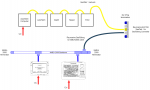
NMEA 2000 (2).png
 
There is a switch on the Autohelm to turn power off to the Seatalk network, turn it off. Add a fused power cable to either, one of the STNG ports on the convertor, or to the N2K network.

This will power the wind, depth and speed displays. The plotter and AIS will not take power from the N2K network.
 
Thanks very much Paul.

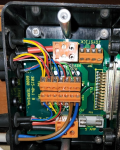
On the ST6000 course computer I can't find a switch to control power to the Seatalk network. Picture of the terminal board here; the Seatalk connector is the block at the upper left of the middle row of terminals, with two sets of yellow, red and bare cables connected (one goes aft to the cockpit devices, one forward to the nav station where the kit there is disconnected).

2.png

I've checked the manual but could have missed something. Your suggestion would be my preferred approach, with all devices powered from NMEA 2000.
 
Ah - you’ll see from my other post that I’ve probably done it wrong! It’s worked for nearly four years so I’ll leave it alone though.
 
I haven't tested yet, but another consideration is exactly what you said previously; timing of the AutoHelm controller start.

Another option seems to be a power isolator between the NMEA 2000 backbone and the SeaTalkng converter. That would mean all the SeaTalk1 kit is sharing one power supply from the AutoHelm computer, and all the NMEA 2000 kit is powered (if it's powered from the bus) from the backbone supply. That to me feels a bit more logical, if a bit messier.

Something else to note: my wiring is incorrect, as corrected here: Raymarine SeaTalk 1 to SeaTalkng & NMEA 2000 - Marine How To (which also notes Paul's approach of disconnecting the red Seatalk power wire).

My wiring has terminators on the converter - but it should only have one if I place it at the end of the backbone, or none if it's a drop device from the NMEA backbone. This is the new likely layout I'll set up, and I'll test the power approaches.


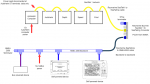
NMEA 2000 (2).png
 
I think you also need to put a blanking plug into the unused ng port on the converter (black one).
 
I haven't tested yet, but another consideration is exactly what you said previously; timing of the AutoHelm controller start.

Another option seems to be a power isolator between the NMEA 2000 backbone and the SeaTalkng converter. That would mean all the SeaTalk1 kit is sharing one power supply from the AutoHelm computer, and all the NMEA 2000 kit is powered (if it's powered from the bus) from the backbone supply. That to me feels a bit more logical, if a bit messier.

Something else to note: my wiring is incorrect, as corrected here: Raymarine SeaTalk 1 to SeaTalkng & NMEA 2000 - Marine How To (which also notes Paul's approach of disconnecting the red Seatalk power wire).

My wiring has terminators on the converter - but it should only have one if I place it at the end of the backbone, or none if it's a drop device from the NMEA backbone. This is the new likely layout I'll set up, and I'll test the power approaches.


View attachment 135101

This is incorrect.

Terminate one end of the STNG convertor, connect a STNG backbone to N2K cable to the other end of the STNG convertor then terminate the far end of the N2K network.

Also, you cannot split the power as you describe, you should only have a single power supply to the network. With things correctly connected, as above, the STNG and N2K components form a single network, do not get confused by the fact they use different connectors and cables, it's just one network. If you connect the power cable as i previously described, it will all work fine. With the network powered up your N2K sensors etc will work, the autohelm screen will be on, but doing nothing and the autohelm itself will be off, it cannot draw power from the network. To use the autohelm you obviously need the network turned on as well as the autohelm.
 
Last edited:
At the moment the only devices on the NMEA 2000 backbone are a Lowrance display and an AIS transceiver, both of which have their own 12v supplies so it hasn't mattered yet - they aren't taking power from the backbone.
My em-trak 9xx AIS and B&G Vulcan chartplotter are both powered, but the Vulcan didn't accept NMEA 2000 data from the em-trak until a T with power was added to the NMEA 2000 backbone. Did you find different, please?
 
Something else to note: my wiring is incorrect, as corrected here: Raymarine SeaTalk 1 to SeaTalkng & NMEA 2000 - Marine How To (which also notes Paul's approach of disconnecting the red Seatalk power wire).

According to Raymarine's forum, it shouldn't be wired as you have it in your diagram and as suggested on the website you link. As PaulRainbow says, the Seatalk1 to SeatalkNG adaptor should be connected as part of the backbone - someone asked this question specifically on the old Raymarine forum in this thread about that converter: Connecting SeaTalk1 and NMEA2000 using the SeaTalk Converter

They don't elaborate as to why, but it's probably because the STNG-ST1 converter includes a section of backbone that would be otherwise unterminated. You can get a ready made cable to convert between the STNG and Devicenet backbone connectors - Raymarine part nos A80674 or A80675 depending on whether you need a plug or socket.
 
This is all great info, thank you!

OK, backbone to backbone. Do the blue terminals act as the ends of that 'internal' backbone, so they're the ones that go either to termination or, if the converter sits in the middle of an NMEA 2000 network, to the NMEA 2000 network either side of the converter?

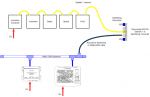
If that's the case I guess the white connectors are for devices spurred off the SeaTalkng network, in which case is this latest diagram correct?

* I appreciate SeaTalkng is NMEA 2000 with different physical connectors, I'm just using the terms for simplicity.


NMEA 2000 (2).png
 
Yes that looks correct. The white connnectors are for spurs and can remain empty. They supply some black blanking plugs for unused spur connections but they are just dust covers and not needed electrically. The way you have the terminators there is correct - only two are required, one at each end of the backbone.
 
Brilliant.

I had the wrong cable, somehow - not exactly sure, but I think I had a spur type cable designed to join NMEA 2000 like a drop, but I need the backbone type cable to wire this way.
Local dealer is sending me the right cable so I can try it all the correct way.

It actually seems to work OK at the moment, before re-wiring correctly, but I'm sure once I introduce more devices and gain complexity, we'd start to see odd behaviour. It's great to get it all correct from the start.
 
Aren't backbone cables and drop cables just the same?

T's are male on one side and female on the other - thus T's can be connected directly to each other without a cable between them, and also the backbone has a male end and a female end. I feel like this is potentially confusing, until you realise to expect it.

Correspondingly, terminators are available in male and female versions - one of each must be used (or they can be replaced with inline terminators).

The leg of the T is female and the back of my chart plotter is male, thus all drop cables have a male end and a female end too.

This is ignoring SeatalkNG though, which I'm less familiar with.

The Garmin NMEA 2000 Network Fundamentals PDF is quite good.
 
Helpful notes, thanks.

I believe they're electrically the same and don't know why I needed a new cable - it was the dealers suggestion! I'll know more when it arrives - I reckon, being Raymarine, it'll be thicker - because their backbones are thicker - and with a blue end rather than white.

Some (if not all?) manufacturers have thicker cables available that are intended for use as backbones, with less voltage drop over distance.

Side note: when I first ran my NMEA backbone I couldn't discover a standard direction - do you run the first backbone male end forward, or female end forward? I went with male forward - pointy cable end to pointy boat end. Or visualise the backbone as an arrow pointing forward. Best I could come up with!
 
N2K backbone and spur/drop cables are the same, but spur/drop cables have shorter maximum lengths than backbone cables.

STNG backbone and spur cables are different to one another, easy to spot as they are different colours.

Doesn't matter which way you run the backbone.
 
Top