Portsmouth Harbour submarine defence

Nigbb

Well-Known Member
Joined
28 Dec 2021
Messages
97
Visit site
Hi, can anyone please tell me how much water there is through the marked channel in the submarine barrier low tide?
Was it removed down to the seabed or is there still something there?
Obviously I realise it will depend on the height of the tide.

Thanks
 
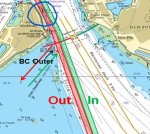
There are actually two channels, one in the middle, and one close to the shore.
I wouldn't use the one close to the shore at low tide, that's not a good idea.

I've never seen anything less than a couple of metres through the middle channel.
But the chart does show slightly lower depths, a bit more than 1.5m.
Bottom end of a big spring tide could change that, in which case go around Horse Sand Fort.

Upper end of a decent high tide you can go straight over the barrier anyway :devilish:
 
Navionics shows charted depths of circa 1.5 to 1.7m around the middle boat channel but who know when that was last surveyed so who knows how reliable or accurate it is. As to what was removed or what remains that is unclear, it might be covered in Solent Hazards the Peter Bruce book.
 
There are actually two channels, one in the middle, and one close to the shore.
I wouldn't use the one close to the shore at low tide, that's not a good idea.

I've never seen anything less than a couple of metres through the middle channel.
But the chart does show slightly lower depths, a bit more than 1.5m.
Bottom end of a big spring tide could change that, in which case go around Horse Sand Fort.

Upper end of a decent high tide you can go straight over the barrier anyway :devilish:
OK thanks, yes I was referring to the one in the middle. We are 1.1m so should be fine at any tide.
Cheers Nigel
 
Navionics shows charted depths of circa 1.5 to 1.7m around the middle boat channel but who know when that was last surveyed so who knows how reliable or accurate it is. As to what was removed or what remains that is unclear, it might be covered in Solent Hazards the Peter Bruce book.
Thanks, on SaviNavi it does not give a depth, we only draw 1.1m so all good at any tide I think.
Cheers Nigel
 
Don’t go over the submarine barrier at any tide as SC 35 suggest, unless your in a rowing boat…….

Many have done this, and very few have come to grief.
It does depend on the conditions.
If there is a 2m swell running then it’s clearly not a good idea.

You can check it out at low tide: see the tops of the blocks in relation to the middle passage markers, then make your own call. On a spring high, there will be something like 2m+ of water above the blocks.
 
Last edited:
SC35 could be local, or could even be a seasoned navigator..? yet despite both possibilities a boat owner should adhere to a common sense approach to safe navigation, both QHM & charts show & advise to use the safety of the deep offshore & shallow inshore water navigation passageways, that’s why they are there. The blocks are not all at the same level or spacing now & still have the ability to offer a surprise if note is taken from any irresponsible comments to cross the submerged barrier, even on the highest tide. Remember the barrier was put there in the first place to stop vessels crossing….!!!
 
Last edited:
Many have done this, and very few have come to grief.
It does depend on the conditions.
If there is a 2m swell running then it’s clearly not a good idea.

You can check it out at low tide: see the tops of the blocks in relation to the middle passage markers, then make your own call. On a spring high, there will be a bit less than 2m of water above the blocks.

I would also put my voice to NOT going over the barrier at any state of tide, use the designated gaps. I remember the start of the 2008 Round Britain power boat race when some high profile people got caught out.

There is no excuse for ignoring charts and you will look pretty stupid come insurance claim time when you state that you knew it was there but some bloke on an internet forum said you’d be fine.
 
I didn't say it was fine, I said it was possible at the upper end of a high tide in flat conditions, which it is.
Ignoring charts is one thing, leveraging local knowledge to achieve a shorter passage with known depths and boat draught is something else.

I often see RIBS or smaller powerboats go straight across at high tide, and if they were hitting the barrier on a regular basis, we would probably hear about it.

Round Britain 2008 was very unfortunate, it was blowy, it wasn't high tide, but you couldn't easily see the blocks either, and they were marshalled into the area NE of Horse Sand Fort which wasn't a good idea.

Having said that, Best Practice is to use the middle charted gap or go around if there is any uncertainty.
As above, you'll look pretty daft filling out the insurance claim form if you get it wrong.

The inner passage is also "possible", but you'll find less than a metre of water there at low tide.
But at least you can see the blocks :devilish:
 
Last edited:
I would also put my voice to NOT going over the barrier at any state of tide, use the designated gaps. I remember the start of the 2008 Round Britain power boat race when some high profile people got caught out.

There is no excuse for ignoring charts and you will look pretty stupid come insurance claim time when you state that you knew it was there but some bloke on an internet forum said you’d be fine.
I did this once by mistake, pilot(age) error; I wasn't where I thought I was not helped by the Garmin chartplotter removing the feature at all except the most zoomed levels. Got away with it. After I realised what had happened I nearly sh*t myself.
 
SC35 could be local, or could even be a seasoned navigator..? yet despite both possibilities a boat owner should adhere to a common sense approach to safe navigation, both QHM & charts show & advise to use the safety of the deep offshore & shallow inshore water navigation passageways, that’s why they are there. The blocks are not all at the same level or spacing now & still have the ability to offer a surprise if note is taken from any irresponsible comments to cross the submerged barrier, even on the highest tide. Remember the barrier was put there in the first place to stop vessels crossing….!!!

That inshore passage gets very shallow at times, and is entirely unsuitable for navigation for most vessels at anything other than mid to high tide, despite being marked as a viable passage.

Charts are always correct, right?
The community edits on the latest charts are improving things.
But for example, the entrance to Chichester Harbour keeps moving around, the charts are always a bit behind where the shoaling actually is,

Following the chart is the best you can do if you haven't been somewhere before.
But pottering around in a tender at low tide can show up some differences.
 
Last edited:
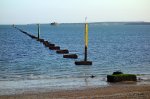
You can see from the yellow pole roughly how much water you have to play with at high tide: enough for a RIB or a small powerboat but not enough for a fin keel sailing yacht.

The blocks generally go a little deeper as you go further offshore.

To me it's the same as any other charted hazard: if you are confident that it will be safe for your boat at a particular tide state and weather condition you can go over it: if there is uncertainty, you should go around it.


10040637945_0db0024b94_h.jpg
 
Last edited:
SC35, you commented you can cross the submarine barrier on the upper end of a decent high tide, but the majority of navigators would wish to eliminate risk & usimg & taking note of info provided on charts printed by one of the best hydrographic offices in the world, on which obstructions & lowest chart datum are given, same as plotters, one also has the ability to use eyesight & common sense as the risk in your picture will indicate, but if in doubt call QHM on channel 11, tell them where one intends to cross the barrier, once they stop laughing they may ask if you have life jackets on board, but pretty sure they will send a police launch after the event for the rescue & to mark the possible wreck. LoL
 
Last edited:
QHM published a guidance chart for the Portsmouth Harbour small boat channel that showed it going very close to rocks.
I wrote in, and they amended it. QHM are very good, but they don't always get it right.

But anyway, that is not the point ... the hazard is correctly marked, small boats cross the submarine barrier at high tide regularly without hitting it, and everyone is free to make a judgement call as to whether they can do the same thing or use the passages, or go around.
Same as fishing boats around the rocks on the East corner of the IOW.
They know what they are doing - if you don't, then steer clear and go around or use the middle passage.

It's really not such a difficult concept.
 
Last edited:
You can see from the yellow pole roughly how much water you have to play with at high tide: enough for a RIB or a small powerboat but not enough for a fin keel sailing yacht.

The blocks generally go a little deeper as you go further offshore.

To me it's the same as any other charted hazard: if you are confident that it will be safe for your boat at a particular tide state and weather condition you can go over it: if there is uncertainty, you should go around it.


View attachment 136035
Used to go to the beach here as kids back in the 60s and 70s and swim out to the blocks and back. Happy days. I always take my yacht though the gap or round the fort just in case.
 
Top