Polyster or Epoxy resin for under waterline repair? (for repair on the hole in my hull - viewable in my shotblasting post)

UK-WOOZY

Well-Known Member
Joined
7 Feb 2015
Messages
1,152
Location
medway river
Visit site
Antifoul removal required please in Kent, near dartford (as soon as possible)

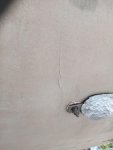
After the anti foul removal there was a hairline crack which i ground back and unfortuanetly it was all the way into the glass with about a millimeter separating the crack from the inside, the glass in this area wasnt as thick as i thought it would be on a 1988 boat.

I have been searching for people to do the repair, i dont want to tackle it as no experience, wouldnt mind having a go if it wasnt below the waterline.

I have found two people that said they can (Constant Fiberglass in Crayford and another club member) but both would use Polyester resin... Others have told me not to use Polyester and powdered matting for the area but to use bi-axial/cross weaved and epoxy for this area. EDIT: GelNShine in Essex said he can do the work too, hes done the hull hairline cracks before and said he would also use Polyester as the hull is Polyester.

this facebook member on the Jeanneau Owners page reached out to me and has called me and spoken to me and gave lots of advice on messenger to use SP106 epoxy and the biaxial and is willing to do the job for me, but currently lives in Crewe, a 200 mile journey. Im leaning towards using him (https://www.facebook.com/kostas.kordakis) He also said using acetone isnt good for cleaning the area as it affects the bonding of epoxy,


After the repair is done I will be using a barrier coat using 5 coats before copper coating.

Thoughts from the experts here please! Many thanks.
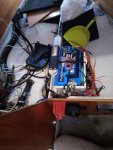
IMG_20200612_103924.jpg

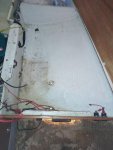
IMG_20200613_144024.jpg

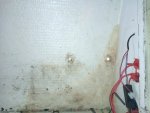
FB_IMG_1592071942498.jpg


yyyyy.jpg

IMG_20200614_161443.jpgIMG_20200614_161507.jpg
 
Last edited:
I've always understood that polyester doesn't stick to old polyester as well as epoxy does, so a polyester repair can't match what was there in the first place as that was chemically bonded wet. Aside of that I've also always understood that epoxy is stronger and more water resistant.
 
ok, you two have confirmed my suspicion. 2 business have so far offered to do the work with polyester, only one other with epoxy but they arent a business, hes a person that contacted me via jeanneaus facebook owners page

if only i could find someone to do the work with epoxy nearer to me
 
Pro's will quite possibly do that with polyester.
It looks a big job though.
You probably need to seriously check around that bulkhead to be sure its bonding to the hull is good.
You may need significant reinforcement inside.
You might want to know how the damage happened and have someone look over the rest of the boat.

I think you should get a pro to look at it and give a proper method statement.
Ask to see their work or get references?
I know of boats which have been osmosis treated using epoxy and glass cloth instead of just resin, so maybe you could get some reinforcement outside over a large area or the whole hull, combining the repair with the coating process.
 
Although I believe epoxy is better I have seen and done underwater repairs with polyester and not seen negative results. One, a 32ft FV went ashore and was taken back to the hull moulder's works (Cygnus ). After sheeting in and dehumidifying, about 10 feet of one side was removed, a new section moulded and shot in. Of course the new moulding offered a chemical bond. She's still going 25 years on.
 
Woah!
Before you do anything you need to work out what the hell happened.
Cracks like thet don't just occur.
Was it bad chocking in a cradle, did you hit something, was it slung badly, did it dry out on a post?
Get a surveyer to look because this has insurance written all over it as this could be more significant than a little hole.
Will it happen again on the other side, etc etc.

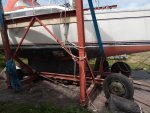
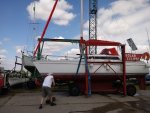
Looking at the photo below my guess is the cradle prop was either a foot forward or aft of the crack.
The hull cracked on the hardpoint (bulkhead)
index.php


As far as the fix is concerned, the location being aft lower qtr,
Epoxy is the only sensible solution and as said above, inside needs beefing up.
A few layers to fair in the hull on the outside but you add the strength on the inside.

However you really need a good surveyor to check it out.
 
to clarify there was not a hole before i ground the crack out, the crack ended before the inside but not by much. Im suspecting the crack was caused by the strops being in the wrong place, either at my club or before i got her almost 3 years ago at a different place. this is how she was supported on her trailer at my club this year, and last year.

IMG_20200425_164544.jpg

IMG_20200425_164516.jpg

IMG_20200526_150411.jpg


hhh.jpeg

20597225_10212904268500033_1438679384783477181_n.jpg

hard to know when it happened, she had many layers of antifoul over that area. possibly straps though, i also kept my tool bag in the rear cabin entrance next to the bulkead, maybe it was the weight of all the tools. dunno. i had a survey on the boat after buying her but cannot afford yet another survey on top of other works
 
Is it possible the sling sat on the anode applying untoward pressure?
Hulls really aren't supposed to fail this way though...unless there is faulty layup, or something else out of order. your surveyor should have sounded the hull and found this if it was there. She must have had a nudge of some sort, insurance job.
How far did she go on the lorry with the four supports?
Sorry to suggest it's not a simple patch repair.
 
The crack has occurred on a hard point (where the bulkhead is, and has most likely occurred due to flexing of the hull around the hard point. So the first thing you need to do is stiffen the hull around the hard point on the inside to stop the flexing. To do this, you need to get some bi-axial cloth down either side of the bulkhead, and wrap the glass up the bulkhead for a couple of inches to get it all bonded together and stiff. Then you can fill from underneath with a resin filler (use something like SP microfibres mixed with resin, or if you want to be really lazy, you can use Isopon P40), and then cover the outside with a couple of layers of woven rovings (bi-axial again).

As far as the resin is concerned, it makes no difference what you use. As the boat is built with polyester resin, then I would use that. The only downside is that it does give off quite a pong. What's important is the cloth you use, as that's what creates the strength, not the resin. The resin is simply there to bind the cloth together.
 
I 've done plenty of repairs in the underwater part of the hull with polyester. If the repair is coated with an epoxy barrier primer there is no problem at all. Polyester is thixotropic and that means that it will stay in the reinforcing material of your choice until it cures. I don't trust epoxy resins to stay in place unless the repair is done with a vacuum bag. Epoxy needs hours before it gels so gravity has enough time to work it out of the material...
About strength, epoxy maybe be more strong, but polyester is not weak either- and its more than enough for a job like this.
 
The crack has occurred on a hard point (where the bulkhead is, and has most likely occurred due to flexing of the hull around the hard point. So the first thing you need to do is stiffen the hull around the hard point on the inside to stop the flexing. To do this, you need to get some bi-axial cloth down either side of the bulkhead, and wrap the glass up the bulkhead for a couple of inches to get it all bonded together and stiff. Then you can fill from underneath with a resin filler (use something like SP microfibres mixed with resin, or if you want to be really lazy, you can use Isopon P40), and then cover the outside with a couple of layers of woven rovings (bi-axial again).

As far as the resin is concerned, it makes no difference what you use. As the boat is built with polyester resin, then I would use that. The only downside is that it does give off quite a pong. What's important is the cloth you use, as that's what creates the strength, not the resin. The resin is simply there to bind the cloth together.
The danger with this is that it might be plenty strong enough, but it runs the risk of being obvious to subsequent buyers/surveyors as patch repair.

When it comes to making a good job of it, dead right it's not so much about the resin. Operator skill and working conditions are very important. Ideally it wants to be indoors. Luckily, it's summer. You need all that GRP dry. You need a good plan. Working overhead with heavy rovings is difficult. Working inside around that bulkhead could create a weak line at the bulkhead. How hard would it be to remove and replace that bulkhead?

I don't like the look of the supports on the lorry. If it was insured by the OP then, and is still insured by the same people now, might a claim be possible?
 
Can someone explain why wagon drivers always seem to put loads outside of the wheelbase?
It looks to me as though, whilst making the steering lighter, it will have a strong pendulum effect and help in making the load less stable.
 
It doesn't take much to crack a hull against a hard point. Years ago I had it happen on a 27 foot boat simply because a fender happened to be placed right next to a bulkhead and the scissor effect was enough to put a vertical 2 foot crack down the topside.
 
Looks to be really badly supported on that cradle with the keel off the ground.
Many years ago a fellow club member proudly showed me his Trapper 28 supported solely by four acrow props so that he could A/F the bottom of his keel. He remarked that it was supported like it was in the sea. He seemed surprised when I pointed out that there it was supported across its entire underwater surface area whereas here it was supported by less than two square feet of hard wooden pad.
 
View attachment 92824

View attachment 92825

when the boat was back at burnham on crouch when we purchased her-

View attachment 92826
I suspect that cradle was the start of it, all the weight concentrated on the four points. One of them near to the damage and the hardpoint which is the bulkhead. Normally the lift drops the boat on to the keel which takes most of the weight, then the props take a bit of the weight. Take note of Javelin, he is the sharp cooky who works in the boatyard and does articles on work such as this for PBO.
 
Top