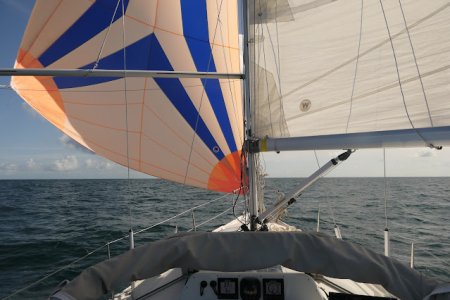
Poling out the genoa - hints and tips please?

wonkywinch

Well-Known Member
Joined
30 Jul 2018
Messages
3,819
Location
Hamble, UK
Visit site
I'm looking at options to improve our sailing on a broad reach/run without buying an assymetric. Our Beneteau 38 has a c 110% genoa ie it comes back to the shrouds when sheeted in tight.

As we mostly sail shorthanded and everything is currently set up in the cockpit (in mast furling main and furling genoa) and I don't want additional hassle of a spinnaker or assymetric, I wondered whether a pole would be a good investment.

Here's the rub - I don't really like sailing on a dead run, it makes me seasick so would rather head up a little onto a broad reach and gybe if necessary. So, is it still worth poling out the genoa if the sails are on the same tack? Our genoa will often flap and sag as the AWS increases and it's sheltered by the main.

Any suggestions? Furl the main and sail on genoa alone with/without pole at 150/160AWA? Man up, buy a pole, take some stugeron, and goosewing?

I found a useful page at Whisker Pole Seminar but it emphasises keeping the pole in line (and as an opposite extension of) the boom.
 
Should you decide to pole it out, I d suggest to keep the genoa sheet mechanically independent from the pole end, in other words try and keep the possibility of furling/trimming the sail without having to maneuver all the pole rope parafernalia, the pole remains in its position while you first do whatever you want with the sail -sometimes it has to be quick, very-, then take care of the pole.
 
If you're planning on doing lots of broad reaching, you don't necessarily need a pole to stabilise the genoa. I sometimes run the sheet via a carabineer and block on the boom end. This really helps to keep the leech open and basically does the same job as the pole would, but it's much easier to set up. It's essentially a barber hauler but pulling outwards.
 
A Barber hauler to gunwhale outboard and forward of sheeting point might stabilise the jib when running and broad reaching. Run the jib sheet through a ring which is attached to the barber hauler which itself returns to cockpit makes very easy set and gybing.
However a pole can do better. On the leeward side it will pull the jib clew outwards and enable sheet to be tightened to get all of the jib working. Pole not too long.

On the windward side it is meant to hold jib out to catch wind but not sheltered by main sail. Here a longer pole can force jib out further. However a shorter pole can stabilise the jib and prove useful. The thing is a short pole can be quite light but a longer pole will need to be stronger.
Now the pole can have a beak fitting on the end to clip sheet into. A similar fitting on the other end might fit a ring on the front of the mast.
The pole ideally should have topping lift. A guy up to half way up mast. (try a fixed length guy) This can aid adjustment in light winds but also can take the weight of the pole when handling it into position. (ie can't be dropped over board)
You might like to experiment with a sheave on the end of the pole and a line like a barber hauler so you can adjust just how far out you want the sheet.
Or just get a piece of wind surfer mast and experiment with a shorter pole.
All good for experimentation. ol'will
 
If you're planning on doing lots of broad reaching, you don't necessarily need a pole to stabilise the genoa. I sometimes run the sheet via a carabineer and block on the boom end. This really helps to keep the leech open and basically does the same job as the pole would, but it's much easier to set up. It's essentially a barber hauler but pulling outwards.
Seems like a good idea.

Naive question: I assume you have to take it off if you want to gybe or tack, so its only suitable if you are going to be on the reach for some time?
 
The whole issue of poling out is discussed here.

 
RE: Our genoa will often flap and sag as the AWS increases and it's sheltered by the main.

You have an in mast mainsail furler.
When you are broad reaching and the genoa sags, you have the option of furling the main until it is not windshadowing the genoa.
Maybe, you will end up with just the genoa or you could have half a main and half the genoa.
I say experiment with what you have before looking for extra gear.

gary
 
If venturing down this route a few thoughts for peaceful experience hopefully
1 do it out of confined areas of Solent-there’s nothing more annoying than setting up than to have some idiot tacking up to close just because they claim to be racing and you will be windward boat of course -usually in a Sunsail type boat at back of fleet play this type of game as they don’t own vessel
2 have a preventer on main boom well set up-winchard type slowing down helps but I guess you do/have this already;
3 don’t try out running through needles or other rough areas into Solent -any bounce is annoying plus you might find a ferry just where you want to be or small fleets of dinghies etc
4 look for day with just enough wind -it’s annoying when too little
5 as said try with a reduced main -inmast main furler might have this benefit
6 start by running on headsail alone with pole rigged but unattached and work out you will gybe pole -here the sea room helps of course
7 find a pole you could borrow?
8 try out with a windsurfer pole on light day-rather depends how easy to find
9 a return trip from Poole or Weymouth maybe in light breeze with 4 crew ?
Good luck and do post some pictures of set up in action.
 
Seems like a good idea.

Naive question: I assume you have to take it off if you want to gybe or tack, so its only suitable if you are going to be on the reach for some time?
The way I set it up is:
Block shackled to boom end.
Line run through block, with a large carabineer on one end, the other runs back along the boom and is made off on any convenient point.

Clip the carabineer to the genoa sheet. Let out boom to desired angle. Haul on line to bring carabineer up to boom end. Unfurl genoa and tension sheet.

To gybe the genoa, you need to let the tension off the hauler line and then unclip the carabineer. It only takes a few seconds and is far less effort than moving the pole around.

You could improve my setup quite a lot by using a snatch block instead of the carabineer, and perhaps leading the hauling line to a winch and cleat/clutch. That would allow you to easily make on the fly adjustments.

I hope I've managed to describe that reasonably well, it makes it sound more complicated than it is!
 
I'm looking at options to improve our sailing on a broad reach/run without buying an assymetric. Our Beneteau 38 has a c 110% genoa ie it comes back to the shrouds when sheeted in tight.

As we mostly sail shorthanded and everything is currently set up in the cockpit (in mast furling main and furling genoa) and I don't want additional hassle of a spinnaker or assymetric, I wondered whether a pole would be a good investment.

Here's the rub - I don't really like sailing on a dead run, it makes me seasick so would rather head up a little onto a broad reach and gybe if necessary. So, is it still worth poling out the genoa if the sails are on the same tack? Our genoa will often flap and sag as the AWS increases and it's sheltered by the main.

Any suggestions? Furl the main and sail on genoa alone with/without pole at 150/160AWA? Man up, buy a pole, take some stugeron, and goosewing?

I found a useful page at Whisker Pole Seminar but it emphasises keeping the pole in line (and as an opposite extension of) the boom.

‘Different strokes for different folks’….. BUT, sailing solo, on a Rassy 310 (105% genny) I am much happier popping the furling cruising chute (effectively a flying 150% genny) than I am rigging the pole.

The pole requiring cabin top action to rig and recover - even though it’s of the easy to deploy on mast variety. Whereas I can pick my time to clip/unclip the furler onto the mini ‘sprit, to deploy or recover the cruising chute. If I need to loose sail area / manoeuvre, in a hurry, with the chute I simply furl. With the pole out, I can furl the sail, but am left with a pole swinging about. I have sailed that way, once from midnight until dawn, but it didn’t feel very seaman like!

IMG_0309.jpeg

Having said that, a rig which works surprisingly well, in light airs, is the cruising chute poled to leeward, or goose winged. But I like plenty of sea room! Came over from St Vaast to Le Havre like that on Monday.

EDIT: I run the sheet through the, piston release, end fitting on the pole. So that I can furl the sail in the normal way. Or release the sheet by pulling the trigger line run from end to end on the pole.
 
Last edited:
I use poles when on a long broad reach or run. I set them up independent of the sail with a separate sheet. The sheet has a snapshackle and a long length of line on the pin so I can disengage the sheet from the sail in an instant, leaving the pole set up. Useful in the event of an emergency or when gybing. I use an uphaul and fore and aft downhauls to hold the pole in place. Add in a main boom gybe preventer and you dont want to be gybing or altering course too often!

I use a lightweight whisker pole for light winds/occasional use, with an uphaul and downhaul on bridles from the pole ends if needed.

I use snatch blocks and soft shackles with friction rings so I can position things wherever I want on the toerail.

As post #7 and #8 say, furling away some main is useful, even quite a lot. For me my genoa is larger than the main so keeping it filled is the priority.

I dont alter course to avoid a dead run. But I am a relatively slow boat so the shortest course is best. I often find its the underlying swell that can cause rolling if its at 45 or 90 degrees to the wind waves, especially near or around headlands.
 
‘I can furl the sail, but am left with a pole swinging about.
I only ever use the pole with an uphaul, fore guy, and aft guy. No swinging around involved. Guys are marked with whipping so that I can quickly and easily set it up.

I like my rigging, and I don't like the pole to be bouncing between the forestay and cap shroud...
 
If you are on that heading where the genoa is sometimes blanked by the main, you might consider sailing by the lee. It is surprising how far off dead downwind you can get with a poled out genoa in this fashion. Don't do it with the main though!

Otherwise, 'tacking' downwind takes bigger angles to fill sails than you really want at the time.
 
I only ever use the pole with an uphaul, fore guy, and aft guy. No swinging around involved. Guys are marked with whipping so that I can quickly and easily set it up.

I like my rigging, and I don't like the pole to be bouncing between the forestay and cap shroud...
This is great advice.
Also I find that it is best to furl the genoa when on the foredeck setting up the pole - then unfurl once back in the cockpit.

However, unless doing a longish offshore leg, in cruising mode we rarely bother with the pole in inshore waters. We have a biggish mainsail so if going dead downwind we often simply furl the narrowish jib if going dead downwind in any breeze. Will be near hull speed so jib makes little difference.
In lighter winds need to head up a bit and tack downwind anyway for best VMG.
Lazy sailing but with a biggish sail plan works well.
 
This is great advice.
Also I find that it is best to furl the genoa when on the foredeck setting up the pole - then unfurl once back in the cockpit.

However, unless doing a longish offshore leg, in cruising mode we rarely bother with the pole in inshore waters. We have a biggish mainsail so if going dead downwind we often simply furl the narrowish jib if going dead downwind in any breeze. Will be near hull speed so jib makes little difference.
In lighter winds need to head up a bit and tack downwind anyway for best VMG.
Lazy sailing but with a biggish sail plan works well.
The genoa is a much larger sail than the main (33.1 sq m vs 28.9 sq m for the main) and we are limited letting out the main fully as we have swept spreaders so need to keep the sail off them.
 
Who will make a case for a Reaching Strut...?
I use a permanently rigged selden carbon "fly away" jib pole, primary because of my dinghy like rig, with very swept spreaders makes dead down wind slow, and hard on mainsail wear. Pole allows much more effective wing on wing downwind, without pole, thej8b just hangs limp in lee of main, mostly.

This is also usable as a jib reaching strut, and is sometimes very effective. Particularly as my adjustable jib cars are on the cabin top, well inboard.

Even Cornish crabbers use flyaway jib poles, as above. Google it.
 
Last edited:
For short periods, ie an our or so, I just clip the pole to the bowline tying the sheet to the genoa. Furl the sail, set up, pull the penny sheet and unfurl. I also find poling out to leeward v effective on broad reaches. The more seamanlike set ups described are great if crossing the ocean , but are they really worth it for an hour or 2 in a sub 40' er
 
Top