
Polarity of JB 2E 105K Capacitor Polarity (Genuine Boaty Question)

cygnusv

Well-Known Member
Joined
12 Feb 2013
Messages
287
Location
Yorkshire, UK
www.best-camping-stoves.com
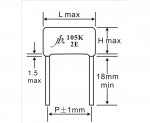
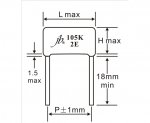
I'm working on a small project on my boat's 24 volt electronics. It calls for the inclusion of the capacitor shown below. I have the capacitor, but there is no visible identification of polarity. No markings of any type, posts are the same length. Can those of you who know these things please enlighten me which posts are Pos and Neg? Graphic of the capacitor below. Many thanks
1634486139112.jpeg
 

Attachments

  • 1634486139112.jpeg
    1634486139112.jpeg
    80 KB · Views: 12
Thank you VicS. It confused me when I read that AC capacitors had no polarity but DC ones had. I did wonder though....
It is the kind of capacitor that makes the difference - electrolytic capacitors must be connected the right way round, but with most (or possibly all) other kinds you can connect them however you want
 
Just to explain most simple capacitors are not polarised being essentially 2 plates with an insulator or even air between. However for large values of capacitance extra tricks are needed to get large values. Actual capacitance is a function of plate area and spacing of plates. Electrolytic capacitors get the large area by using an elecrolysing system to give a very thin layer of insulation. But this layer laid down by electrolysis depends on having correct polarity to maintain that insulating layer. Hence pos. and neg. leads.
Interesting that you can buy a 1 picofarrad capacitor right through to a 1 farrad capacitor. That is a huge range 1000000 to 1. I am not sure but I think Tantalum capacitors also use this electrolysis as they also are polarity sensitive. But they come in large values like 10 microfarrads.
Just what is a capacitor?
Electricity is flow or transfer of electrons along a conductor. One electron leaves it's own orbit and joins another atom's orbit. However an atom will not accept another electron until it is in the process of losing an electron. An atom will not let an electron go until it has a replacement coming in. So in an electrical circuit we must have a ring of electron motion from the motivating force (battery solar cell or magnetic field) right around to a resistance or similar that limits the electron flow but still allows it then back to the motivating source.
Now let us say that we have a circuit battery to lamp back to battery but we have a gap in the wiring. The battery gives a push and a pull and the electrons feel the pressure to march around but there is a gap. So nothing happens.
Not quite. If the gap is very close the pressure causes the electrons to kind of stretch towards the other side without actually flowing. Now the larger the area of electrons facing the other area of electrons on the other side the more this effect. It is such that electrons can actually move in to the plate on neg side and out of the plate on pos side. If it is close enough and big enough we can measure a current flow into this stretch for a time until the stretch has gone as far as it can go. Relatively large current which diminishes quickly. ( as an aside a capacitor has a voltage rating because the elecrons can actually jump across in an arc with ehat which melts everything)
Further if we disconnect our battery this stretch tension remains as a voltage across the gap. If current is allowed to flow out of the gap it will do so, large current then diminishing as tension is released.
In fact we have something like a battery storing charge. A battery capable of being charged very quickly in both polarities. This gives the impression that the capacitor can conduct AC but not DC. It also gives the possibility that across DC it can absorb some peak in voltage or replenish a drop in voltage say to a GPS at engine start providing there is some isolation in line.
But capacitors have a much wider range of uses in electronics and especially radio as the time for charge/discharge can be used to tune a frequency. But that gets complicated. ol'will just waffling.
 
Top