Photos - Canadian Coastguard vessel in rough seas....

Bajansailor

Well-Known Member
Joined
27 Dec 2004
Messages
6,563
Location
Marine Surveyor in Barbados
Visit site
I was sent these photos recently by a friend in Canada - they were apparently taken off Vancouver island :

CanadianCoastguard1.jpg


CanadianCoastguard2.jpg


CanadianCoastguard3.jpg


CanadianCoastguard4.jpg


CanadianCoastguard5.jpg


CanadianCoastguard6.jpg


I am sure that even the RNLI offshore boats would find these conditions somewhat interesting!
 
Fantastic photographs, thanks for sharing.

RNLI all weather boats just as capable, many of the worlds maritime rescue services send their crews to Poole (RNLI HQ) for training and their technical department is sub contracted to assist on design and techy stuff to many other institutions world wide.

Nevertheless those are hairy conditions in any mobo vessel, there is a video on you tube somewhere with the US coasties turning similar type vessel over in same sort of conditions, all done deliberatly to let new coxswains experience what it is like.
 
Hi

Great pictures.

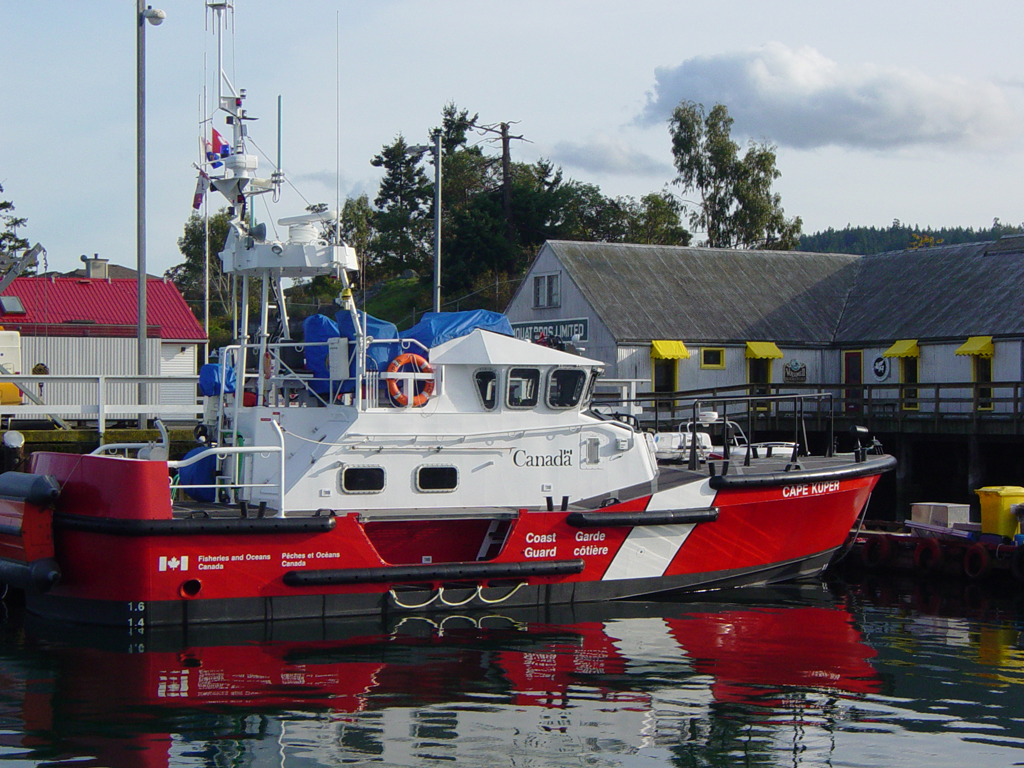
This is a close up of a sister vessel moored in Ganges Harbor on Saltspring Island just off the east coast of Vancouver Island. Slightly calmer when I took this picture in October.

sDSC03183.jpg


Slightly calmer conditions!


Harpsden
 
Wow fantastis photo,s Bit like the aegir on the R. Trent.! Was on the QM2 a couple of years ago on the way from N.Y. to Nova Scotia and we hit hurricane force winds and were unable to go to Nova Scotia,so turned into the St. Lawrence river. Got as low as I could with a viewing window and the trough,s must have been 30 to 40 feet deep.Thought how brave Ellen Mc Arthur must have been.Didnt bother the ship too much as we were going into it.
 
According to the Canadian Government website:-

"The naming and dedication of the CCGC Cape Kuper represents the completion one of the largest aluminum boat building projects in Canada. The $60 million project, undertaken by Victoria Shipyards, resulted in 24 cape-class, search and rescue motor lifeboats being built for delivery to the Canadian Coast Guard.

Due to construction efficiencies, completion times were reduced from eight to five weeks per vessel. Because of this, overall completion of the program occurred 14 months ahead of the original projected completion date."


That seems an amazing build program!

Harpsden
 
Great pics BS but can anyone explain why it was necessary to have 4 peeps on the flybridge in these conditions? I can understand why the helmsman might want to get as high as possible to pick his way around the worst of the breakers but surely it would have been far safer to seat the other crew members in the wheelhouse or am I missing something?
 
I was wondering the same. I'm sure there must be some big lumps of drift wood about, you only need a great chunk of wood coming in with the wave and it's going to get a bit messy.
 
[ QUOTE ]
According to the Canadian Government website:-

"The naming and dedication of the CCGC Cape Kuper represents the completion one of the largest aluminum boat building projects in Canada. The $60 million project, undertaken by Victoria Shipyards, resulted in 24 cape-class, search and rescue motor lifeboats being built for delivery to the Canadian Coast Guard.

Due to construction efficiencies, completion times were reduced from eight to five weeks per vessel. Because of this, overall completion of the program occurred 14 months ahead of the original projected completion date."


That seems an amazing build program!

Harpsden

[/ QUOTE ]

yes you're right, 5 weeks per boat, that really is amazing, but with that budget they were able to put in the necessary resources !
nevertheless, I can imagine what kind of R&D, planning, preparation was required.
 
The Canadian Coastguard vessels appear to be sister ships to the 'new' USCG 47' lifeboats - more about them here at http://en.wikipedia.org/wiki/Motor_life_boat and
http://www.uscg.mil/datasheet/47mlb.asp

They were / are being built to replace the old 44' lifeboats - these were what the RNLI Waveney class was based on.
Lots about them at http://www.44mlb.com/44mlb-home.htm

I would agree re how it must surely be much safer for the crew to be inside the wheelhouse, strapped in to their seatbelts, rather than having 4 of them on the flying bridge. But I guess they had their reasons for being out there....

PS - Re building them in 5 weeks, that really is amazing - the build costs for each boat 'works out' to around GBP 1.4 million equivalent, which is considerably less than the new cost of an RNLI Trent class vessel.
 
There are indeed some very big pieces of wood in the water, logs that have washed down the rivers or escaped from the log booms.

Having cruised the area you have to constantly watch for them although some places are worse than others. The worst logs are the sinkers which sit vertically in the water with only the very top of the log showing if at all. You can hit the top of one those and its bottom hits the seabed so the bow of the boat is impaled on it!


Harpsden
 
[ QUOTE ]
Great pics BS but can anyone explain why it was necessary to have 4 peeps on the flybridge in these conditions? I can understand why the helmsman might want to get as high as possible to pick his way around the worst of the breakers but surely it would have been far safer to seat the other crew members in the wheelhouse or am I missing something?

[/ QUOTE ]

Training exercice: a few trainees and an instructor?
 
I think that you will find that these are basically locally produced Trent class boats, with some variations for local conditions and operating practices.... for instance the Canucks run them with a crew of 4.

The Canadian CG is notoriously underfunded, the SAR obligations in Canda are split between them and the Military, who provide the aviation assets. Primarily EH101 Merlins, (which they bought as a sop to Westland after the Sea King replacment program went pear shaped.. and which have had real problems..) and Buffalo's fixed wing aircraft.

The Canadian military maintains a long range capapbility wereby they have parachute paramedics who they fly up into the arctic in the C130, and then jump into the accident.... they then have to operate until aid can reach them overland or they build a runway /forums/images/graemlins/wink.gif..... Its a very big country.
 
You could be right but, the Trent is an all Fibre composite construction and the USCG 47's are all alloy construction, upper works are also much bigger and composite construction on the Trent, USCG are those noisey 2 stroke Detroits at 425 hp each but the Trent's are MAN 860 hp so she is much faster too.

Fairly shifts !

Trent

TrentAWLB.jpg
 
I may be getting myself arse about here, that boat pictured is I think based on the Trent, she runs twin cat 3196 and cruises at the mid 20's... they are something like 14.5 meters long....

The Canucks also run these boats... (I think they are called Westport class)

vessel-1032-1.jpg


Which are very close to the Severns.... Cruise around 20knts, around 16 meters in length.

So i may have gotten a bit confused...

Aluminum is the material of choice in Canada, too many logs, and Ice, and rocks.....
/forums/images/graemlins/smile.gif
 
Well that makes my somewhat 'exciting' experience of Force 7 WAG in a 23ft Shetland seem positively bland..

Hats off to all those who go out in conditions we do our upmost to avoid..

I think pics/video's of these conditions should be shown when the collecting jars are out. I'm sure it'll boost takings.
 
Ah, that's an Arun class now out of service with the RNLI and replaced by the Trent and Severn, they sold the design rights (in partnership with Halmatic) to be used for rescue craft. In fact I think Halmatic built a few for UK use as patrol craft and piloty type things many years ago. The pic above is grp version which they all were.
 
By the way, not all of the Aruns were fibreglass - one was built of steel - I think she was called Snolda and based at Lerwick.
Unanimous opinion generally has it that she was / is the best Arun x far (ask Starboard Paul on this Forum - he used to be an Arun Cox'n).

The Canadian 47' lifeboats are basically the same as the USCG 47' vessels, and these were a development of the old USCG 44' vessels, which were certainly very impressive! These 44 footers are very similar in design to the UK's RNLI Waveney class boats, all of which have now (I think) been replaced by either Trents or Severns.
 
Top