Pearson Bros. "Bobbin" - best way to reinforce rubbing strake?

Lomax

Well-Known Member
Joined
22 Sep 2016
Messages
375
Visit site
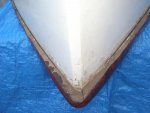
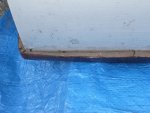
I have just become the proud owner of a Pearson Bros. "Bobbin", a lovely little 9-foot sailing dinghy, which I intend to use as the tender for my main boat. It's in generally good condition for its age, and the hull appears fully intact, but the rubbing strake is a bit weak in places. It appears to be made from some kind of engineered wood (like MDF?), with top & sides covered by a U-shaped GRP channel. This leaves it open along the bottom edges, where water can come in while the dinghy is stored upside down. The wooden core of the strake has cracked in places, which compromises its strength. I would like to improve things by 1) sealing the bottom edges so that water can no longer get inside, and 2) reinforce the wooden core, by bridging the cracks with an adhesive. I'm thinking both things can be achieved by pouring a thin epoxy into the gap all around, with the obvious downside that the rubbing strake would become permanently bonded to the hull (this may be a good thing though?). Before I do anything stupid, I thought I'd check what my fellow forumites think :) Some photos:

bobbin rubbing strake 1.jpg

bobbin rubbing strake 2.jpg
 
Last edited:
Thin epoxy is probably too thin to be of value in the cracks. I'm aim for Mayo consistency.

But more effective would be a fillet along the edge.

I'm not 100% sure the cracks are because of water vs impact...

I'd be tempted to add a better edge protection. Either 2inch plait or a string of small fenders (has advantage of added buoyancy) to properly protect from rubbing...
 
Thin epoxy is probably too thin to be of value in the cracks. I'm aim for Mayo consistency.

But more effective would be a fillet along the edge.

I'm not 100% sure the cracks are because of water vs impact...

I'd be tempted to add a better edge protection. Either 2inch plait or a string of small fenders (has advantage of added buoyancy) to properly protect from rubbing...

Thanks, note taken re. epoxy consistency - I might opt for two applications; first thin, then thicker. Maybe topped by a fillet reinforced with a narrow strip of glass mat? Should I perhaps be using polyester instead of epoxy?

Better edge protection will be added too, in the form of small fenders, but that's for later. The strake needs to be reinforced to improve the rigidity of the hull along the top edge; it flexes a little too much for my taste in places. It also needs to be sealed to prevent water from getting into the gap when stored upside down.
 
Polyester is cheaper ;-)
Never used polyester thickened unless it was with loose chopped strands. Not saying you can't just not something I've done.

If it was me...

I'd sand the surface.
Fill the cracks with mayo epoxy (if it is really squidgy by dry then wet epoxy first). "Paint" the exposed surface with something... unthickened epoxy seems sensible enough.
Once cured...
Sikkaflex the inner edge. Will be cheaper than epoxy and filler I suspect and will leave some flex. BUT can't then glass over.

If I was going to glass over... I'd probably use polyester for it all...

I might also consider screwing and glueing a new piece of wood below the current...
 
I am restoring an earlier Pearson Bobbin dinghy with a wholly wood gunwhale, which was mostly rotten. I git as far as buying some green oak to steam and glue on, then found that green oak doesn't glue well, so it's back to the drawing board.
 
Sorry to resurrect this old thread...

Just bought one of these dinghies in Plymouth, plan to leave it down here.

No rudder nor mast etc. Good fun rowing it though.

Was wondering about an unstayed mast and small sail? The mast socket is still there, as is the centreboard slot. Mebbe a plastic pipe and a bigger version of what the kayaks use for a sail? Could use an oar for a rudder until i find a wee rudder?

How is everyone else's going? Etc. Cheers
 
Sorry to resurrect this old thread...

Just bought one of these dinghies in Plymouth, plan to leave it down here.

No rudder nor mast etc. Good fun rowing it though.

Was wondering about an unstayed mast and small sail? The mast socket is still there, as is the centreboard slot. Mebbe a plastic pipe and a bigger version of what the kayaks use for a sail? Could use an oar for a rudder until i find a wee rudder?

How is everyone else's going? Etc. Cheers

Mine has been delayed because the workshop I had lined up for the job became unavailable. I hope to have her done for next spring.

I'm planning to use a 4.2m2 non-official Topper sail (I bought one from Rooster for anther dinghy a few years back) with a Mirror mast (if it fits - length of aluminium tube if it doesn't). Topper sails are sleeved and the smaller 4.2m2 one has a long sock like sleeve at the top which can be cut off and sewn across to make it fit a smaller mast.
 
Mine has been delayed because the workshop I had lined up for the job became unavailable. I hope to have her done for next spring.

I'm planning to use a 4.2m2 non-official Topper sail (I bought one from Rooster for anther dinghy a few years back) with a Mirror mast (if it fits - length of aluminium tube if it doesn't). Topper sails are sleeved and the smaller 4.2m2 one has a long sock like sleeve at the top which can be cut off and sewn across to make it fit a smaller mast.

Thanks
 
I also have a Bobbin which will become our tender if we ever get out of this boatyard. She gets occasional outings on a nearby lake when i am playing with the Enterprise. I can say that the row of fenders idea is a great one ( especially when overloaded with children ) makes it much less tippy.
 
Top