Peaks of madness to blow the gaff

Greenheart

Well-Known Member
Joined
29 Dec 2010
Messages
10,384
Visit site
Yes, here's another plan, just possibly my craziest yet. Matter of fact I think I mentioned it a while ago. It's matured... :eek:

Still looking at those Youtube films of dinghies, just trickling along over glassy waters...

...and I began to think again, what options there could be, to increase the fun when there's too little wind to give more than steerage way under full sail.

I understand that there's often more movement, even a few feet higher above the water. So...how about using a couple of mainsail track slides, to support two points, a yard apart, near the bottom end of a very light, alloy pole, perhaps ten feet long...

...so, when the "gaff" is raised by a halyard, sliding up the mainsail track, its peak will be seven foot (or possibly much more - according to your pole-length, and ego! :D) higher than the standard masthead. Permitting bigger sails...

Of course, your mainsail won't be usable, with part of the track occupied. And the complexity of creating a custom-made sail, part of which runs in the track, while part is attached to the pole, doesn't appeal...so my thinking is to hoist a colossal overlapping genoa instead.

Can you picture it? A dinghy wearing a 2oz-genoa with a thirty foot luff? More than double your standard sail area? :):)

Tacking...will be interesting, possibly involving stalling and going astern. But this is only a Force 1 idea.

Actually, looking at the cloud-scraping topsail-yards of the big Edwardian gaffers, I can't really call this a new idea... :rolleyes:
 
Last edited:
Yep, Gunter rig. And no reason you couldn't have a mainsail-style sail on the aft side of it, no harder than a jackyard topsail or the sort of cutaway you need to clear the main masthead with a fidded topmast.

Pete
 
Ultimate una rig

Yes indeed, Avocet, effectively it's a gunter. But Pete, I felt the difficulty is getting the sail's luff up to the 'gaff' peak, when the track is unavailable, and when the spreaders prevent the sail being loosely 'strung' to the mast. Won't there be a hideous kink at the point where the sail's attachment to the gaff, meets its uppermost point of the track?

Hence, the genoa. Considering how long-footed many genoas seem to be, I reckon it might be necessary to fit a bit of a bowsprit too.

On the other hand...nice idea, to cut a monstrously oversized, lightweight mainsail specially for the purpose, permanently rigging its upper few meters of luff to the pole, and allowing the lower section to go up the mainsail track as usual.

The kink I foresaw, could be ironed out with practise and experimentation. And, slab reefs could be built in at the boom-end, so the exact degree of lunacy you prefer can be adjusted to each day's weather. I like it!

The downside I suppose, would be the time required to lower the thing if a gust arrived. Whereas, a genoa halyard could be let go in a moment to free the beast.

It'd be fun to see two identical dinghies (one as an unsullied 'control'), racing and comparing their pace/balance/handling...
 
Last edited:
Won't there be a hideous kink at the point where the sail's attachment to the gaff, meets its uppermost point of the track?

There would be if the luff was straight. So you get your skilful sailmaker to cut one that fits around the joint. Look at pictures of topsails on boats with separate topmasts - there can be some quite radical joggling around the area where the two masts meet, but the rest of the sail still sets sweetly.

Your plan has the benefit of modern sail track; most old topsails either had to have a flying luff, or be handled aloft, or run up one or two jackstays or leaders to try to control a couple of points on the luff.

Pete
 
Dan

Some of your ideas have been almost feasible, but for about 25 separate reasons, just forget this one!

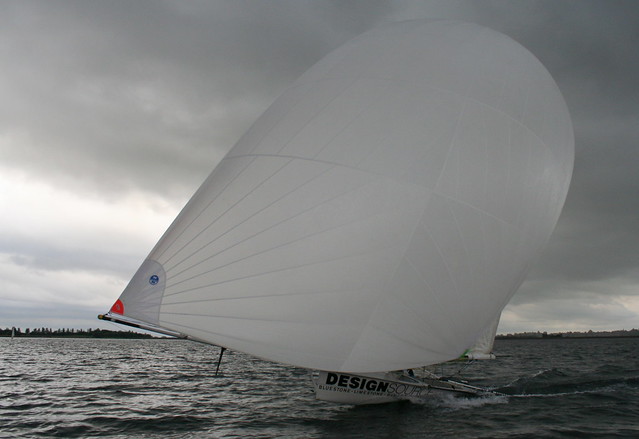
As someone who has considerable experience of sticking unfeasibly large rigs onto very small boats (please see pic below of the 12' skiff I used to campaign, thats a 60sqm kite and about 20sqm of white sail on a 45kg 12' hull) take it from me that you are into diminishing returns and if you want to ghost in the light stuff what you really need is a long, light, slippery hull.

Indentally historic skiffs used to be poking additional sails out all over the place on various bendy poles until people realised that basically that's a slow, **** idea compared with a properly set up rig...

2837080131_9efce9824c_z.jpg
 
Indentally historic skiffs used to be poking additional sails out all over the place on various bendy poles until people realised that basically that's a slow, **** idea compared with a properly set up rig...

Yep - Dan's wet dream, some of 'em :)

Pete
 
As most (older) dinghy are fractional rig what your suggesting is a mast head rigged light code Zero for them? Or is it cut like a Genoa and set on the spinney sheets? Hoisted on a separate halyard, why not use the burgee halyard if its only for light airs?

Not certain how well it would work, think it would make sail makers and riggers happy as it was experimented on.

Tried it once as a kid swapped my big sister's Scorpion spinniker for my cadet one on a new years day race, she was not impressed :D it worked..
 
Those b&w pics certainly are appealingly mad, even if the designs weren't terribly effective. I love the exaggerated sail plan, including a tiny 23 sq' topsail to cover the crack!

I take the point, Iain; but I'm not trying to design a fast boat, just turn drifting performance aboard a staid hull, into useful progress.

While I totally respect your evident experience of the theme, it still looks logical to me that if a hull can make four knots in a force 2, the best way for the same hull make best use of a force 1, is by raising more sail, ideally vertically. Or, not?

If it isn't...why isn't it? (Is the answer a long and difficult physics lesson? :()
 
Shades of a jackyard topsail.

ELFmorph-2.gif


Check out the topsails used by Chesapeake Bay log canoes

26c166ed-4974-4241-bb3d-435176e8a191.jpg


And AIUI, Thames Barges used to sail under topsail alone occasionally - using only the highest sail.
 
Ok, so if it's a genoa its going to need some kind of forestay. Getting any kind of luff tension on something that terminates even on the totally unsupported section of mast above the hounds is going be nigh on impossible, by the time you've terminated it on your sliding yard thingy and it's tried to make its way round the front on the rig, your luff tension will be non existent. Trying to sail with the boom and main lying in the boat will be a nightmare, and sheeting your code zero thing will be a joke, especially the bit where the spreader is poking through it.

I expect you will end up with something that can go just above a beam reach at best, before breaking in the first 8kt puff.

If you must try something like that just try a big kite.
 
Just you wait!
When you see the headsail of a Swan 53 ghosting towards you through the mist, and it turns out to be a 420...that's me! :D

I was thinking that luff tension in a force 1, wouldn't be greater than the sliding spar could cope with. Presumably if a longer length of the pole overlaps with the relatively rigid supported upper mast, the slight thrust it encounters in a 'drifter' won't deform it much.

And, as the mainsail will be out of action, some sort of compensatory backstay could discourage the rig's profile from becoming too laughable.

Though surely if only the genoa is to be hoisted, it doesn't matter much if the mast isn't straight - it could be like a shepherd's crook, and still support a sail whose luff is separate. Perhaps this will become known as Dan's Leg o' Mutton...

As to the boom & mainsail cluttering the cockpit...I'd crutch the boom. And, the giant kite was always a given.
 
I was thinking that luff tension in a force 1, wouldn't be greater than the sliding spar could cope with.

But you're trying to compensate for lack of wind by increasing sail area. Ideally you want the same force on the mast and the sheet cleats as you'd get with the normal sail in say a F3, so that you move at the same speed.

I believe there were edwardian yachts with telescopic topmasts that ran inside the lower mast. Your mast would be better supported like that. The problem with it on a track on the aft side of the mast, with all the load coming from ahead, is that it will be doing its best to wrack the top fitting around the leeward side of the mast to the front. You'd need very strong (heavy) track and cars to withstand that unfair strain.

Pete
 
Just you wait!
Presumably if a longer length of the pole overlaps with the relatively rigid supported upper mast, the slight thrust it encounters in a 'drifter' won't deform it much.

Erm, dinghies don't have supported upper masts. They are free to flop and depower above the hounds. Unless they are setting a great big masthead kite, where they have cap shrouds, D1s and pre bend to stop the whole lot disappearing over the side in a puff (hint!)

If you want more fun in light winds then just put a bigger rig on it and at least you have a chance of it sailing properly and not breaking!
 
Indeed. Mine was intended as a cheap solution, though as Pete points out, the excessive pressure on just two track slides which were only designed to share moderate portions of the mainsail, would probably destroy the track, necessitating a new rig anyway.

By 'supported upper mast' I only meant the short upper portion of the mast which is supported.

Telescopic masts...interesting. My Topper mast (wholly unstayed) effectively had that. The components were fairly light too, so weight aloft wasn't a critical issue. I wish I hadn't left it on the Isle of Wight in '94...
 
Telescopic masts...interesting. My Topper mast (wholly unstayed) effectively had that.

Sure it didn't have a dozen paid hands down in the bilge though, manning a big windlass attached to the mast step.

They would winch the topmast up and down as required around the racecourse.

Pete
 
I'd read of the infinite laboursome tasks (and cheap labour that enabled them) on those old race-boats.

I suppose it's nice to know that whatever wild impractical onboard-schemes we might speculate about, ideas much crazier really were designed, ordered, built and used by barmy billionaires, eighty years ago and more! :)
 
I'd read of the infinite laboursome tasks (and cheap labour that enabled them) on those old race-boats.

I particularly like the technique for a fast hoist of the mainsail (some races started with boats moored to buoys, so sail hoisting was under time pressure). Send twenty men up the ratlines, then at the gun have the ones at the top hang onto the halyard and jump off. As they're plummeting to the deck, their mates are racing up the ratlines behind them to catch the moving halyard and follow them down. As each man hits the deck he runs to the shrouds to go up and do it again, so you have a steady flow of bodies in a loop down the halyard and up the ratlines until the sail is hoisted.

Pete
 
Slick! I'd like to see that implemented today, using chubby guests on charter boats as human downhauls, instead of powered winches/windlasses. :)
 
Top