
Outhaul attachment

PabloPicasso

Well-Known Member
Joined
12 Feb 2010
Messages
2,904
Visit site
Here are some diagrams from Harken's website for outhaul designs.

How on earth do you attach point "A" inside the boom? Now I could come up with a method to rivet an attachment hoop in there, but how could one tie a line to it? Screenshot_20220621_092425_com.android.gallery3d_edit_23317613891233.jpg
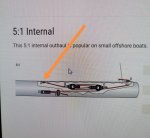
 
Probably through a small inspection hole. The whole setup strikes me as rather impractical though, unless you happen to be in the business of selling expensive sail hardware :ROFLMAO:

These days you'd probably be better off with a bit of Dyneema and some low friction rings.
 
On booms with that system, I've always seen "point A" actually is at the gooseneck, you just drop the rope through and tie it off, as the Boom Gooseneck fitting normally has already got holes in it.
 
A lot of booms have a system of blocks inside the boom for reefing lines, and that outhaul system could conflict. My out haul system was much simpler with the outhaul taken right through the boom and down to a mast foot block and up to a small winch on the back of the mast. Once tensioned a jammer where it exited the boom held it.
 
When I refit my boom, I'll take the line through the boom , then use the block and tackle vertically between gooseneck and the same point as the bottom of the vang, the adjustment tail will then come aft to where I can easily adjust it.
 
Last edited:
On booms with that system, I've always seen "point A" actually is at the gooseneck, you just drop the rope through and tie it off, as the Boom Gooseneck fitting normally has already got holes in it.
This....

We have this setup, though ours is about a 21:1 I think. Certainly very powerful.

A lot of booms have a system of blocks inside the boom for reefing lines, and that outhaul system could conflict. My out haul system was much simpler with the outhaul taken right through the boom and down to a mast foot block and up to a small winch on the back of the mast. Once tensioned a jammer where it exited the boom held it.
The type of boat that is interested in this sort of quick, winch free, outhaul adjustment is normally not the type of boat that has single line reefing.

This is very much aimed at the racing side of things, where conventional slab reefing is preferred.
 
I'd agree with having A somewhere easy to access near the gooseneck.

If you are going to put a system into the boom - and I agree that it's a good idea which, if threaded carefully to start with, shouldn't interfere with other lines running through there - why not rig it as a cascade system? 4 small single blocks would give you a 16:1 system.
 
But why would you? Pulling on the rope exiting E/F is the same as pulling on the rope exiting C. (?)

I also think it's 4:1, as there are only two sheaves involved at the moving block.
Sheaves involved at B and E are stationary and do not contribute to purchase.
 
5:1
Consider the balance of forces on bloc C. Five pulling left and the working one pulling right. Each of the left ones (and the bitter end) exerts a force 1/5 of the right working one.
 
Yes, the force pulling left is shared by five lengths of string, but in my view they do not all contribute to mechanical advantage.
The standing part, starting at the anchoring point at block C and passing over the smaller sheave of block B does not provide any purchase. That sheave is similar to a halyard sheave at the mast top – it provides a change of direction of the pull, but no mechanical advantage.
It is only the sheaves of the moving block (C) that do so, IMHO.
 
This seems to be the consensus of several sources:

There are two different types of pulleys: fixed and movable.
  • A fixed pulley is attached to a supporting structure (anchor). It only changes the direction of the force on the rope and does not provide any mechanical advantage.
  • A movable pulley is not attached to a supporting structure (anchor). It is supported only by two parts of the rope. The mechanical advantage of a movable pulley is two.
Formula for mechanical advantage for a pulley: The formula used to calculate the mechanical advantage of a pulley system is MA=2n where MA is the mechanical advantage of the pulley system and n is the number of movable pulleys in the system.

By my reckoning that makes the diagram a 4:1 system.
 
I have slab reefing, so unlikely to have anything but lines inside the boom. But I will check next time I'm at the boat.

Under the boom there is the vang, cunningham, and reefing lines so already cluttered. Hence wanting to put new outhaul purchase inside the boom. It'd be a neater solution.

I like the idea of a cascade though. In all a useful discussion

But thanks for a answering my original question about "A".
 
Does an outhaul really need that kind of 4:1 system? I would suggest not unless that boat and hence main sail is very big.
My outhaul goes from close to boom end, around a pulley , runs inside the boon and exits at the gooseneck via a built in clutch (along with reefing lines) and if it needs tensioning by use of a winch mounted on the aft of the mast - the winch also tensions the reefing lines. Nice and simple and it works KISS
 
Does an outhaul really need that kind of 4:1 system? I would suggest not unless that boat and hence main sail is very big.
My outhaul goes from close to boom end, around a pulley , runs inside the boon and exits at the gooseneck via a built in clutch (along with reefing lines) and if it needs tensioning by use of a winch mounted on the aft of the mast - the winch also tensions the reefing lines. Nice and simple and it works KISS
It's a use case thing.

On my dad's Dufour we had exactly as you describe, and for the purpose of fast cruising this was all that was needed.
On the Elan we also had this setup. It worked fine, but in race mode it gave the pit person another job to juggle at the bottom mark, i.e getting the outhaul back on before we went upwind again, often juggled with one of the cabin top winches being used for the kite sheet, and the other for the jib halyard. Or if we were getting adventurous and coming into the bottom mark poleless, both in use with the kite sheets.

On the JPK we have the "in the boom cascade" setup, though much more powerful than illustrated. This means that the mastman can tension the outhaul at the leeward mark without using a winch. Which makes the overall co-ordination of the mark rounding and all the little things that have to be done to change from downwind to upwind that little bit easier.
On one windy race we actually broke the cascade inside the boom, so we ran the reefing line to the clew to use as an outhaul. Worked fine in terms of sail shape etc, but for the racing use case the in boom system was better so we fixed that....
 
Does an outhaul really need that kind of 4:1 system? I would suggest not unless that boat and hence main sail is very big.
My outhaul goes from close to boom end, around a pulley , runs inside the boon and exits at the gooseneck via a built in clutch (along with reefing lines) and if it needs tensioning by use of a winch mounted on the aft of the mast - the winch also tensions the reefing lines. Nice and simple and it works KISS
Ours has a total 16:1 via a cascade, and if you haven’t wound it on before sheeting the main, wait until the next tack. It’s the one control that doesnt lead to the cockpit, not enough sheaves at the gooseneck. It’s external as I felt 3 reefs were sufficient to use all the space inside the boom.
 
I may have been not clear in post #13.

The calculation is simple:
Disregarding friction, in static conditions (all lines in tension and no motion), the tension of the outhaul line pulling multiple bloc C to the right equals the sum of the forces of all the lines pulling multiple bloc C to the left.
All the five lines pulling multiple bloc C to the left have the same tension, being the same line threaded many times, thus the tension of each line, included the bitter end C-E/F is 1/5 of the total, that is 1/5 of the tension of the outhaul line.
I guess you have not counted le line attached to the becket of the bloc.

I think I can not explain my opinion better than that, so I'll not contribute any more to this thread.
 
Top