
Number of poles - volvo alternator

Birdseye

Well-Known Member
Joined
9 Mar 2003
Messages
28,796
Location
s e wales
Visit site
Am changing the alternator on my boat and uprating at the same time. As usual the little LCD on the MD 2030b instument panel has gone t1ts up so I have no way of adjusting the tacho. Which in turn means I need to know that the number of poles and therefore the tacho signal frequency is the same in both old and new alternators. The new one is 12 pole but does anyone know what the standard volvo alternator is ( valeo paris -- rhone A13N234)
 
Am changing the alternator on my boat and uprating at the same time. As usual the little LCD on the MD 2030b instument panel has gone t1ts up so I have no way of adjusting the tacho. Which in turn means I need to know that the number of poles and therefore the tacho signal frequency is the same in both old and new alternators. The new one is 12 pole but does anyone know what the standard volvo alternator is ( valeo paris -- rhone A13N234)

I replaced my alternator last year (VP 2003, Valeo unit) with one from Phoenix on Ebay (Ray Wild). http://stores.ebay.co.uk/Phoenix-Marine-Electrics

He was able to advise a correct Valeo equivalent replacement of the same footprint and type but higher o/p (70 amp). The item I bought is N12411 ebay number 221533924902 £126.00 inc VAT & Post. Worked fine all 2014 season, including driving the tacho correctly, just ordered another for a friend (VP 2003 also). No connection other than satisfied customer.

Might be worth a call?
 
The rpm indicator signal is taken from one of the field windings and transmits once every revolution.
Therefore the number of poles the alternator (usually 6 or 7) is irrelevant.
It's actually quite easy to modify an alternator, with no rpm feed to drive a rev counter.
Any half-competent auto electrician should be able to do that for you - I've just done it on a Bosch which had no feed to the rpm-indicator.
Unfortunately taking the signal off the alternator, though cheap and simple, can be highly misleading, as the back-emf in the system increases and the charge-output drops, the rev-counter signal can become so attenuated that the counter reads grossly low.
 
Interesting comment charles but my understanding is that the tacho feed normaly comes from one of the stator coils in unrectified form, so the number of poles is relevant. Born out too by my previous attempt the change alternator when a higher output 12 pole one from adverc sent the tacho through the roof with a constant ratio increase in readings . Something like double previous values.

How do you tell how many poles there are in an alternator. Is it something you can count from peering inside it?
 
The rpm indicator signal is taken from one of the field windings and transmits once every revolution.
Therefore the number of poles the alternator (usually 6 or 7) is irrelevant.

That is of course incorrect. The tacho feed is taken from one of the phases of the stator windings and gives an AC output which gives one cycle every time a pair of poles passes, not once per revolution. So the number of poles dictates the frequency of the tacho feed.
 
Interesting comment charles but my understanding is that the tacho feed normaly comes from one of the stator coils in unrectified form, so the number of poles is relevant. Born out too by my previous attempt the change alternator when a higher output 12 pole one from adverc sent the tacho through the roof with a constant ratio increase in readings . Something like double previous values.

How do you tell how many poles there are in an alternator. Is it something you can count from peering inside it?

You're right, the number of poles is relevant. You can count them, but you may not be able to see them easily without taking the thing apart. Why not ask the supplier?
 
treid that. Valeo UK is full of salesmen focussed on the UK car manufacturers. They asked me what a pole was.

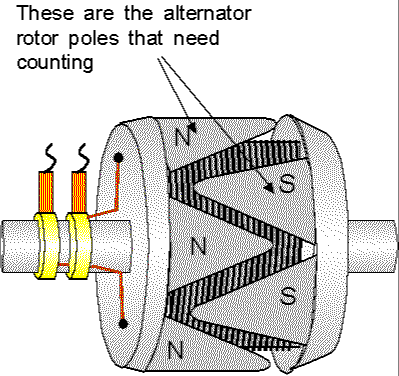
Mind you , what are they ? :D Are they the iron "ears" for want of a better word that the statoir windings sit on? Are they the same as the number of stator coils?
 
treid that. Valeo UK is full of salesmen focussed on the UK car manufacturers. They asked me what a pole was.

Mind you , what are they ? :D Are they the iron "ears" for want of a better word that the statoir windings sit on? Are they the same as the number of stator coils?

The poles are on the rotor. They look like interlocking triangular pieces round the outside of the rotor.

Edit: Added pic...

poles.gif
 
The rpm indicator signal is taken from one of the field windings and transmits once every revolution...

Twaddle, as discussed above.

Note that some tachometers have adjustment, or you can get a device to change the frequency.
[Later] Just re-read the OP, I have successfully adjusted a tachometer with a broken LCD, although I did it in my workshop rather than on the boat.

You can measure the current frequency with an oscilloscope, or a multimeter with a frequency range.
 
Last edited:
Just a thought on pole numbers. We would imagine that with more poles an alternator would charge at a lower rotation speed. So if that is the claim of the replacement alternator then yes do check the number of poles when conecting a tacho. good luck olewill
 
Interesting comment charles but my understanding is that the tacho feed normaly comes from one of the stator coils in unrectified form, so the number of poles is relevant. Born out too by my previous attempt the change alternator when a higher output 12 pole one from adverc sent the tacho through the roof with a constant ratio increase in readings . Something like double previous values.

How do you tell how many poles there are in an alternator. Is it something you can count from peering inside it?


You are correct,in so much that it is ac on the W connection, all of the alternators that I have rebuilt the point of connection is from the diode cooling plate, therefore all phases both star and delta winding ends supply that terminal output.


On some alt. by removing the brush gear it is possible to count the poles others can be seen from the drive end cap.
 
Top