
Not the first I've seen

Praxinoscope

Well-Known Member
Joined
12 Mar 2018
Messages
5,788
Location
Aberaeron
Visit site
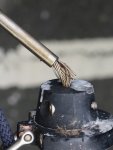
One of our club members has just dropped his mast and found this (see attached image) at the head of the forestay. The furling genoa gear has obviously been slowly cutting its way through the wire as it turns during furling. This is not the first time I have seen this happen.
To me it seems a bit of poor design that allows this to happen, I don't know if any wire terminal manufacturer has thought about lengthening the 'tang' of the terminal so that the head of the furlong gear rotates around the steel of the tang rather than the strands of the wire.
Maybe there is a technical reason this can't be done, it would mean replacing the head components of the furling gear to accommodate the larger diameter of the tang, but I can't see a reason why this solution wouldn't work.
Forestay.jpg
 
What brand of furler is that?
It looks like the top of the swivel is designed to clamp onto the wire?
Maybe the problem is that the swivel is very close to the swage, so any flexing occurs over a very short length of wire?

What is the average life of forestays with this brand of furler? i.e. is this an unusual case?
How old was this forestay?

If the backstay is eased downwind, presumably the top and bottom of the forestay need to articulate somewhat, and you might not want that movement to be inflicted on a T terminal in the mast?
 
Wing Mark not absolutely sure make of furler, but think it is a Harken, will check next time I’m down the harbour, it’s fitted on a Sadler 290.
 
not absolutely sure make of furler, but think it is a Harken

That would surprise me.
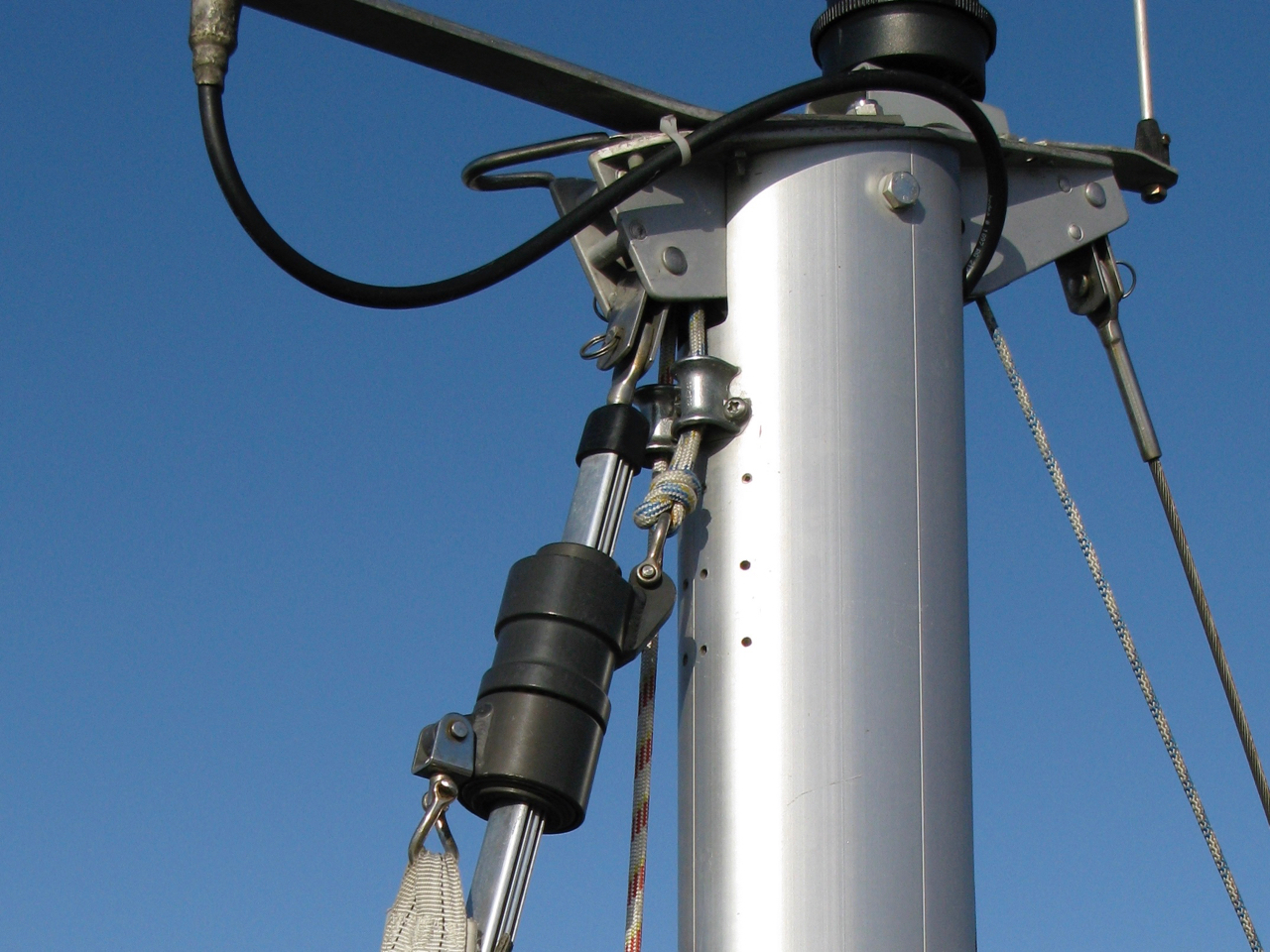
This photo shows the halyard swivel and foil end cap of a Harken furler. Far from recent (circa 1992), but I don't think they have changed too much over the years. As can be seen, the foil end cap, which is plastic or rubber, clearly rides on the swage body.
IMG_1948.JPG%20%E2%80%93%20Version%202.jpg
 
Baba Yaga, you are correct in that it is not a Harken, it is in fact one of the rarer ones a Goiot, (so apologies to Harken on this one) but I don’t think this alters the principle that to have a component that rotates around a forestay wire often under pressure is not a sensible engineering option.
Even, if as in most units the rotating component is a material such as Delrin or similar, a build up of grit and salt on the inner surfaces create an excellent abrasive, which over time will damage the wire strands.
Conor 54 identified Reef Right Engineering of New Zealand as offering a solution to this, I’m just surprised that it hasn’t been more widely adopted.
 
I don’t think this alters the principle that to have a component that rotates around a forestay wire often under pressure is not a sensible engineering option.
Even, if as in most units the rotating component is a material such as Delrin or similar, a build up of grit and salt on the inner surfaces create an excellent abrasive, which over time will damage the wire strands.

Maybe so, but what is the alternative? You have one component, the wire, which is static, and another component, the foil, which must turn in order to furl the sail. The foil will have to bear on something along its length, not just at the top (where I agree the swage body is the better alternative). Further down there is just the wire and I imagine most systems use the foil connectors as bearings, certainly Harken does.
I found your picture in post #1 interesting, don't you think the damage could be a result of halyard wrap?
 
I found your picture in post #1 interesting, don't you think the damage could be a result of halyard wrap?
If you look at the edge of the larger part of the swivel there's certainly some evidence that something has been wearing away at it. Maybe a wrap bulged the wire and the bearing action finished it off?
 
If I were in the market for a furling system I would plump for Reef Rite, on account of their innovative approach to design. I particularly like the idea of the locking pawl to prevent unintended rollout of the full genoa, having been placed in very uncomfortable and possibly dangerous situations while delivery crewing on a boat whose genoa furling line broke three times between Ireland and Spain.
 
Maybe so, but what is the alternative? You have one component, the wire, which is static, and another component, the foil, which must turn in order to furl the sail. The foil will have to bear on something along its length, not just at the top (where I agree the swage body is the better alternative). Further down there is just the wire and I imagine most systems use the foil connectors as bearings, certainly Harken does.
I found your picture in post #1 interesting, don't you think the damage could be a result of halyard wrap?

The solution already exists, just hasn't been used in this application. A collar/sleeve mounted to the wire that is made of the right material. Selden us a composite/plastic inner guide so that the foil does not contact the wire along its length, the foil is primarily supported by an upper bushing on the swage, and a lower bearing, as other do.
 
The original post just shows why it's important to go up the mast to do a rig inspection regularly. I make sure to check ours at the start of the season and again mid season.

The original damage shown in the photo will not have occurred all at once.
 
I think it highly unlikely to be a halyard wrap, this is long term wear from a component rubbing hard against the wire, the Reef Rite solution is a way of preventing this, I will have a closer look at the Selden solution. As two separate companies have looked at this problem and come up with alternative solutions suggest that this is not uncommon, as I said in the title of my OP, I have seen this before, (about 5x) over the years, and I haven’t sailed in the heavily populated South Coast for about 40 years so would anticipate that there are many more examples around.
 
I think it highly unlikely to be a halyard wrap, this is long term wear from a component rubbing hard against the wire, the Reef Rite solution is a way of preventing this, I will have a closer look at the Selden solution. As two separate companies have looked at this problem and come up with alternative solutions suggest that this is not uncommon, as I said in the title of my OP, I have seen this before, (about 5x) over the years, and I haven’t sailed in the heavily populated South Coast for about 40 years so would anticipate that there are many more examples around.

There are so many different types and configurations of systems, what you say doesn't surprise me. There will be some (as our previous boat) that are fine for 30+ years, and others which are not quite so well engineered or fitted.
 
I bet there are also a few not exactly installed in accordance with the instructions!

A quick look at all the furling gear on the boats in our harbour shows all of them have tge top swivel of the foil rotating around the wire, including my own, so not sure that they are all assembled in conflict with the assembly instructions.
In fact checking the installation instructions of the Plastimo unit(which I have) they show the top of the foil ending on the wire .
 
A quick look at all the furling gear on the boats in our harbour shows all of them have tge top swivel of the foil rotating around the wire, including my own, so not sure that they are all assembled in conflict with the assembly instructions.
In fact checking the installation instructions of the Plastimo unit(which I have) they show the top of the foil ending on the wire .

From a cursory glance at the manual, it appears though the Plastimo furler relies on the coupling sleeves to centre the foil on the wire. It's fair to say that this is not the best method, and a dedicated top bearing/bushing arrangement would be better. But this is the reality with the different price points.
 
One of our club members has just dropped his mast and found this (see attached image) at the head of the forestay. The furling genoa gear has obviously been slowly cutting its way through the wire as it turns during furling. This is not the first time I have seen this happen.
To me it seems a bit of poor design that allows this to happen, I don't know if any wire terminal manufacturer has thought about lengthening the 'tang' of the terminal so that the head of the furlong gear rotates around the steel of the tang rather than the strands of the wire.
Maybe there is a technical reason this can't be done, it would mean replacing the head components of the furling gear to accommodate the larger diameter of the tang, but I can't see a reason why this solution wouldn't work.
View attachment 124065

Isn't that the bit that stays still at the top? Looks like the halyard attachment shackle with halyard attached in the lower left of the pic. If we had a better picture of the whole top setup we could see for sure. The hole through the centre looks small as though it may have jammed and acted as a "clamp" on the wire and therefore caused the wire to unravel and break. Without a better picture its hard to tell though.
 
This was some time ago, but I decided that my rig needed a bit more rake and so asked Rotostay (still in business, then) to make me a new longer forestay. They firmly told me 'No - the top of the foil must bear on the top swage'.
 
A quick look at all the furling gear on the boats in our harbour shows all of them have tge top swivel of the foil rotating around the wire, including my own, so not sure that they are all assembled in conflict with the assembly instructions.
In fact checking the installation instructions of the Plastimo unit(which I have) they show the top of the foil ending on the wire .
And how often do they fail?
Not often at all?
So is there a general problem with the foil bearing on the wire?
When there are a couple of rolls in, the foil is going to bear on the wire lower down anyway.
 
Top