
Non structural filler...

onesea

Well-Known Member
Joined
28 Oct 2011
Messages
3,841
Location
South West
Visit site
Looking for a filler for a hatch opening, that hasn't been cut.

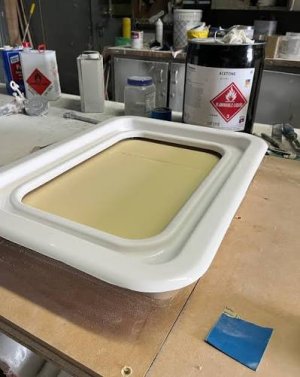
The boat cockpit has inlays for hatches to be cut for cockpit lockers. However she had 1/4 berths instead and although moulded they where never cut.
images.jpeg

The mouled inset created dips like that above (but without the middle cut out), that have been filled with plywood. However water gets ruined and underneath and then comes out when sailing, a surprisingly amount.

Is there an affordable filler ideally not too heavy I can use to replace the plywood, that will not absorb water and stop it pooling.

To create a smooth finish, this will be covered by teak effect decking or deck grip paint.
 
Looking for a filler for a hatch opening, that hasn't been cut.

The boat cockpit has inlays for hatches to be cut for cockpit lockers. However she had 1/4 berths instead and although moulded they where never cut.

View attachment 200954

The mouled inset created dips like that above (but without the middle cut out), that have been filled with plywood. However water gets ruined and underneath and then comes out when sailing, a surprisingly amount.

Is there an affordable filler ideally not too heavy I can use to replace the plywood, that will not absorb water and stop it pooling.

To create a smooth finish, this will be covered by teak effect decking or deck grip paint.
You haven’t given dimensions, but something like this?

Livarno Home Large White Chopping Board
 
I was hoping for a filler type substance the molds are not exactly straight out true 🫣
Expanded polystyrene concrete - Wikipedia

Depends on how "experimental" you want to be, but it should be cheap enough to make up a few small test batches first. Microspheres (as used with epoxy resin) might be a lightweight concrete aggregate alternative but they'd be more expensive.

If you didnt want to commit to something permanent, applying a release agent and/or plastic film and then casting in situ should make it lift-out, in case it all goes horribly wrong.

I would probably look into casting some kind of (plastic?) reinforcing grid into it, and/or incorporate some fibre into the mix, to stop it cracking, since I'd expect it to have poor tensile strength, plus maybe handles and some foam to sit on.

There is hexagonal mesh fencing stuff, I think made of polypropylene, that might do as reinforcing. Now I think on't, long, long ago I made up some...er... fake numberplate moulds with plaster of paris and used a (nylon?) mesh as reinforcement, and that seemed to work quite well.

(I also have some reinforcing my groin following a hernia operation, and thats worked well too, though its a rather different application)

Would probably want to do a bit of reading up on the polycrete stuff first.
 
Last edited:
Looking for a filler for a hatch opening, that hasn't been cut.

The boat cockpit has inlays for hatches to be cut for cockpit lockers. However she had 1/4 berths instead and although moulded they where never cut.

View attachment 200954

The mouled inset created dips like that above (but without the middle cut out), that have been filled with plywood. However water gets ruined and underneath and then comes out when sailing, a surprisingly amount.

Is there an affordable filler ideally not too heavy I can use to replace the plywood, that will not absorb water and stop it pooling.

To create a smooth finish, this will be covered by teak effect decking or deck grip paint.
Post a photo of the actual cockpit. It will help.
 
AFAICT a photo of the actual cockpit will only help if you expect to get something off-the-shelf to fit the space. Otherwise, you either need to shape to fit, or use a filler, as in the OP's...er...OP

A perhaps simpler/more conventional alternative to polycrete might be to just fill it with foam.

With care, and a light application of solvent (petrol or white spirit) polystyrene foam would probably self mould to the space, since it will dissolve on contact with a solvent-wetted surface. However, polystyrene isn't closed-cell so will absorb water.

I dunno if there are closed cell foams that are solvent dissolvable.

There's that firm (polypropylene?) stuff that white goods etc are sometimes packaged in which appears to be closed cell but I suspect will resist solvent, (I could test some with petrol this afternoon) but it (or the breadboard stuff above, or foam floor tiles, or artificial teak decking - that might actually look quite good, or rubber or cork floor tiles, or treadmaster stylee non-slip decking tiles, or yoga mats or bits of old flat glassfibre boat hull) could be carved to fit and then bedded in conventional mastic or polyester filler.

Alternatively/in addition you could make drains for the wells these hatch surrounds create in your cockpit, to reduce the ponding problem. Options for this would include cutting slots and then lining them, drilling lateral holes with tubes through them, or drilling vertical drain holes with drain hoses.

Light lift in foam pads could just be fitted on-demand and stored below, largely avoiding water and UV issues

Any infill you use thats fitted permanently will have to resist, or be protected from, ultra violet

Or of course could just avoid the whole thing by removing these surrounds and flush-filling the hole, but thats quite a big job.
 
Last edited:
Post a photo of the actual cockpit. It will help.
Thanks for the responses so far, more ideas still appreciated.

At the moment the cockpit seats have decking type PVA foam on them. So the problem is mainly covered, except water comes out when dealing it standing in then so a photo is of little use. I estimate I am looking at

@ducked your point regarding solvents is mute. The fuel filler is in the cockpit, plus I use the area to top up the outboard and alcohol stove cartridges. So resistance to chemicals is essential.

The closed cell foam isn't bad idea as could create built in cushions in the cockpit. But the covering would have to be flexible.

Drains would probably get blocked add complications and obstructions below.

Maybe just replacing and sealing the plywood might be best solution. It's done the job for 40 odd years I guess.

I just hoped there would be something new out there.
 
Thanks for the responses so far, more ideas still appreciated.

At the moment the cockpit seats have decking type PVA foam on them. So the problem is mainly covered, except water comes out when dealing it standing in then so a photo is of little use. I estimate I am looking at

@ducked your point regarding solvents is mute. The fuel filler is in the cockpit, plus I use the area to top up the outboard and alcohol stove cartridges. So resistance to chemicals is essential.

The closed cell foam isn't bad idea as could create built in cushions in the cockpit. But the covering would have to be flexible.

Drains would probably get blocked add complications and obstructions below.

Maybe just replacing and sealing the plywood might be best solution. It's done the job for 40 odd years I guess.

I just hoped there would be something new out there.
Closed cell foam wouldnt in theory require a cover since it isnt supposed to absorb water, though Id guess your decking PVA foam is also supposed to be closed cell and has. Lifting out when not in use could address this.

Only one of the 3 drain configurations I outline has hoses below. The horizontal slot and hole options do not, and could trivially be kept clear, but perhaps wont drain quite so well.

No solvents OK. The point is moot. If it was mute I wouldnt have mentioned it.
 
Stokbord?? Like ply but made from recycled plastic...

Google Search
The problem with doing a composite method is cracks around the edge and getting water under neath and the problem reoccurring.

As @PaulRainbow and @PCUK say it might be costing up the some affordable polyester filler preferably light weight and just filling the lot.

Coming to the conclusion what’s there has to come out then I can work it out. Dry it out, poor some water in to measure the volume required then decide on composite with board or just filler the whole thing…

She’s not back in the water till April and I can put cockpit tent up so not to weather dependant.
 
Top