"Non-stick" valves: ever heard of them, anyone

MapisM

Well-Known Member
Joined
11 Mar 2002
Messages
20,658
Visit site
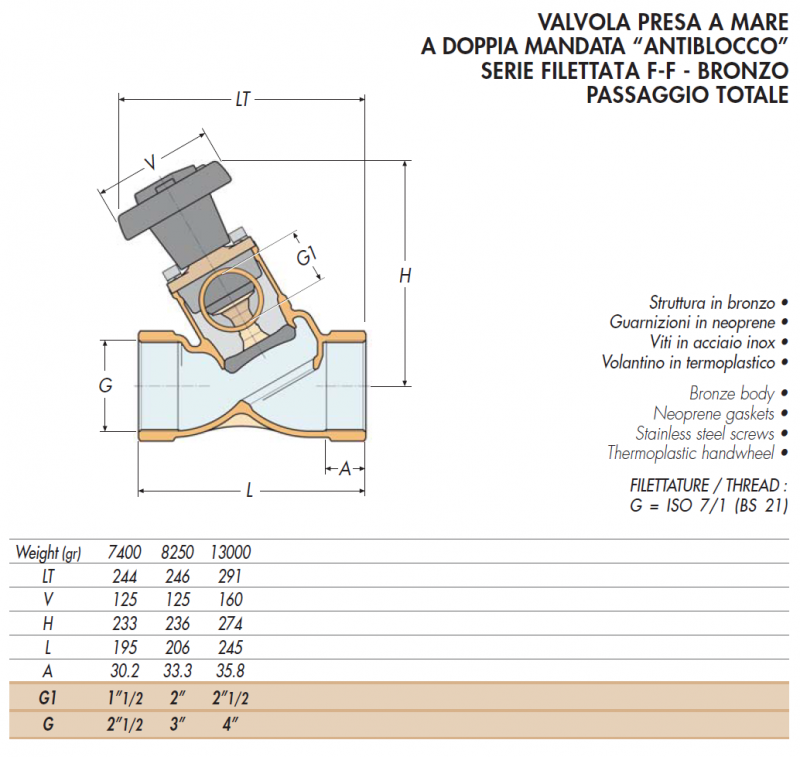
The things I am talking about are as per pics below, and this is the relevant page in Guidi website.
Btw, one interesting feature shown in this webpage is that the closing bit (or "control kit", as Guidi calls it) is available as a spare part and can be replaced - something which afaik is not possible with any traditional ball valve.

The fact that they are built (and patented, afaik) by Guidi should be a good guarantee in itself.
Besides, they are only available in bronze, and they are somewhere in between reassuringly and outrageously expensive…
So, I guess they are bound to be good.
Otoh, I never came across them on any boat, and I neither heard any experiences about them - hence this thread!

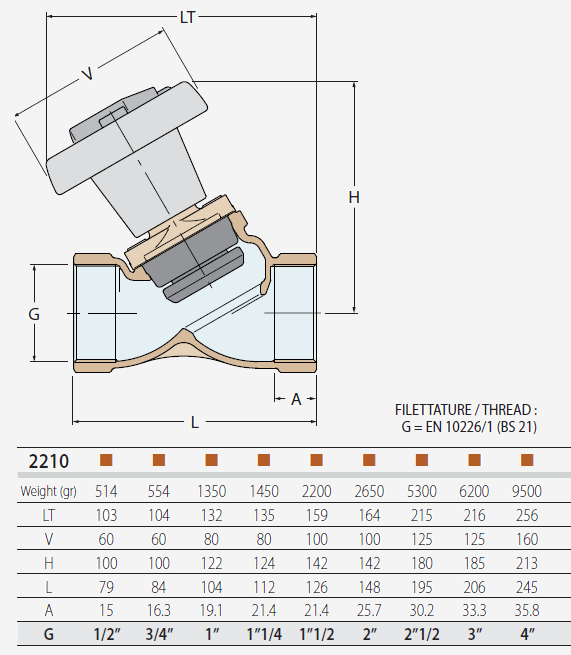
valvola-antiblocco-filettata-con-indicatore-di-posizione_0.jpg


misure_2210.2.png
 
Wow, this must be a forum first.
I can't remember to have ever seen an inquiry about any nautical component which was totally unknown here in the asylum...
Oh, well. Thanks anyway.

I'll try to collect some feedback old style (i.e. asking some installers).
And if eventually I'll decide to give the above thing a try, I'll post the impressions in due course...
 
Yes I have heard of them and most site members use them without realising they are using them.

Generally they are coated with various materials on the parts which stick and they are extensively used in fuel pump nozzles as one example.
 
How do the prices compare with these-
https://www.valvesonline.co.uk/manu...ronze-globe-valve-sdnr-pn25-screwed-bspp.html
I've seen them used in potable water pipes but no experience of their suitability in the marine environment.
Well, the list price of the Guidi valves is almost double vs. the ones in your link, but I'm not sure of how valid the comparison is, since prices advertised by online resellers are usually discounted, to some extent.
Besides, indeed those valve look more general purpose, while Guidi ones are specifically included in their marine range.
Which doesn't mean that some non-marine stuff can't do the same job, anyway!
 
Last edited:
Yes I have heard of them and most site members use them without realising they are using them.

Generally they are coated with various materials on the parts which stick and they are extensively used in fuel pump nozzles as one example.
What do you mean by not realizing to be using them?
The way to handle them vs. the usual ball valves with lever is very different, I reckon.
Regardless, what did you hear about them? Any idea of their pros/cons?
 
What do you mean by not realizing to be using them?
The way to handle them vs. the usual ball valves with lever is very different, I reckon.
Regardless, what did you hear about them? Any idea of their pros/cons?

Most people using fuel pumps don't realise the valves inside them are coated with various compounds to stop them sticking, and they are also coated with other anti wear materials on moving parts.

There is no difference at all as the only difference is the coating which can be many things and it depends on what they are used for. In a ball valve as you describe the ball may be coated, but depending on type the two cones may be easier to coat and cheaper to finish. Teflon is a popular choice for many things as it is defined as a plastic and can be applied in several ways depending upon the base material it is applied to.

Gate valves are usually reliant upon a screw thread and this may have an electrically deposited metal coating applied such as a brass or bronze to both halves of the thread to stop these sticking, or they may have PTFE coatings on both halves of the thread to stop corrosion, it depends on the specific application.

Generally; a low friction coating on a ball valve may allow it to move under vibrations, it could close or partially close when it should be open, or it could vibrate open when it should be closed and to counter this manufacturers adapt the housing to allow you to insert a cotter pin in both the fully closed and fully open position so you can stop your valve from moving from its desired position.

For screw threads it is more about frequency of use, a frequently opened and closed valve would need a high deposition of anti friction metallic coating for frequent use, for infrequent use a thinner deposition of material will suffice and it depends how frequently the valve is used as to how long the coating will last.
 
P what are thinking of using them for on your boat ?
Look like a glorified tap .I would have thought ok for between fuel tanks or water tanks ,you know draining off etc .
Not sure I would use them on application where seawater flow rate is important because they look restrictive internally.
Also with sea use , your main engines IN , geny IN and Aircon pump IN theses are infrequently moved in normal use .
Ok you may excerise them as and when but a nice lever is handy ( scuse the pun ) .
Another potential issue is eyeballing there status ? You can see if a lever is open or shut or accidentally in between.
Not so sure with these ,guess you just hand turn them until they stop either up or down hmm ?
Then there’s another Sod’s law added layer of compilation of the 4 hex screws ( dissimilar metsls + sea water hmm ) a gasket to perish or realign or simply get a replacement part in [ insert your years ] the future .
Taps also leak down the turning shaft - eventually, drip drip etc .

Nah mate leave them in the catalogue.:encouragement:
 
Not sure I would use them on application where seawater flow rate is important because they look restrictive internally.
I had the very same doubt, looking at the drawing.
Otoh, a 100% flow capacity is specified in some tech specs which I found (on an IT-only website, sorry).
Anyhow, the things are specifically meant for seawater, that's for sure.
In fact, there is also a 3-way version (see below), which is specifically designed for engine raw water, with the second intake to be used for sucking from the bilge in an emergency.
Only available in pretty substantial sizes btw, from 2" 1/2 to 4".
I can't imagine Guidi building shabby components meant for installation in 80+ footers...

PS: ref. the s/steel screws, I don't think they get in touch with sea water, though I'm only guessing from the pics.

valvola-3-vie-filettata-antiblocco-bronzo.jpg


misure_2250_0.png
 
Last edited:
I like those a lot mapism. Thanks for the info. I'm just about to change all my seacocks because I feel like it, and just took delivery of 3000£ worth of ball valves. I wonder if I should stop the job and buy yours.

It might depend on the boat but on mine the ss would not be in a galvanic circuit with the bronze, so all good on that score.
 
It might depend on the boat but on mine the ss would not be in a galvanic circuit with the bronze, so all good on that score.
If you mean that your seacocks are bonded, so they are on my DP (as opposed to those of the CNA, which weren't).
Otoh, if by chance you mean anything else, could you elaborate?

Anyhow, in spite of what Assassin takes as a given, I don't think the screws would touch seawater, at least on the first version above.
Not that I've seen them in flesh (yet), but pretty sure the neoprene gasket goes around the screw - that's the very least I would expect from Guidi.
The only possible doubt is about whether in the second version (3-way) the screw are enclosed in bronze also inside the cubic "box", but I'd be surprised if they weren't - again, considering where they come from.

I'll email you in a min ref. a possible purchase option.
 
If you mean that your seacocks are bonded, so they are on my DP (as opposed to those of the CNA, which weren't).
Otoh, if by chance you mean anything else, could you elaborate?

Anyhow, in spite of what Assassin takes as a given, I don't think the screws would touch seawater, at least on the first version above.
Not that I've seen them in flesh (yet), but pretty sure the neoprene gasket goes around the screw - that's the very least I would expect from Guidi.
The only possible doubt is about whether in the second version (3-way) the screw are enclosed in bronze also inside the cubic "box", but I'd be surprised if they weren't - again, considering where they come from.

I'll email you in a min ref. a possible purchase option.

P let me elaborate and apologies for not making it clearer in an earlier post .
This SS screw thing .
They don’t have to be in contact directly with seawater , just sat in a salt air environment is enough.
Any gasket separation is only at the head flange end .The threads and tap ( tap as in screw ) will be in contact .

There’s a thread by John + Michie regarding a fast alternator top bolt on a VP .Thats the alloy body of the alternator and std steel bolt .Add 10 years or less of sat in a boat ER and guess what corrosion.Accidentally getting them wet on the outside isn’t gonna help either .

Take a look at these pics - scrutinise the metallurgy.

View attachment 76099

View attachment 76100

So here is a boat ER component those bolts that hold the alloy valve cover are made of the exactly the same light alloy as the valve cover .They could have used any size 13 mm and suitable L base metal bolt from a part supplier.
But nope .
Even though sea water ( I hope :) ) is not passing any where near they use the same metal .The salt air leaves them alone , they do not cease in , some years later .
In fact MAN are quite fussy on keeping bolts as much as possible the same to facilitate easy retrieval at a later date .

If you look at a VP engine ( certainly the KAD series ) they just use AN Other bolts and the paint soon cracks off , the heads rust and the process of ceasure starts .Alternator main bolt being just one example .

As I said my concern is the retrieval of those SS bolts from the bronze and the at reinsert x threading the hard SS into a soft bronze ( or what ever the body is made of ) .
Then potentially ripping a gasket = seepage = exacerbating the salt environment.
There’s a pair of dissimilar metals bolts and body as opposed to similar metals illustrated in the pic above .
Surley from a insurance POV a invoice for new seacocks in a timely manor trumps never replacing the body ,even though you ad hoc did a few internals - cos you could ?

The 1 st time those SS bolts will retrieve easily and you will think Porto was wrong .
However during this you inevitably get seawater into the 4 holes as you lift out the inner replaceable part .
Think nothing of it - grab the I pad and raise a post telling us all how great they are .
Er until the 2 nd and subsequent times whereby the now neat saltwater has has done its stuff acted as a nice electrolyte between the SS bolt and body of the thing .Good luck with that .
 
Last edited:

Other threads that may be of interest

Top