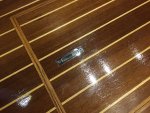
matthewriches
Well-Known Member
Having nearly completed my interior refit, the time had come to deal with the galley floor… oh the decisions! I wasn't going to get away with a concrete flagstone floor :nonchalance: so teak and holly it was!
Now I'm not a woodworker, far from it so this called for an able hand!
The boat originally had a wooden floor that had become damaged, which was then unlovingly replaced by the previous owner with lino – all downhill from there really but it was ripped out in the early days of my ownership.
Take 2 pieces of Robbins Elite teak and holly veneered plywood…
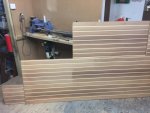
Then make a crude, but accurate Blue Peter style template (ask an adult to help with the scissors)…

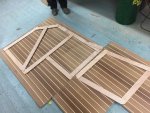
Then chop some shapes out and test fit. It is important when cutting veneered wood to use a sharp router to stop the edges from splintering upwards and ripping the veneer.

Make a hatch for shower pump access. This was made using the routed inner section to ensure a continuous pattern matched design. A teak edge was added, glued on with thickened West Epoxy and panel pinned. Ensure brass or stainless pins are used to avoid rusting in the future.
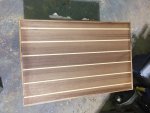
The large part of the floor was made away from the boat. Inner edges were also edged, again glued with thickened West Epoxy and pinned.
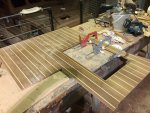
The hatch frames were trimmed flush and everything was machine sanded. 3 coats of Bonda Wood Seal were applied with a foam roller. This makes for a very hard surface and starts to make everything look pretty!
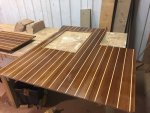
The panels were glued to the GRP floor using yet more thickened West Epoxy. A small threshold strip was added, as it was impossible to lay the panel in one piece due to the floor shape. A few pieces of recycled teak “skirting” were also added around the cupboards to hide the GRP base.
Once the Bonda had dried, many coats of varnish were applied. I chose to use varnish as opposed to oil.
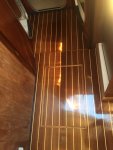
All that’s needed is a few more afternoons to install the new staircase and finish varnishing the remaining odd bits, skirting, bulkhead and cupboard doors!
Now I'm not a woodworker, far from it
so this called for an able hand!The boat originally had a wooden floor that had become damaged, which was then unlovingly replaced by the previous owner with lino – all downhill from there really but it was ripped out in the early days of my ownership.
Take 2 pieces of Robbins Elite teak and holly veneered plywood…
Then make a crude, but accurate Blue Peter style template (ask an adult to help with the scissors)…
Then chop some shapes out and test fit. It is important when cutting veneered wood to use a sharp router to stop the edges from splintering upwards and ripping the veneer.
Make a hatch for shower pump access. This was made using the routed inner section to ensure a continuous pattern matched design. A teak edge was added, glued on with thickened West Epoxy and panel pinned. Ensure brass or stainless pins are used to avoid rusting in the future.
The large part of the floor was made away from the boat. Inner edges were also edged, again glued with thickened West Epoxy and pinned.
The hatch frames were trimmed flush and everything was machine sanded. 3 coats of Bonda Wood Seal were applied with a foam roller. This makes for a very hard surface and starts to make everything look pretty!
The panels were glued to the GRP floor using yet more thickened West Epoxy. A small threshold strip was added, as it was impossible to lay the panel in one piece due to the floor shape. A few pieces of recycled teak “skirting” were also added around the cupboards to hide the GRP base.
Once the Bonda had dried, many coats of varnish were applied. I chose to use varnish as opposed to oil.
All that’s needed is a few more afternoons to install the new staircase and finish varnishing the remaining odd bits, skirting, bulkhead and cupboard doors!