
New LED lighting for heads

Not quite- just reporting some empirical hands on experience, extended use of a mix of non-stabilised LEDs running up to 15v on one boat.

Others have posted similarly on this thread.

N

Others might find it interesting to see some balancing hands on empirical experience take a look at my lab work. You have been fortunate others might not be!
 

Attachments

  • 12volt resistor solder melt@16v.jpg
    12volt resistor solder melt@16v.jpg
    82.9 KB · Views: 0
The forward heads in our boat is right up in the now. The wc is centrally placed right at the forward end of the space and faces aft. There are mirror fronted cupboards on both sides of the space and I wish to install new led lighting above these mirrors. I have in mind a fitting of perhaps 8 to 12 inches in length.

Any suggestions ad to where I might be able to source something suitable?

Thanks.

For a voltage stabiliser, try looking for BENCOR on eBay. He seems to sell units, we have a couple in place to hopefully protect LED lamps and other sensitive electronics.
 
As we all go LED, to you think we'll see regulated lighting circuits as the norm, or is it likely to go on being per-bulb?

Yes I think eventually stabilised constant voltage power supplies will be the norm. They are not that expensive if boat owners wish to upgrade their lighting circuits now. Volt drop isn't a particular issue on long cable runs when using LED lamps as the load current is much lower than that associated with incandescent lamp loads.

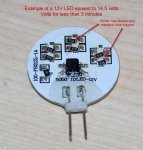
Incidentally, the lamp I showed with the slipped resistors was working perfectly when level. The resistors slipped only when I turned the lamp vertically and gave it a tap. The point being the lamp was hot enough to melt the solder and empirically it seemed to be working well, hence the warning. The very low cost lamps are constructed using the least expensive components and a low wattage resistor is less expensive that a higher rated one. In the example the resistors were clearly not rated to carry the current flowing at the elevated voltage and the extra current turned them into heaters, which in turn, melted the solder. However 12V was clearly marked on the example lamp and at 12V it was absolutely fine.

Avoid linear regulators they are very inefficient and waste power whilst preventing LED lamps overheating but expend heat into the linear regulator's heat sink, if fitted! That's another subject.

At the moment in the absence of constant voltage supplies, I would recommend only use constant-current controlled lamps on your expensive boat. These are widely available and not too expensive given the build quality of good lamps from a reliable source. A constant-current driver contained within the lamp will significantly extend its working life whilst maintaining the light output.

Well designed resistor controlled LEDs are fine if you have a constant voltage, in a car they work well and are designed for best light at 13.8V, that's of course when you tend to use them most, when your engine is running.
 
At the moment in the absence of constant voltage supplies, I would recommend only use constant-current controlled lamps on your expensive boat. These are widely available and not too expensive given the build quality of good lamps from a reliable source. A constant-current driver contained within the lamp will significantly extend its working life whilst maintaining the light output.

Many thanks. I have some of your bulbs and they work jolly well. Will they also work off a constant voltage supply if I fit one, or will the two regulators confuse each other?
 
Many thanks. I have some of your bulbs and they work jolly well. Will they also work off a constant voltage supply if I fit one, or will the two regulators confuse each other?

Thank you for the plug!!

Constant-current regulated lamps will work perfectly well with a constant 12 volt regulated power supply. The advantage of the power supply is that less expensive resister controlled lamps can be used without risk of overheating.

I noted a recommendation on this thread to an EBay vendor who supplied possibly useful power supplies. I took a look at the recommendation and the device needs a voltage of at least 1.5V more applied voltage than the required regulated output to work effectively. Seemingly if 13.8 volts was applied a steady 12 volt output would be available. However, if 12 volts is applied to the same regulator it will have a regulated output of less than 10.5v........erm that's not really that suitable for LED lamps on our boats. They would be relatively dim, despite the vendor oddly claiming that 10.5 volts would be OK for most applications. So the message is make sure you understand what you are buying.
 
Thank you for the plug!!

Constant-current regulated lamps will work perfectly well with a constant 12 volt regulated power supply. The advantage of the power supply is that less expensive resister controlled lamps can be used without risk of overheating.

I noted a recommendation on this thread to an EBay vendor who supplied possibly useful power supplies. I took a look at the recommendation and the device needs a voltage of at least 1.5V more applied voltage than the required regulated output to work effectively. Seemingly if 13.8 volts was applied a steady 12 volt output would be available. However, if 12 volts is applied to the same regulator it will have a regulated output of less than 10.5v........erm that's not really that suitable for LED lamps on our boats. They would be relatively dim, despite the vendor oddly claiming that 10.5 volts would be OK for most applications. So the message is make sure you understand what you are buying.
If you do an eBay search for boost/buck then it *should* supply very stable voltage both ways, ie if the supply is above or below the voltage you want to output. Though you need to check the spec, a lot are actually just buck!
I think it's these ones I have on board...
http://cgi.ebay.co.uk/ws/eBayISAPI.dll?ViewItem&item=350769448474
Very handy though I actually have bedazzled leds.

This one looks similar..
https://m.youtube.com/watch?v=vUb5xu72hvQ
 
Last edited:
I would caution against using LED lighting designed for use in the home. This is because the LEDs installed in shore based lighting products are designed to be used with an LED driver which outputs a fixed voltage of 12V. I don't think it is widely appreciated that damage will accrue to home lighting LEDs when used on a varying power supply as is normal on our boats. When charging batteries the engine alternator will produce 13.8V, at that voltage 50% more current will flow through a 12V resistor controlled lamp it gets worse if modern shore power is used. A modern smart battery charger which cycles batteries up to 16V when in equalisation mode will actually double the current flowing through the lamp, the outcome is fairly predictable.

I would concede that boat 12 V systems are often a bit over 12V while charging. I think anybody who "equalises" a battery system without isolating all attached consumers is asking for trouble anyway, never mind frying some LED lamps. The only time I have used that cycle I have had NOTHING but the battery connected to the charger.
I have a 12-30VDC to 12V DC stabilised power for the LED lamp circuit. Mind you I never had any particular bother with LED lamps before buying the stabiliser....
 
Top