Navily Anchor App - A 24m boat thinks it is OK to anchor with a 4-1 scope (with a CQR) in 45kn (and seems quite happy to only drag 50m)

Star-Lord

Well-Known Member
Joined
25 Jan 2020
Messages
1,279
Location
?
Visit site
I enclose a joyous review for an anchorage I was researching on Navily. They gave it 4/5. I will be watching out for their boat and giving it a very wide berth!!

(name of boat deleted) — 00/00/2019 (dates deleted but not year)
Sailboat — 24 m
Wonderful sandy bottom even with a CQR we held within seconds. We anchored awaiting a strong mistral which brought with it a gusty 45 knots due to the nearby mountains. I dived on the anchor the next morning to find even with a 4/1 scope we dragged 50m+ The negative of anchoring here is if there is little wind you are nearly guaranteed to be rocking like a seesaw! But I give it 4 stars for its beautiful sandy bottom along with a great beach plus little town with lots to do!
star-full.svg
star-full.svg
star-full.svg
star-full.svg
star-empty.svg
 
At least they eventually recognised the drag.

Slow drags, where the anchor gradually creeps backwards without digging in any deeper are not uncommon, and this may be what occurred to this skipper. These are very disconcerting to observe underwater, but often the owner is unaware anything untoward is occurring.

They are often a precursor to the easily recognised situation where the anchor lets go completely, producing a rapid drag.

A longer scope would obviously be much better at this sort of windspeed, but sometimes it not feasible.
 
AS Noelex mentions a common issue. You can see this even on some 'instructional' videos where shallow setting anchors never really lock up and slowly drag. This is even true of shallow setting anchors sized correctly for the yacht - and often goes unnoticed. The issue arises when the anchor meets some thing 'foreign' in the seabed, shell, seaweed or a discarded beer can - then the anchor can trip.

Jonathan
 
Last year in the Balearics I dragged four times in clean sand, three times on reversing the anchor in and once when the anchor appeared well set.
One occasion was because the sand was merely a thin layer covering a sheet of rock, another occasion covering clay (harder to spot as the anchor appeared set but only its tip had penetrated the clay. Spade anchor btw. )
One occasion was in a heavily used anchorage where, judging from the marks on the seabed, the sand had been ploughed into a very friable loose substrate.
I didn't find the reason for dragging when the anchor had appeared to be well set (20 seconds in reverse at over 3000rpm). But it certainly wasn't because I had anchored in sand at only 4:1 scope in 45kn gusts!
 
CQR's are not as good as they were said to be for many years. Years ago I had one drag on a good scope and it's not hard to see why. It's modelled on a ploughshare, which was designed to dig in to its own depth then rip the soil up, not keep getting deeper. If you look at the head of a Spade anchor, it's actually a CQR upside down to make a spoon.
 
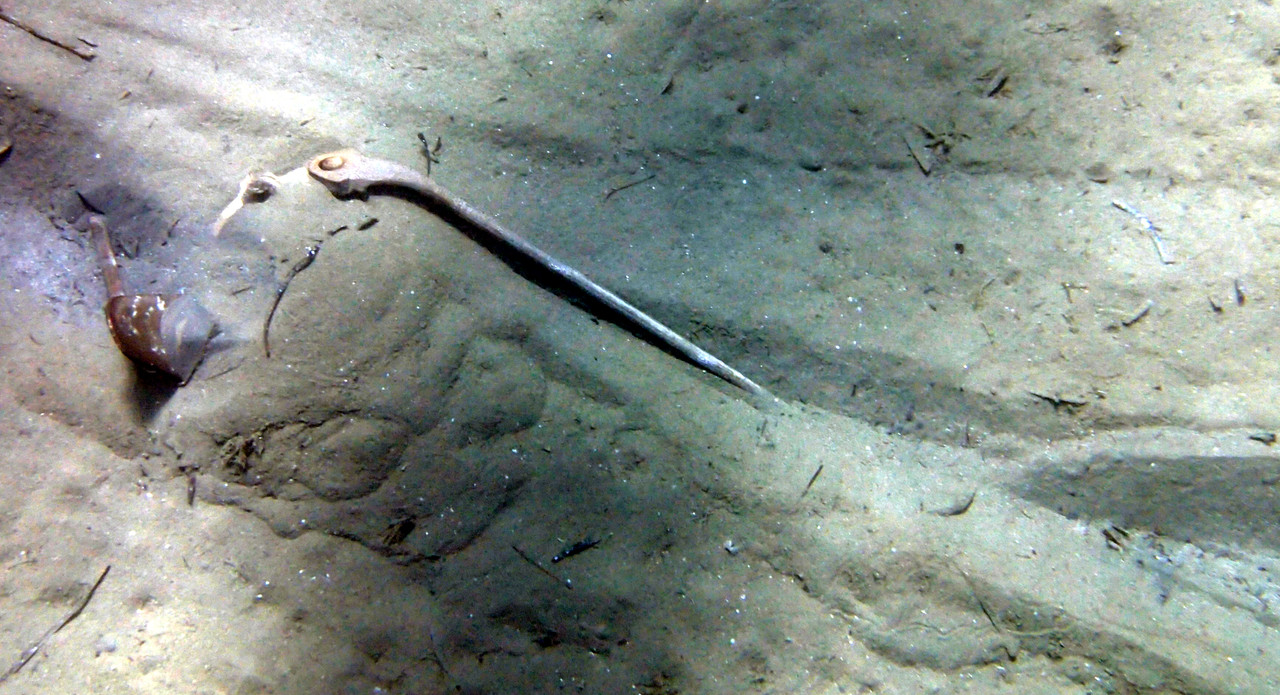
The odd thing about CQRs is that they can hold well but they do not seem to behave as their literature says they do. This photograph was taken during winds of about force 6. The anchor held the boat and did so overnight during very boisterous conditions. What it did not do is rotate, finishing up with the shank on the surface at 90 degrees to where it is here, with both faces of the plough buried. I have dived on very many CQRs and have never seen one that was vertical rather than horizontal as shown here.

 
One occasion was because the sand was merely a thin layer covering a sheet of rock

This type of substrate does not receive much discussion, but is one of the more common difficult substrates.

Unfortunately, it can be difficult to pick especially if there is enough sand for the anchor to behave normally when setting. In some cases the anchor can hold the full setting force provided by the engine, but it will let go in stronger wind as the anchor cannot bury further.

Here is a photo of an Ultra in this type of substrate. You can see the sheets of rock off to the left of the photo. The anchor is doing a good job considering the substrate, but cannot bury deeply because of the rock just below the sand layer:

img_2174404_1_a5afebca8fef810d3dc0776fcbefbd19.jpeg


This photo shows just sheet rock with virtually no sand above. This provides even worse holding, however, the anchor can still grab on small rock projections, as this Delta has, and hold the full setting force, despite the unreliable nature of the holding.

With very little sand, this latter type of substrate is at least easy to pick by noting the behaviour of the anchor while dropping the anchor, providing you are paying attention.

img_2173308_0_db2f200e0d3ed0f78518dcdeccff66e9.jpeg
 
Dragging two boatlengths over night in 45knots is not a huge amount.
That is what he observed underwater, so may include the distance the anchor took to set.
Some seabeds are effectively fluid, anchors will drag a little unless they are immense.
So what does one anecdote tell us?
 
I had a cqr copy for many years.

If we'd had a windy night, in say the Medway mud in Stangate creek, the anchor would need a good clean when brought up, but typically only on one side of the plough suggesting it had been set on its side like Vyv's picture above.
 
This type of substrate does not receive much discussion, but is one of the more common difficult substrates.

Unfortunately, it can be difficult to pick especially if there is enough sand for the anchor to behave normally when setting. In some cases the anchor can hold the full setting force provided by the engine, but it will let go in stronger wind as the anchor cannot bury further... With very little sand, this latter type of substrate is at least easy to pick by noting the behaviour of the anchor while dropping the anchor, providing you are paying attention.

Good point. I learned to feel the rumble of rock under sand with my hand on the chain. Hear it sometimes. Then up with the hook and look elsewhere.
Clay under sand was a right bastard though. The pick appeared to hold but I wasn't sure. As I dived over it I could see it dragging very slowly, creating a ball of heavy stiff clay as it went. By the time I got back on board I was bearing down on a Russian motor cruiser whose owner who made it clear that he wasn't impressed by my seamanship ?
 
I continue too be fascinated that despite the criticism of the CQR it did suffice until 'about' 2005/2010. It is till used today and some members here still use one. I confess we used a genuine CQR before alternatives other than Delta and Bruce were developed and we actually never had a problem. We did drag regularly with our Manson 'CQR' clone.

Jonathan
 
I continue too be fascinated that despite the criticism of the CQR it did suffice until 'about' 2005/2010. It is till used today and some members here still use one. I confess we used a genuine CQR before alternatives other than Delta and Bruce were developed and we actually never had a problem. We did drag regularly with our Manson 'CQR' clone.

Jonathan
Maybe the biggest problem with the CQR was our Yachtmaster courses used to tell us that a 3:1 scope was OK?
 
I continue too be fascinated that despite the criticism of the CQR it did suffice until 'about' 2005/2010. It is till used today and some members here still use one. I confess we used a genuine CQR before alternatives other than Delta and Bruce were developed and we actually never had a problem. We did drag regularly with our Manson 'CQR' clone.

Jonathan

I too used a CQR successfully for many years. I now successfully use a Bruce. The moral is, beware of, and do not use
copies or clones.
 
Maybe the biggest problem with the CQR was our Yachtmaster courses used to tell us that a 3:1 scope was OK?
I think this is a big problem. It sounds like the boat in question was playing it safe with a 4-1 scope. So assuming he normally uses 3-1. People anchoring in 3m with 1m bow to water (not everyone will do this) would lay out 12m!!! Shallower water means more scope! Minimum 20m scope please!
I have it on good authority (Captain Fatty) the CQR works if properly scoped and the anchor weighs above a certain weight... Maybe 25kgs... Or rather works well most of the time. But a 24m boat laying out 4-1 with CQR in 45kn wind... I wonder how much the boat weighed... Anchor was probably undersized... 50m drag was a result!
 
Top