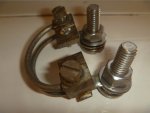
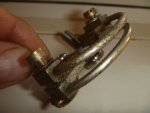
Mystery electrical object?

andyj301

Active Member
Joined
28 Sep 2016
Messages
64
Visit site
Please could anyone enlighten me as to what this is?
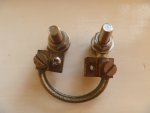
P1050825.JPG P1050827.JPGP1050826.JPG

It seems to be part of my bowthruster circuit and part of the alternator charging circuit. Thick wires attached to bolts and thinner wires to screws. I haven't got a clue where to start Googling about this. There seems to be something wrong with it, as it melted the plastic junction box it was in, when I ran the bowthruster. I can see what might be wrong and wondering whether I should try to solder it or replace with something more modern? Any help gratefully appreciated.
 
Looks like a shunt for measuring amps.

Attach a voltmeter to the smaller screws and it works out current .

You need to track the thin wires and find out where they go to see if it does anything useful these days - you can probably just remove it
 
Yes a current shunt. Designed for use witha moving coil milliamp meter. Hence very low voltage drop. Note that the meter is wired across the movable terminals which will pick off a portion of the volt drop. So move the clamps closer together you get less meter indication (so able to measure higher current) or further apart (nearer the main terminals for more meter movement or more sensitive readout. Hence actual accuracy could be achieved by using in conjunction with a test calibrated amp meter to set the clamps to the meter calibration marks. However even if it is not calibrated you could use it with a moving coil meter 0 - 1A MU45 Panel Meter - Moving Coil Type | Jaycar Electronics to give a reading which with regular checking will give you an idea of normal. ie charge current. Put a switch in to reverse the wires to check discharge current. NB fit fuses to the 2 meter wires if it is in the positive battery main wire.
If it is in the bow thruster or starter motor circuit it may be over loaded and so get hot. Tjhese currents are so high that if you set it up for measuring current the indications for samller currents would be too small. I doubt it would be suitable for a typical digital meter as they typically need more volt drop. It is probably ok even if it melted the plastic box. Perhaps if you use it just wire it into the alternator charge circuit or domestic service circuit not all of battery current. ol'will
 
Thanks for the detailed info, ol'Will. It's a wonderful world when help can arrive from such a great distance.

One end of the shunt seems to have melted the solder join, wasn't sure if this caused or was the result of the heat. There were also solder fuses above it which may have developed cracks over time.

Think I'll remove the shunt for now, the electrical system installed by the PO is 'overly complicated'.
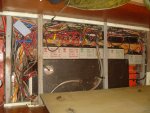
P1050437s.jpg
 
That's a lot of batteries!
There are six more wedged into various nooks, six pairs in total with each pair isolated by a diode. The surveyor was concerned with the electrics being in the bilge. It's great to have the weight low down but I accept his point, and the batteries are now getting near to replacement.
You seem to have another shunt wired also, in the upper part of picture just to the right of centre. Have you and ammeter or battery condition meter of some sort?
There is something called Link 10, I'm not sure if it's linked to that shunt. There also seems to be shunts on the negative of each pair of batteries.
 
Last edited:
Top