multihullers please and others

mikemacdonald

Well-Known Member
Joined
13 May 2005
Messages
244
Location
Littlehampton, W. Sussex
Visit site
Just had a look at the Biscay Storm video, daunting. Interested to know what our learned friends tactics would be if caught out in similiar conditions in a decent cruising cat. Our worst was 30Kn steady and 55 kn gusts on the Port quarter through the nigh coming back from St Vaast in a Heavenly Twins, I had blisters on my hands fighting the wheel all night ,we were reefed right down and the storm jib up, wet and wild and pretty scary but the boat looked after us, in the morning in the lee of the IOW, what was all that about.!!!! PS, would have liked some sort of drogue, any suggestions????
 
Did Biscay in May this year having waited a week in Audiernne for the storms to die down. This was in Solaris Sunstar (35ft). First night out winds were in the 28 - 34 range with gusts up to 40kts. The sea state was quite bad due to a week of storms.

As the wind increased we reefed down more and more and at one point went down to bare pole but put both engines on to give us grip.

We ran like this for a few hours and eventually the wind eased and we started to put reefed sails back up.

I must admit we felt reasonably comfortable. Lack of heel (monos take note!) and the steerage we had by having two engines.

It was not pleasant but not horrific either.

That said the conditions the Velux guys are experiencing are far worse.
 
parachutes and drogues are entirely different tools. The parachute is designed to anchor you to the water and will reduce sternway to absolute minimal (otherwise there is a danger of damaging the rudders. Whereas a drogue is designed to be hung on the stern to enable the boat to achieve a few knots through the water downwind and steerage way, and to give before a breaking wave.

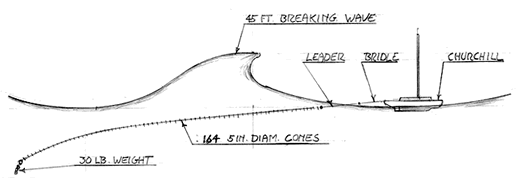
If you have the searoom, a drogue system is safer cause it is designed to ride through a breaking wave, whereas the parachute is designed to hold you in position and pull you through that wave. The kinetic energy from the wave is mainly absorbed by the drogue (provided it is designed like the series drogues), whereas the parachute relies on the strength of the vessel to absorb the kinetic energy - of these two, I prefer the series drogues (see here)
fig4_1.gif
 
Series drogues are the best item for multihullers, but this does demand a robust stern rather than french windows in order to cope with major breaking waves.

They are certainly my preferred solution and I like the Jordan series (see link on my other post).
 
Ive had a few experiences of gale force conditions in our Prout Snowgoose 37. Caught in a F8 in Biscay but only for a few hours coast hoping from La Caruna down to Finistere. We had huge waves from behind and managed to set a new record of over 17 knots surfing in our heavily loaded cat.
Got caught in a F7 from Algarve to Madeira. Not normally a problem but beam seas and one rogue wave, twice the size of all others left the inside of the boat looking like we had been ransacked. We slide down the side of the huge wave dramatically but suvived upright. Similar wind direction and strength between Madeira and Canaries and we had nothing to compare.
FRom the Azores to Ireland we had a F8 gusting over 50 knots for 24 hours. We were running with it, towards Ireland and had seas braking over the back of the boat. Even had a fish land in the cockpit! She was running on just a storm jib on the auto pilot under control despite surfing regularly without a drogue or anything else. The surfing wasnt wild and she ran true and straight. Down below she felt comfortable and stayed pretty flat. We ran normal watches( just me and my wife onboard) and not a lot changed. We just sat in the cockpit and watched the mountains build behind us. The occational big one would send me scurrying to the autopilot to take over until I realised that it did a better job than me so we left the autopilot to its own devices regardless of the size of the wave.
We hove too in 35 to 40 knots in the atlantic waiting for the worst of a storm to pass on route from the Caribbean without much fuss. We had a parachute ready to deploy but never felt the need.
Would glady cross the Atlantic again in a good cat
 
Excellent!
Unless you have done it you just don't know do you?
I have had one rather frightening experience with a friend on a run back from the Azores on his Snowgoose Elite, (before I built my own). At least it felt frightening surfing down big atlantic rollers under bare poles at up to 15 knots. Don't know what the wind force was as the gauge packed up ( your 17 knots sounds hairy) Hadn't been over 10 knots before and that only rarely. We used a drogue to slow us to about 6 knots and then went inside and shut the door, made several cups of well laced cocoa and played cards till morning. Tried Dominoes but they kept falling over for some strange reason.....
Lessons learned? When I built Peregrine I put very oversized bitts on fore and aft with enormously reinforced big plates underneath and fairleads on the inside of the hull fore and aft as well as outside for the drogue. I also have a very powerful hydraulic autopilot so I can play cards...... You do need a lorra lorra sea room though.
 
You may need different devices depending on wind strength and direction relative to intended course. Here are my options

Tested solutions:
Up to F8
Wind behind: take a reef in when surfing above 15 knots
Wind ahead: reef right down, motors on, sail close-hauled slowly to ease the pounding and wait for it to stop.

F8-9
Wind behind: bare pole, feather mast into wind to minimize drive as required
Wind ahead: forget progress, heave to with power assist.

Planned but untried
F9+
Never mind which way it's blowing: deploy para anchor. If it doesn't work, run off trailing warps with weights e.g. anchor attached to both sterns. I plan to get a series drogue before my next long haul.
 
Yep! Drogues every time. Don't like sea anchors. Too passive. With a drogue you can still steer a course so long as its downwind! In fact they seem to work better if you are not directly downwind and about 30 off.... And his heavenly twinge might be little but it has a super centre cockpit. Ideal I would have thought.... /forums/images/graemlins/wink.gif
 
But he's only got a little heavenly twinge! At 15 knots he will be crapping himself!
Joking aside though we all have tactics that hopefully work with our own boats. I have seldom needed to resort to engine power though and think tactics should use engines as a last resort to claw off a lee shore etc if desperate and you really can't sail. Over reliance on engines in crappy conditions would worry me. I find the Snowgoose will hove to to windward (although you have to ignore the slamming!) But it really does depend on if you can still sail or not. Given enough sea room I prefer to go downwind with a drogue and would never use a sea anchor. You will also find the drogue sets very well on a long bridle. I don't think I would want to try one off each hull though as the whole idea of the bridle is that you can tune it to pull a little off centre which helps the boat roll over the waves rather than going helter skelter straight down em... (honest It works a treat!)
 
Thanks for all your posts. Actually, we now have a snowgoose 37, Chocolate Goose, hence the interest . The Heavenly Twin was a superb little sea boat, but too small for 4 of us. Best we have done so far with the Goose is 30 kn wind in the Solent the other week, rock solid but sheltered water. Sea teach are selling a thing called Sea Brake, looks a bit gimmicky, does anyone know anything about its performance; the video looks OK but personal experience would be good. Otherwise, the Jordan system looks very promising?
 
get the jordan system. Have another look at it, there is a weight on the end of it which stalls the end drogues until the boat gets hit by a breaking wave, thus initially there is a much reduced drogue effect to allow the kinetic energy of the wave to dissipate, then as the boat starts to accelerate on the front of the wave, additional drogues are activated and the boat is slowed down and pulled gently through the wave (especially a prout)

The other advantage is that it is independent of distance between waves, whereas the other single drogues have to be a specific position within the wave train.
 
I have been back and forth about what our storm tactics should be...

Currently I am carrying nothing other than warps, chain and anchors if I needed to stream anything from the stern. I tried to engage Richard Woods about his experience and have had a short email conversation with John Passmore who holds the record for flipping the only Heavenly Twins.

Pat Patterson in the annex to his book "In the Wake of Drake" talks about multihull storm tactics. John Passmore in fact followed them as the weather of Shetland increased to hurricane gusts. His big mistake was leaving the helm and letting the boat run unaided, had he not been solo and able to share (he was exhausted) he probably would have sailed into the next port when the winds fell (from what I can gather).

But, I also know from messages on here and from John who spent many hours chatting with him following the capsize, that Pat was later showing more interest in para-anchors as a sensible approach.

On here the multi sailors all show interest in series drogues, yet this is untested on a multi, in fact I have never read of anyone who has rode a storm on any vessel streaming a series drogue.

I too want to do something, but what?

I am also confused about the length that people suggest for series drogues, up to a hundred buckets for example, surely, the last thing you want is to stop the boat. I have never seen one, but if the buckets are as large as the ones on my life-buoys then I would be afraid of the stern being ripped off the boat, never mind the cleats.

Also, you can't steer with a series drogue, a short line on a big drogue can be used to steer a boat under tow.

What to do? what to do?
 
[ QUOTE ]
"It's not easy being green"

[/ QUOTE ]

Where to start? First, it is clear there is no 'magic bullet' that works the magic for every situation.

So you start with 'Heavy Weather Sailing' - so you begin to understand. Then you start formulating questions. Some are easy to answer - like having cleats on fore and afterdecks that are really, really up to the job in heavy weather. We all agree on that - but only some actually do it!

Then we start to consider the special-purpose gear. Let's make it simple - how many boats do you know that has heavy-weather anti-chafing gear already on board and ready? One? Two? None.....? Do that first.

Next, let's argue about series drogue versus para-anchor. Have you got the 600-foot or more stretchy warp that both systems need? If not, go out and get one. When you've come back with that kit already available on board, let's now discuss what drag devices are probably most effective......

Multihulls work better in the big seas when whatever they're tethered to uses a bridle. That needs to be 3-6 times the boat beam, to be properly effective. How are you gonna attach the bridle arms to the warp? Have you done it - or just thought about it?

Next, is this device intended to stop the boat ( like a handbrake ) or simply slow it down ( like a footbrake )? That decides whether you hang it off the front or the back. Bear in mind that, if off the back, the boat must continue to be steered. For however long it takes. Do you trust your autopilot with your lives.....?

Next, what to attach to your warp to produce the wanted drag. All sorts of things have been tried. Both the Jordan Series Drogue and several flavours of Parachute Sea Anchor work - provided they're big and robust enough. If they're weensy, they won't do the job but for an hour or two. Not good enough!!

Kindly remember that Heavenly Twins 'Lottie Warren' was capsized by wave action - following the designer's wrong advice. A deployed parachute sea-anchor ( handbrake ) or series drogue ( footbrake ) would probably have had a different outcome. Speak to the journalist/owner for details.

Whatever you choose, it *must* be well strong enough. Don't compromise here.

Otherwise, 'Sea Leopard ' has probably got it 100%......
 
[ QUOTE ]
Kindly remember that Heavenly Twins 'Lottie Warren' was capsized by wave action - following the designer's wrong advice. A deployed parachute sea-anchor ( handbrake ) or series drogue ( footbrake ) would probably have had a different outcome. Speak to the journalist/owner for details.

[/ QUOTE ]

Are you saying that Pat and others have decided the advice followed by John was wrong, i.e. streaming a loop from bow to stern to force the boat to slide sideways down the waves? (stage 1)

and then streaming a loop from each hull with a tyre? (stage 2)

You see, I have kept these in memory in case, should I now remove them as bogus and as you suggest look toward a series drogue.

I have doubts about the para anchors now after reading Richard Woods experience of seeing his para break up, I wondered at the time if this was because cats are too light with windage and tend to snap and snag on a para (armchair wonderment only).

My greatest fear, I may only get one chance to get this right. My storm experience is from trawlers and lifeboats, both of which are far preferable to my little boat, but that is only from lack of knowledge I think.
 
The number of drogues is dependent on the size of the boat.
When at slow speed, the weight on the end of the series drogues at least halves the number of drogues actually working.
The weight of the series drogue on the cleats will be considerably less than that of the para-anchor, especially during the impact of a breaking wave.
Notwithstanding this, you would be foolish to hang the series drogue (or parachute) on any cleat that could not actually stand the full weight of the boat. and that means a reinforced anchorage point with metal strapping eitherside of the hull for at least a couple of feet for each leg of the bridle.

Boatmike's installation would make even that look flimsy!

The drogue is supposed to slow the boat down to a couple of knots or so

Have a look at the video of real life and tank tests http://www.jordanseriesdrogue.com/D_11.htm
 
There are two things wrong with your post.
1. Series drogues have indeed been used on mutis. My own post tells you of my own experience and there are many others. I did not record the wind strength as we had no way of doing so but in that instance I would estimate that it was F9-10. Certainly not less.
2. You can't steer with a drogue out... Not true as I said you can indeed steer but only to a limited extent. This limited extent in my view is about 30degrees either side of dead downwind achieved mainly by an unequal bridle assisted in my case by a good autopilot. Often enough to ensure you track away from danger but not always of course. If you are off a lee shore forget the drogue anyway as it will be useless if you need to make way to windward.
 
I agree largely with your post apart from one very clear point. A proper autopilot ( not an undersized autohelm) will steer the boat superbly well if the drogue is deployed properly. Frankly in any conditions I have faced the autopilot does a very good job of relieving the stress on a short handed crew and I have simply never found conditions where I could do better than my autopilot including going to windward in a F8. ( Not with a drogue obviously!)
I do agree with you however that chafe on any gear is important and that's why my bridle has chain covered with nylon tube for the first 6 feet either side connected to heavy stretchy nylon rope. This bridle has also given me the confidence to ride out a gale in the Isles of Scilly with a ground anchor set while chaos rained on other boats around. The drogue does not even come on board for normal channel cruising though and unless setting out to the IoS or beyond I would never see the opportunity to use it.
Only those who have had the misfortune of being caught in a true ocean storm know what it can be like, but when you have actually been there and done that, and lived to tell the tale you know that your tactics, in my case learned from someone who had sailed many thousands of blue water miles, are sound.

I would frankly never dream of even trying a sea anchor. The forces are simply too great. Others who have actually done so may change my mind but the only people I know who tried said "never again" The drogue is just simply magic though and if I ever set off across an ocean again it will be on board cos I have tried it and it works, but I hope never to use it again, ever!
 
It was actually a home made device that I have posted details of before Mike but if I was to buy a ready made one it would probably be a Jordan. The important thing is that there is a fairly long warp of soft nylon rope say 150/200 metres to deploy it on (not the 600 metres that some have suggested) Frankly I think you probably need to ensure that it is really robust rather than offering maximum drag and that it has sufficient weight on it to stop it leaping the waves. People have tried streaming all kinds of things in emergency. I know one guy that had nothing to hand in a really nasty storm off Cuba who tied all his fenders together , weighted them down with a CQR anchor and towed that behind him! Seems to have worked as his cat (a Dean of about 42ft I think) came through OK and his reported 20 knots sliding down wave fronts was slowed to about 8-10 which enabled him to control the boat and stop it broaching in the troughs. If you are really interested in how I made mine PM me and I will let you have details but I would not claim it to be better than a Jordan, only cheaper!
 
Top