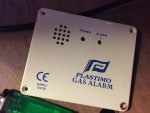
MQ2 gas sensor - resistor help needed please

Crazy-Diamond

Well-Known Member
Joined
27 Mar 2019
Messages
175
Location
Essex. UK
Visit site
Hello all,

My Plastimo gas alarm is not working. Not surprising given the state of the sensor. I have ordered a replacement sensor, but I need to get a new resistor too. I have a basic grasp of the colour codes, but I can't work this one out. Could someone enlighten me please?
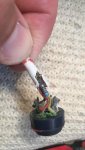
resistor.jpg

It looks like brown red black black - but I can't find a resistor like that.

Any help appreciated.

Giles
 
Could it be brown red black black silver? Ie a 5 band resistor. In which case it's an E96 or E192 series (not E12 or E24), and should be read as 1 2 0 x10^0 to 10% tolerance. ie any old 120 Ohm resistor will do fine.
 
Could it be brown red black black silver? Ie a 5 band resistor. In which case it's an E96 or E192 series (not E12 or E24), and should be read as 1 2 0 x10^0 to 10% tolerance. ie any old 120 Ohm resistor will do fine.

Correct.
I suspect the resistor will have survived though.
 
Well, the easy solution is to re-use the resistor then.

I suppose it could be a 5 band - as there is a silver colour at that end of the resistor.

Thanks for the input
 
Some progress with this alarm repair. I replaced the sensor with an MQ2 alarm, along with the relevant in-line 120 Ohm resistor for one of the wires. The old one was ruined.

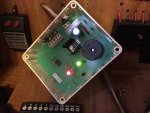
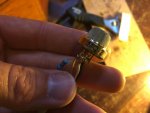
When powered up the red "alarm" light on the panel illuminates, when there is no gas, but the audible alarm does not sound, the sensor itself also became slightly warm to the touch. Perhaps this is intended to keep it dry (it does live in the bilge after all). I used a disposable cigarette lighter to test the sensor, even though the red LED was on. Rather strangely the LED went out when gas was applied. Give the six pins on the back of the sensor are not labelled, I swapped the wires over hoping to get the opposite reaction, but it was the same (hence the poor quality soldering in the pic below).

Some shorting of the sensor wires did make the alarm sound, so I know that is working. I am uncertain how to proceed here. My grasp of electronics in this area is not strong. Perhaps I am wasting my time trying to replace the sensor, and should just get a new unit. However, if I can fix this with a few pounds worth of components I'd be happy! The new sensor is working, because it makes the LED go out when I squirt the unlit lighter at it.

I can see there are various types of sensor available, all quite cheap, perhaps I need a different spec?

IMG_7983.jpg

IMG_7984.jpg

IMG_7985.jpg

I have a CO alarm in the boat, perhaps an easy solution is to get a similar (stand alone) gas alarm, but I think having that in the bilge won't work!!!

All ideas and advice gratefully received!

Giles
 
I don't know how much you value your time, but with the prices you can get sensors like this on E-Bay for the whole repair project looks like a false economy....
 
The sensor is a new one from ebay

Well... it seems like by fiddling with it you missed out on the E-Bay buyer protection policy which is in my extensive experience second to none.
Anyway, I meant "Gas Alarm", the whole instrument. In the modern electronics replacing components especially if diagnostics is involved is in most cases a waste of time and money.
BTW: I can't comment on most of the parts of the current behaviour of your instrument, but the higher temperature is normal. The sensor detect flammable gasses by the means of a resistor heated to a temperature high enough to burn them. If this occurs, the temperature of the resistor rises even higher resulting in a change of resistance which is what triggers the alarm.
 
Last edited:
I think the new ebay sensor is working, seeing as it reacted when given the gas :)

Can you suggest an ebay replacement gas alarm, 12v with a remote sensor? I can't see any except a cheapo from China, which I'd rather avoid! :)

Thanks
 
I think the new ebay sensor is working, seeing as it reacted when given the gas :)

Can you suggest an ebay replacement gas alarm, 12v with a remote sensor? I can't see any except a cheapo from China, which I'd rather avoid! :)

Thanks

I don't have any favourite brand/product and taking in account the simplicity of the instrument, I don't think there is a major risk in buying one of the Chink ones. I have on my boat one of them (not with a remote sensor) for 4 years now. I test it regularly and it is still working well. The manufacturer recommends changing the sensor after 5 years (because of the high operating temperature these have to be considered as "consumables") but I will happily spend another $20 or so for a completely new system instead of changing the part.
So, my recommendation: go through the offers, find something what fits your needs, check the feedback and if generally positive, buy it. Testing of these things is very straight forward (do have a strict schedule in place though) and your risk is close to zero.
 
Top