MPPT Controller

Stemar

Well-Known Member
Joined
12 Sep 2001
Messages
25,673
Location
Home - Southampton, Boat - Gosport
Visit site
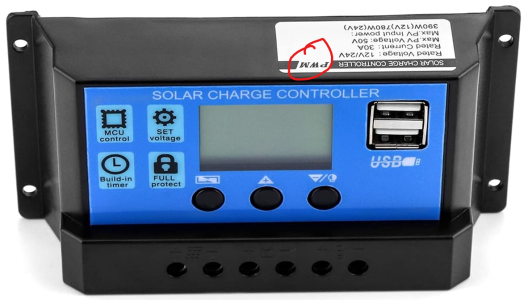
What's the likelihood of this actually doing what it claims?

I just found my own answer - according to comment, it's PWM. I thought it was too good to be true!

As I would like to keep my starter battery topped up as well as charging my domestic bank (150AH LA), is there an affordable combined MPPT controller and B2B charger?
 
Last edited:
There's an identical one fitted on my fairly new-to-me Sage 26 HT, where the previous owner bought everything Chinese off eBay! It only has a ~50W (presumably Chinese eBay) panel driving it, but seems to still work fine after ~ 2 years keeping my 100Ah house battery topped up when the boat is moored up. I will be looking at more panels and Victron MPPT controller(s) when I get some time though!
 
Buy a Victron genuine MPPT, then you can waste a lot of time looking to see what it's doing on your phone (via Bluetooth, so your phone has to be close) - at least you will know it's working. That's what I did, given me hour's of amusement for what £60-70. !
 
What's the likelihood of this actually doing what it claims?

I just found my own answer - according to comment, it's PWM. I thought it was too good to be true!

As I would like to keep my starter battery topped up as well as charging my domestic bank (150AH LA), is there an affordable combined MPPT controller and B2B charger?
Zero likelihood as you point out.

But they do work as adequate pwm controllers for a fiver I have found.
 
I would prefer a name brand. However, PWM can be pretty darn cheap and still work fine. I had a $15 controller like that running a 50W panel for 15 years on a small boat. Then I sold the boat.

I've had PWM and MPPT, and here is something to think about; companies like Morningstar make both PWM and MPPT because sometimes PWM is better. Read this white paper.

PWM vs MPPT. Which is better ... depends.

While in most cases, cruisers with larger banks are better served by MPPT, PWM has advantages for small banks and battery maintainers. Don't believe me, believe the people that make both.
 
A PWM, pulse width modulation, charger basically pulses panel voltage to the battery with a duty cycle that then charges a 12 or 24 volt system. They don't work with the newer high-voltage panels and they have an input Voc (open circuit voltage) limit of around 30V. This is IMO outdated tech.

A good MPPT, maximum power point tracker, will connect to an array with higher voltages and usually has programable charge profiles with 3 stages, bulk, absorption, float as well as support for different battery types.

I would not use a PWM for anything other than a small panel keeping a starter battery topped up.

MPPTs are more expensive, that is their only disadvantage over PWM.
 
Looks exactly like one I bought years ago as a backup. I used it when my Marlec HRDi PWM failed and awaiting parts. It actually worked well and daily output matched the HRDi. I had a lot of data for comparison. It was also close to output from the other panels with an Epever MPPT unit. However, that's in strong daily med. sun when MPPT has less advantage over PWM.

Certainly not MPPT and doesn't display any useful information. Advert promised A, daily Ah, etc. Luckily I have other instruments for that information.
 
What's the likelihood of this actually doing what it claims?

I just found my own answer - according to comment, it's PWM. I thought it was too good to be true!

As I would like to keep my starter battery topped up as well as charging my domestic bank (150AH LA), is there an affordable combined MPPT controller and B2B charger?
I use a dual battery PWM controller for keeping starter battery and domestic charged up works well,MPPT controllers can have a high self consumption noticibly if you dont have much solar.
 
Thanks due to Baggywrinkle for spelling out what the acronyms stand for. They seem to trip readily off peoples tongues, or should that be keyboards but so often leave me baffled as to what people are meaning.
 
I use a dual battery PWM controller for keeping starter battery and domestic charged up works well,MPPT controllers can have a high self consumption noticibly if you dont have much solar.

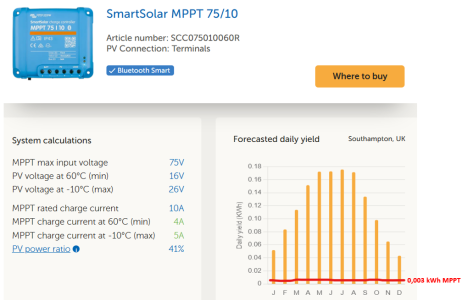
A Victron 75/15 MPPT has a self consumption of 10mA ..... 0,01A so over 24 hrs it will consume 0,24Ah which at 12,8V equates to 3 Wh or 0,003kWh
https://www.victronenergy.com/uploa...-MPPT-75-10,-75-15,-100-15,-100-20_48V-EN.pdf

The expected yield from this controller with a run-of-the-mill 55W 12V panel is shown in the picture below with the self consumption in red.
MPPT Calculator - Victron Energy

1756373464672.png

The PWM from the OP has a self consumption of 6mA ... 0,006 A so over 24 hrs it will consume 0,144Ah which at 12,8V equates to 1,8 Wh or 0,0018kWh
https://www.solarversand.de/media/pdf/80/13/3c/121020-D.pdf (Sorry it's in German but the important number is "Leerlaufverbrauch")

That's a 0,0012 kWh difference per day = 1,2 Wh which at 12,8V is 0,094Ah difference ... or 0,016% of a 60Ah starter battery.

My conclusion is that the self consumption difference between the OPs PWM and the Victron MPPT is pretty much irrelevant.
 
I use a dual battery PWM controller for keeping starter battery and domestic charged up works well,MPPT controllers can have a high self consumption noticibly if you dont have much solar.

High self-consumption wasn't something I was aware of with MPPT regulators in general. My Epever unit quotes self-consumption as ≤20mA at 12V. That would be less than 0.5Ah per day and that's under 0.1% of my battery capacity. Perhaps I was lucky in my choice of an Epever.
 
Well-designed MPPT controllers almost always produce a higher solar yield than PWM controllers. The more complex MPPT technology creates significantly higher levels of self consumption, but except in very rare (and usually brief ) examples, MPPT technology still produces a better result.

A Victron 75/15 MPPT has a self consumption of 10mA ..... 0,01A so over 24 hrs it will consume 0,24Ah which at 12,8V equates to 3 Wh or 0,003kWh
https://www.victronenergy.com/uploa...-MPPT-75-10,-75-15,-100-15,-100-20_48V-EN.pdf

One excellent feature of the Victron controllers is that they have kept the self comsumption low, but the figures quoted are deceptive. Because of the high self consumption all decent MPPT controllers enter a sleep mode when they detect solar panel production is low (at night). This sleep mode disables much of the circuitry needed for the controller to work.

Victron is quoting the self consumption when the controller is in this sleep mode. This is a useful number as it indicates how much battery discharge will occur if the solar panels are permanently disabled, say stored below deck during winter.

When operating, the controller will have a significantly higher self consumption than 10mA.
 
Last edited:
I imagine the higher consumption wouldn't usually matter when generating if it produces more than PWM anyway.

I think much of the MPPT advantage will be lost here in Greece. A PWM in Scotland will spend a lot of time with low panel voltage, often not enough to charge. MPPT will increase the lower voltage to reach a point where it can charge.

In a Greek summer the sun switches on an off from full power pretty quickly almost every day. Even PWM reaches a good voltage most of the time.

My historic measurements show little if any gain for MPPT most of the time.

Completely different in Scotland for some odd reason. :D
 
Top