Moorings in anchorages

Skip 52

Member
Joined
13 Oct 2010
Messages
31
Visit site
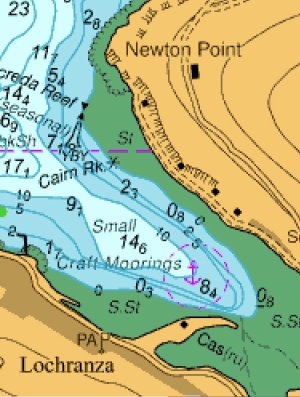
Does anyone know what the legal situation is regarding anchorages shown on admiralty charts? I ask because recently we have tried to use a couple of designated anchorages around Arran - the attached example image is from the Memory Map/UK Hydrographic Office chart of Lochranza. The anchorage area is clearly shown on the chart, but in fact there are now at least six mooring buoys within that area. Which makes it totally unusable when using a 6x rode. Highly necessary here - an anchored yacht was blown onto the rocks earlier this year.

Any advice gratefully received!
 

Attachments

  • Lochranza_anchorage.jpg
    Lochranza_anchorage.jpg
    205.1 KB · Views: 68
AFAIK, the Clyde Yacht Clubs' Association and the Crown Estates co-ordinate to actively control the impact of moorings on traditional anchorages within the Clyde area. Any moorings within Loch Ranza, and elsewhere, are almost certainly agreed with these bodies and are therefore presumably legitimate. If not licensed, the CE is likely to remove them.
There is also the West Highland Anchorage and Mooring association, WHAM, that does similar work outside the Clyde.
 
Last edited:
You should be able to fit more boats in the same space with moorings than anchoring. Visitor moorings will (usually) only be in moderately deep water so they can be used by most yachts. Shallow draft boats may be able to anchor closer to shore. There’s no guarantee of finding space to anchor just as there’s no guarantee of finding an available mooring.
 
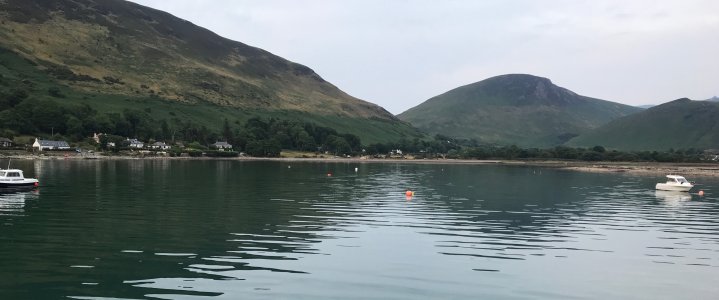
Thank you all for your replies. I'm familiar with the council moorings, which are all outside the charted anchorage. The moorings within the anchorage are all private, mostly unmarked and have mostly appeared just recently. Until they arrived, earlier this year, the anchorage was perfectly usable and offered excellent holding in around 10 metres. Of course there is no guarantee, if other yachts had anchored there first, then fine. But these are mooring buoys... and mostly vacantLochranza_anchorage_photo.jpg.
 
Last time I anchored there was before Covid and there were no moorings. Write to the organisations listed and ask for the moorings to be removed.
 
If you were to invest a few bawbees in Antares charts you would find more detail of the small boat moorings and the space available for anchoring. A few more bawbees on the excellent Knox anchor would allow you to use a less antisocial scope.

You don't need either of those. Just stick the boat in and anchor. Many have anchored here with CQRs, paper charts, pilot guides with success in strong winds. There was a time when 3x depth at high water worked, even with a CQR.

The issue, as stated, is mooring buoys in the anchorage area.
 
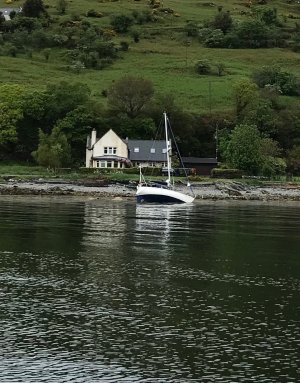
Thank you awol, but we already have the Antares charts, plus an excellent Rocna anchor. We were anchored there on 8th May this year (before the appearance of most of the buoys). It gusted heavily down the glen that night and we awoke to see the yacht that had originally anchored in the same area, slightly to the south of us, completely high and dry on the rocks at low tide on the north side of the loch. We were very grateful that a) the yacht had missed us on the way past and b) that we had used an "antisocial" scope, which held, despite the worst the weather could do. This photo was taken at half tide on our way out of the loch. We take no joy in this and have every sympathy for the owner(s) of the yacht. But it was a lesson learned. The forecast gave no indication as to what actually happened and we will continue to be cautious, wherever we anchor. This information is merely given as background to the post, by the way. As RunAgroundHard so concisely states, the issue in this thread is mooring buoys in the anchorage area.

Yacht_ashore_Lochranza.jpg
 
Two keels! Or three, if need be. Get in between the moorings and the shore. Partially dry out if required.

When I bought the twin keel Seawolf 30 the consensus was you'd be better with a deep keel on the west coast. No so, in my opinion.

Now on the east coast where you're so limited with a single keel.
 
Crown Estates replied to my request via a phone call from the local Liaison Officer. He checked into the two moorings I sent details of. Firstly, they were both registered, but neither of them had the Crown Estates (CE) tag fitted to the mooring, which they should have. Secondly, their actual positions should have been much closer to the shore, not within the designated anchorage. CE suspected that they had simply put their moorings into an apparently clear area, rather than where they were specifically licensed to be. They have requested that the owners check their positions and move them if that is the case.

Regarding designated anchorages on UKHO charts. CE try to keep moorings out of these areas and leave them clear for anchoring. They are going to check the anchorage at Lamlash a little later this year and suggested the use of a trip line in the meantime.

There is considerable pressure on CE to license additional moorings, over a hundred applications in this area within the last month. It appears that a number of purchasers of waterside properties (particularly from the south) seem to think that buying a house beside the sea automatically gives them the right to also put a mooring down. This is not the case and the Liaison Officer mentioned a number of locations where they are having real problems with unlicensed moorings obstructing anchorages.

In conclusion, whilst it isn't a legal requirement to keep anchorages clear, it is a legal requirement to have licenses from CE. Further, whilst CE actively use their licensing try to keep anchorages clear, they can't be everywhere at once and so are keen to be informed of any problems.
 
Two keels! Or three, if need be. Get in between the moorings and the shore. Partially dry out if required.

When I bought the twin keel Seawolf 30 the consensus was you'd be better with a deep keel on the west coast. No so, in my opinion.

Now on the east coast where you're so limited with a single keel.
If you're happy to take the ground Lochranza is quite excellent; take your pick of spots above the castle spit.
 
I don't know about "antisocial" scope but was in Canna the other week and one of the yachts there looked as though they let the anchor hit the bottom then stopped no 2 / 3 or 4 times depth :(. At least there was no wind that night.
 
Crown Estates replied to my request via a phone call from the local Liaison Officer. He checked into the two moorings I sent details of. Firstly, they were both registered, but neither of them had the Crown Estates (CE) tag fitted to the mooring, which they should have. Secondly, their actual positions should have been much closer to the shore, not within the designated anchorage. CE suspected that they had simply put their moorings into an apparently clear area, rather than where they were specifically licensed to be. They have requested that the owners check their positions and move them if that is the case.

Regarding designated anchorages on UKHO charts. CE try to keep moorings out of these areas and leave them clear for anchoring. They are going to check the anchorage at Lamlash a little later this year and suggested the use of a trip line in the meantime.

There is considerable pressure on CE to license additional moorings, over a hundred applications in this area within the last month. It appears that a number of purchasers of waterside properties (particularly from the south) seem to think that buying a house beside the sea automatically gives them the right to also put a mooring down. This is not the case and the Liaison Officer mentioned a number of locations where they are having real problems with unlicensed moorings obstructing anchorages.

In conclusion, whilst it isn't a legal requirement to keep anchorages clear, it is a legal requirement to have licenses from CE. Further, whilst CE actively use their licensing try to keep anchorages clear, they can't be everywhere at once and so are keen to be informed of any problems.

How do the financial aspects of mooring system work on the west coast? You have to have a license but once got, the mooring/license is yours in perpetuity and can be sold on? So you could have a mooring lying unused for many years as long as you pay the license fee? Would it be common for that to happen?

I never had one in Strangford Lough in NI, but was told a handful of years ago that you just pay for your mooring to be put down where there is space (outwith certain club areas) and then pay the Crown Estate fees.
 
I don't know about "antisocial" scope but was in Canna the other week and one of the yachts there looked as though they let the anchor hit the bottom then stopped no 2 / 3 or 4 times depth :(. At least there was no wind that night.
A bit antisocial if they drag. Not the best holding there with optimal technique. Maybe they were just polishing the anchor! My grandfather rescued someone once who had the shiniest anchor he had ever seen and on inquiring did not know 'how to stop'! They had expected to drop the anchor until contact and then relax but had instead spent 48 hours dragging it round and round without sleep wondering why it 'wouldn't work'. Turned out to be a scout leader and his wife who were supposed to be taking the scouts out on a trip but, due to diligent parents, were alone.
 
How do the financial aspects of mooring system work on the west coast? You have to have a license but once got, the mooring/license is yours in perpetuity and can be sold on? So you could have a mooring lying unused for many years as long as you pay the license fee? Would it be common for that to happen?
You either pay directly an annual fee to the Crown Estates, or pay a fee to a mooring association who pay the crown estates as part of a “group deal”.

The crown estates fee is low enough that it wouldn’t worry anyone who was going to the trouble of having a mooring laid (and periodically serviced), even if you only used it very occasionally.

There are moorings which rarely if ever get used, but I’ve not been aware of it being the issue that was presented a few posts ago. I’m always cynical when someone complains about their workload - if nobody was applying for moorings they wouldn’t have a job. Perhaps he meant that they are so busy with admin they don’t have time to do site visits? I wasn’t aware of them ever routinely visiting - do they own boats to do that in?
 
How do the financial aspects of mooring system work on the west coast? You have to have a license but once got, the mooring/license is yours in perpetuity and can be sold on? So you could have a mooring lying unused for many years as long as you pay the license fee? Would it be common for that to happen?

I never had one in Strangford Lough in NI, but was told a handful of years ago that you just pay for your mooring to be put down where there is space (outwith certain club areas) and then pay the Crown Estate fees.
AIUI it was once as laissez faire as that, but due to increased demand for moorings in popular locations and a surfeit of abandoned moorings(Holy Loch was very bad and I think was used as a test case in Scotland for greater pro-active management by CE) it's more formal. If you did keep paying the annual fee once the mooring is in there's no reason anyone would have to complain unless it was a chock-a-block anchorage and a derelict and unserviced mooring taking up space. Even then I'm not sure CE would act unless there was a breach like not attaching the new registration tag to the mooring.
 
Top