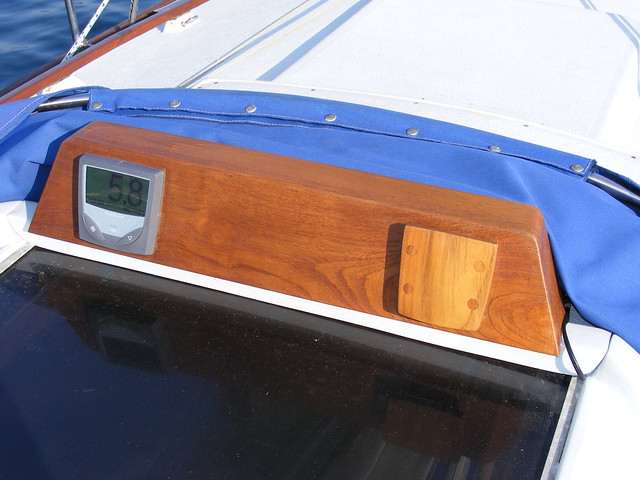
Methods for sealing wires through deck for above companionway instruments

It is often possible to lead the wires into the underside of the console from below, in which case you could fill in the existing holes, which are always likely to be a cause of problems and don't always look great.
That was my thought too. It would be much easier to construct the box so as to accommodate the wires and leave nothing trailing outside. Depending on the boat, there will usually be space between the cabin top and headlining for cables or conduit.
 
Many thanks for your helpful replies.

Do you know if the rubber is flexible enough to enable the connectors to be passed through the rubber seal, or will side slits need to be made terminating at the drilled hole?

brb
As far as I remember the Index gland I bought for my VHF aerial cable which has a soldered on connector on the end. came already slit.

It has never leaked.
 
Use a stainless steel swan neck. Works for us. View attachment 126384
A swan-neck, projecting above the deck, as it does, is too prone to accidental impacts which will compromise its seal to the deck. The one at the foot of the mast on my boat was constantly being snagged by genoa sheets, causing an undetected leak which has resulted in rot in the balsa sandwich construction of my coach-roof, which will cause untold misery and expense to repair. Low profile-type glands are a much better solution.
If the OP can remove his hatch garage and fit it underneath , it will be safe from mechanical mishaps, but the one linked by Coopec in Post#3 is only claimed to be "splashproof and dustproof" and will be a liability, as wherever you put it above decks it will need to be not just splashproof but fully waterproof, such as the Index Marine ones are (to IP68).
 
Last edited:
I am in the process of installing depth, log, wind, and gps repeater instruments in a console above the companionway on a 32ft yacht. However to do this I will need to feed at least 6 wires of differing dimensions through the deck to the side of the companionway. At present there are a couple of wires from the above sprayhood solar panel, though these just pass through a drilled hole which has been sealed with sealant and has been leaking

Does anyone have any ideas as to the best way of doing this. I have looked at various side entry cable glands but I would need at least three or 4 which would look messy. A swan neck would probably been too big. The Elvabro stainless steel cable lead through would be the smartest solution, but this too is mainly used at the foot of the mast and again may be too big. Any other suggestions?

Ideally I would like too have a single hole through which I can pass all the wires. The closest thing I have found so far is the Kathrein HDZ 100 Cable Grommet Housing buy now | SVB but I'm not sure how robust this will be.

The cables would be:

Solar panel 12v positive and negative
12v positive and negative supply
depth coax with plug
log coax with plug
wind coax with plug (however I may use a wireless system for this)
GPS repeater NMEA wire

Thanks in advance for any suggestions.

brb
The gland you reference is only "splashproof" (IP55) . It needs to be fully waterproof (IP68).
 
Many thanks for your helpful replies.

Do you know if the rubber is flexible enough to enable the connectors to be passed through the rubber seal, or will side slits need to be made terminating at the drilled hole?

brb
Any glands I have used came with pre-drilled holes and with slits, presumably for fitting over existing cables which canot be fed through, for whatever reason. The shape of the rubber plug and its housing cause it to be compressed when screwed down, resulting in a seal at the slit and at the holes where the cables come through.
 
Why not make a small swan neck with some stainless plumbing fittings. A flange connector, 2 elbows & some 22mm pipe. . Drill the flange connector for screws or better still it may go right through the deck & you could have enough thread to fit a back nut.
You could do it even cheaper in copper. If you cannot solder use compression fittings. Get the stuff from any builders merchants.
 
I have used standard electrical compression glands to feed a number of cables through to our instrument binnacle. These are ip 67 rated and can be additionally sealed with a bit of butyl rubber to give a perfect seal to any number of cables. They are available to fit 20 22 25 and 50mm hole saw sizes.
Seal fitting into deck with Sika flex and using backnut if thickness of deck head allows.
Just Google electrical compression glands. Stocked by City Electrical Factors Screwfix etc. They can even allow quite large cable sealed plugs to be passed through before conpressing and sealing.
 
If you are retrofitting one and you have a number of holes near the bottom of the mast, you can weld a s/s plate to the base of the swan neck so the plate covers the holes. This is what I did on our mizzen mast. It's a neat solution
Thanks, but I am specifically talking about placing instruments above the companionway here, not taking cables below at the foot of the mast.
 
Think outside the box

Why not use WiFi and a tablet (in a suitable waterproof case). You then don't need wires through the deck, at all. You can also have access to charts and radar. All those instruments will take up a lot of room (and get in the way) and you don't need them all simultaneously (in fact if you cross large bodies of water you don't need depth and if its close quarters navigation you don't need a compass - you just need to see the rocks).

If its WiFi and a water proof tablet you can also use if for close quarters navigation at the helm - and tablets have other uses, or so I am told by my grandchildren (who hanker after my iPad Pro).

I think now you only need worry about the solar cables - and alone they are easy.

Jonathan
I agree with the tablet solution - I currently use an Android tablet operating Marine Navigator with Admiralty and Antares charts for NW Scotland. I am aiming to fit depth, wind, log and GPS to the cockpit, so I have all the information visible whilst underway, especially when short handed. You have reminded me that I could also do with a USB cable as well to charge the tablet.
 
I would recommend the Elvabro Cableport (I have one by the mast foot, very sturdy)
Cableport - ELVABRO AB
It is actually smaller in most dimensions compared to the plastic offering from SVB.
Another possibility could be the SureThru, look up Cable through deck fitting on this site:
Mitron Marinteknik: Sure from Sweden
Thanks, the marintecknik looks promising because it will allow all the cables and connectors through a single hole. I hadn't come across that one. Thanks again.
 
It is often possible to lead the wires into the underside of the console from below, in which case you could fill in the existing holes, which are always likely to be a cause of problems and don't always look great.
That would be a neat solution, however in my case the cables would need to pass through the cover for the sliding hatch to the companionway where there is little space, and therefore could get damaged. I'll look at this again though.
 
I have used standard electrical compression glands to feed a number of cables through to our instrument binnacle. These are ip 67 rated and can be additionally sealed with a bit of butyl rubber to give a perfect seal to any number of cables. They are available to fit 20 22 25 and 50mm hole saw sizes.
Seal fitting into deck with Sika flex and using backnut if thickness of deck head allows.
Just Google electrical compression glands. Stocked by City Electrical Factors Screwfix etc. They can even allow quite large cable sealed plugs to be passed through before conpressing and sealing.
Many thanks. This could be the answer. As you say, the gland can be sealed at the deck level and the space inside at the top can be sealed with Sikaflex or similar. It also allows for additional cables to be passed through and easily re-sealed.
 
That would be a neat solution, however in my case the cables would need to pass through the cover for the sliding hatch to the companionway where there is little space, and therefore could get damaged. I'll look at this again though.


Yes, they are all different. Mine has a small, raised section at the front of the sliding hatch cover, which handily takes the wires out of harms way. The pod is sitting on top of it but I think you can just make it out, it forms a continuation of the deck breakwater:

 
I agree with the tablet solution - I currently use an Android tablet operating Marine Navigator with Admiralty and Antares charts for NW Scotland. I am aiming to fit depth, wind, log and GPS to the cockpit, so I have all the information visible whilst underway, especially when short handed. You have reminded me that I could also do with a USB cable as well to charge the tablet.

A power bank is one 'interim' solution. If you can pack the 2 units in one waterproof case it solves the issue of destruction by water. You can then re-charge both units at a more convenient time.

Jonathan
 
I made an "instrument panel" that fits on the front of the hatch for Jissel. All connections are inside a box on the side, and go below. I could also be unplugged to bring home, when leaving the boat on her mooring. It's got a little tatty in this pic, but it's around 15 years old, so it does have some excuse.
IMG_20210630_094739477_HDR.jpg
For Jazzcat, I'll be going down the tablet route.
 
Top