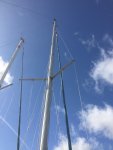
Mast Spreaders Movement

Daverw

Well-Known Member
Joined
2 Nov 2016
Messages
3,050
Location
Hull
Visit site
Just been looking at my mast setup, it has lower shrouds and top shrouds with swept back spreaders, I’ve noticed that these have a lot of front to back movement and not sure what is normal. They are held to mast with two pins into brackets. Boat just pulled out to do other work so the time to sort if I need too
 
I’ve tried it with more tension and mast bend and they still move either side of the natural shroud line, port side more than starboard. Thinking that the pin holes may have opened up a little
 
Sounds wrong; I’d take a close look at fittings for wear and cracks, not forgetting the spreader roots for signs of stress.
 
Many years back I lost a mast through failure of the spreader support in the aft swept direction. Mast crumpled middle backwards. The mast i this fractional rig will rely on the push forward of the middle of the mast that is achieved through the spreader tip leaning on the cap shroud. This push forward is countered by the intermediate spreaders pulling middle of the mast back. If it all works correctly middle of the mast should be stable in fore and aft direction with just a little middle forward prebend. (back stay loose)
So yes it is critical and yes needs to be fixed. My (replacement) airfoil shaped spreaders sit in a shaped socket. However ali into ss it got some looseness so banged in a sliver of ss to force spreaders tip aft direction. ol'will
 
Whilst it is probable that all the "fix-it" answers are right, I think there is another analysis. (As a classic boater, I don't know much about modern rigs. ) My analysis, for what it's worth: If the rig is set up correctly, there should be no lateral pressure on the spreaders. All the stress should be thrust towards the mast, directly along the spreader. Letting the spreader create significant lateral leverage on a socket on the mast is far from ideal. On old boats, like mine the spreaders are designed to pivot on a pin to ensure this. They move with mast bend - as they should.

It is just possible that yours are not meant to be rigid.

And before someone jumps on me saying this is b0ll0cks, I stress that I am saying this tentatively, but the question is worth asking.
 
I once queried a rigger about the loose feel to ours (each held to mast fitting by two pins) and he said the same - the pressure is along the spreader.
 
Whilst it is probable that all the "fix-it" answers are right, I think there is another analysis. (As a classic boater, I don't know much about modern rigs. ) My analysis, for what it's worth: If the rig is set up correctly, there should be no lateral pressure on the spreaders. All the stress should be thrust towards the mast, directly along the spreader. Letting the spreader create significant lateral leverage on a socket on the mast is far from ideal. On old boats, like mine the spreaders are designed to pivot on a pin to ensure this. They move with mast bend - as they should.

It is just possible that yours are not meant to be rigid.

And before someone jumps on me saying this is b0ll0cks, I stress that I am saying this tentatively, but the question is worth asking.

I will stick my neck out and +1 on that. Pivoted swept back spreaders are normal at least for older 3/4 rig masts, allowing the mast to flex correctly under varying loading conditions. At least thats how it looked on the only one I had 25+ years ago! There was a single pin at the root of the spreader, and the root end was rounded to allow it to move. In horizontal storage the spreaders would just hang down below the spar.
 
My analysis, for what it's worth: If the rig is set up correctly, there should be no lateral pressure on the spreaders. All the stress should be thrust towards the mast, directly along the spreader. Letting the spreader create significant lateral leverage on a socket on the mast is far from ideal. On old boats, like mine the spreaders are designed to pivot on a pin to ensure this. They move with mast bend - as they should.

And before someone jumps on me saying this is b0ll0cks, I stress that I am saying this tentatively, but the question is worth asking.

Nothing wrong with what you say and swinging spreaders certainly have a place on very bendy masts as the forces on the spreaders should be kept in-column as much as possible.

It basically depends on the rig setup, so the OP really needs to clarify the boat in question.

In any event, spreaders & fittings should be carefully checked at least once a season.
 
Whilst it is probable that all the "fix-it" answers are right, I think there is another analysis. (As a classic boater, I don't know much about modern rigs. ) My analysis, for what it's worth: If the rig is set up correctly, there should be no lateral pressure on the spreaders. All the stress should be thrust towards the mast, directly along the spreader. Letting the spreader create significant lateral leverage on a socket on the mast is far from ideal. On old boats, like mine the spreaders are designed to pivot on a pin to ensure this. They move with mast bend - as they should.

It is just possible that yours are not meant to be rigid.

And before someone jumps on me saying this is b0ll0cks, I stress that I am saying this tentatively, but the question is worth asking.

I've sailed boats with spreaders not rigidly fixed to the mast.
But I think most modern yacht masts are not intended to work like that.
The spreaders transmit some forward or aft pull onto the middle of the mast to control mast bend fore and aft. Particularly if there is only a single set of lower shrouds in line with the main shrouds.
If you have fore and aft lowers, they control the middle of the mast fore and aft.

It should be obvious what is designed articulation and what is wear?
The fact that the two sides are different is telling us something.
I suspect one is worn and the other is more worn.

If the bracket is what I think it is, I thought the pins were only there to hold the spreader in place when the rig is slack. Normally I'd expect the ends of the spreaders to locate in the bracket firmly and be held at a set angle by the inward thrust from the shroud?

I don't think a bit of movement will matter on an AWB rig, but I'd consider bushing the worn bits and keeping the movement within limits.
I'd talk to the mast manufacturer if possible.
 
Whilst many centre board boats do have flexible spreaders where the only requirement is that the spreaders meet the cap shrouds to improve the angle of the cap shrouds to the mast top these are boats where the loads are light compared to the mast stiffness. I would suggest that a 39f boat will not have excess stiffness (therefor weight) of the mast so location of the centre of the mast both fore and aft and sideways is vital. It should be possible to apply a useful tension to the inner shrouds and have the spreaders resist this aft pull when they lean against the cap shrouds also having useful tension. NB I do not believe in the tension of 15% of max for the wire . I think that is just too much but that is me and I know many try to achieve it.
It is a function of the length and angle of the spreaders so amount where the tip is out further than the straight line of the cap shrouds that determines the push forward. Then the tension of the cap shrouds that contributes to this push forward.
ol'will
 
Last edited:
Top