'Mast gate' - DIY job?

SteveTibbetts

Well-Known Member
Joined
19 May 2008
Messages
300
Location
Me - Brum , Boat - Porthmadog
Visit site
On the to do list is a making or buying mast gate for my Snapdragon 747, I want to,make dropping the main easier when single handed. Should minimise the amount of canvas blowing around the coachroof if the mast slides are held captive to the mast I think. What I want is a method that the bottom slide sits just above the gooseneck when the sail is dropped, rather than dropping out with the others following.
I did try using a tie to hold the bottom slider above the opening in the track but this seems to keep too much sail too high up the mast.

Cheap and easy to buy such a thing?

Is it feasible for DIY when I next visit the boat. What's my shopping list of stuff to take?

Anyone got a template?
 
My Snappie had a hole drilled through both sides of the track just before it widened, with a drop nosed pin through it. I then just put a tie around the boom and loose sail to secure it.
 
Gate for mainsail slugs

On the to do list is a making or buying mast gate for my Snapdragon 747, I want to,make dropping the main easier when single handed. Should minimise the amount of canvas blowing around the coachroof if the mast slides are held captive to the mast I think. What I want is a method that the bottom slide sits just above the gooseneck when the sail is dropped, rather than dropping out with the others following.
I did try using a tie to hold the bottom slider above the opening in the track but this seems to keep too much sail too high up the mast.

You will have keep all the slugs above the opening in the track or as you put it too high up the mast.
Unless you can close up the gap and make a gap much lower or devise some sort of diversion of the slugs to a holder next to the gooseneck. That seems complex.
As said a pin through the track above the gap is most common. good luck olewill
 
It probably depends on the length of the 'gap' that the gate is intended to close. My gap is about 2 inches long and it is closed by a plate of stainless steel, bent to shape and held in place by a screw into a tapped hole in the mast wall. It's only ever opened twice a year, once to load the sail and once to remove it.
 
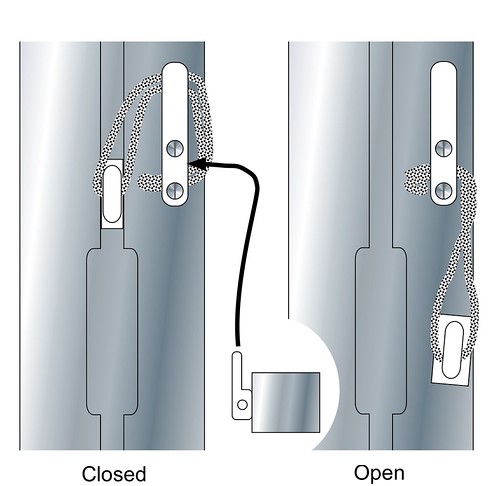
Below is my solution to the problem. A thumb cleat (could be any cleat) with a spare sail slide attached to it by a loop of cord. Length of cord is such that, left to its own devices, the slide just dangles by the mast (open). Push the slide in and loop the cord over the top of the cleat to close the gate. Up and unloop to open. Made it as "that'll do until later" job ten years ago and it works so well it never got replaced.

Mastgate by Graham Cameron Himself, on Flickr
 
What you may find does the trick is, rather than stop the slider(s) getting down to the opening, ensure it can pass the 'opening' without coming out of the track.

This is tricky to describe, but I can't find a photo just now. - Typically in a boat of that vintage you would have the sail slot in the back of the mast widening for about 6 inches or so to allow a rope luff sail to be fed in. With sliders you don't need the opening that long - just slightly longer than the slider itself, and some means of narrowing the slot so in normal use the sliders can go up and down without falling out .

So what you need is 2 pieces of thin-ish (say 1.5mm?)stainless steel sheet riveted either side of the slot to narrow it down to the same width as the rest of the slot in the mast. On one side it runs the full length of the opening, on the other it stops short leaving about one and a quarter, or one and a half times the length of a slider open to the full width on that side of the slot.

You then have a third, smaller, piece of stanless sheet slightly loosely fixed on one or two bolts, with a wingnut or something you can do/undo by hand, and foxed through a short slot in the stainless, so it is 'normally clamped 'closed' (i.e. same width as the rest of the mast slot) and the slide can go up and down without falling out of the track, but when you want to take off, or put on, the sail you slacken the wingnut and slide the small piece of stainless to the side. (Note you should iinsulate between the stainless and the aluminium of the mast (using Duralec or thin nylon sheet) to avoid electrolytic corrosion between the two dissimilar metals).
 
What you may find does the trick is, rather than stop the slider(s) getting down to the opening, ensure it can pass the 'opening' without coming out of the track.

This is tricky to describe, but I can't find a photo just now. - Typically in a boat of that vintage you would have the sail slot in the back of the mast widening for about 6 inches or so to allow a rope luff sail to be fed in. With sliders you don't need the opening that long - just slightly longer than the slider itself, and some means of narrowing the slot so in normal use the sliders can go up and down without falling out .

So what you need is 2 pieces of thin-ish (say 1.5mm?)stainless steel sheet riveted either side of the slot to narrow it down to the same width as the rest of the slot in the mast. On one side it runs the full length of the opening, on the other it stops short leaving about one and a quarter, or one and a half times the length of a slider open to the full width on that side of the slot.

You then have a third, smaller, piece of stanless sheet slightly loosely fixed on one or two bolts, with a wingnut or something you can do/undo by hand, and foxed through a short slot in the stainless, so it is 'normally clamped 'closed' (i.e. same width as the rest of the mast slot) and the slide can go up and down without falling out of the track, but when you want to take off, or put on, the sail you slacken the wingnut and slide the small piece of stainless to the side. (Note you should iinsulate between the stainless and the aluminium of the mast (using Duralec or thin nylon sheet) to avoid electrolytic corrosion between the two dissimilar metals).

Thanks Sis, that's exactly what I'm trying to describe and achieve!

Now if anyone's got any pointers, pics, tool lists, patterns etc I'd be really grateful!

And.. Where the heck do I buy 1.5mm (or any any other size) stainless steel sheet? .. In Birmingham ideally


Steve
 
Found a couple of photos. This is what I was trying to explain - but this isn't a particularly neat example, and in these pics the sliding piece is missing (from the lower right hand side) - only the two long fixed pieces are seen. You can see the hole for the small bolt that would come from inside the mast and through a slotted hole in the missing piece, allowing it to be slid closed or open.
 
Thanks Sis, that's exactly what I'm trying to describe and achieve!

Now if anyone's got any pointers, pics, tool lists, patterns etc I'd be really grateful!

And.. Where the heck do I buy 1.5mm (or any any other size) stainless steel sheet? .. In Birmingham ideally


Steve

You can make yourself a pattern out of a piece of cardboard. Try to have a look at how its done on a few boats if possible (internet image search if no baots around?).

You could try a prototype of using some stongish plastic cut out of a plastic bottle (think shampoo or mouthwash bottle sort of thing) and gaffa tape the fixed ones to the mast. make sure you can get one slide at a time in or out of the gap left, then gaffa tape the 'sliding' gate in closed position, and make sure the slides run nicely up and down without falling out.

If that seems to do the trick you might be able to get the stainless you need from a boatyard or local stainless fabricator, otherwise buy on line from metaloffcuts.co.uk (I've used them twice and been a happy customer). You'll have to bend it to roughly suit the curve of your mast, and work out the best position for the rivets for the fixed pieces, and the small bolt for the sliding gate.

Use monel rivets (from a chandler) and don't forget to insulate the fixed bits at least. Someone said that they only have get sliders in/out twice a year. That may be the case, but note that depending on the arrangement on your boat you may find that, like our boat, you have to open the gate to take some slugs out to reef (as otherwise the line of slugs stops the luff eye for reefing from reaching the boom/ramshorn).

Good luck with it.
 
Thanks Sis, that's exactly what I'm trying to describe and achieve!

Now if anyone's got any pointers, pics, tool lists, patterns etc I'd be really grateful!

And.. Where the heck do I buy 1.5mm (or any any other size) stainless steel sheet? .. In Birmingham ideally


Steve

I have answered a similar question before.
Proctor ??? masts fitted to old Westerlies have a sail slug entry formed by widening the slot on one side only . That side has a curved stainless steel plate retained by a screw with a butterfly top.
When all the sail slugs are in place the plate slides to close the widened part of the slot.

The lower slugs are then able to drop down to the goose neck without coming out of the entry.

Maybe some thing similar will work for you although if your slug entry is not one sided as above you may need two plates . It might be possible for one to be fixed and the other slideable.

Bad diagram of the plate below. I don't think I have the curve quite right but the idea is that the vertical edge forms a continuous side to the slot when its slid into position.

I'd think Birmingham would be the idea place to get some stainless steel.
Seriously cannibalise something or try to scrounge a small off-cut from a fabricator. Stainless steel hacksaws and files easily but is a pig to drill.

mastgate.jpg
 
If you have to drill stainless steel, use a cobalt drill bit. It worked for me.

Its the answer without doubt esp if you have several holes to drill. However a good sharp HSS drill bit, a slow speed, a steady pressure and some lubrication / cooling will do the job.
 
I have answered a similar question before.
Proctor ??? masts fitted to old Westerlies have a sail slug entry formed by widening the slot on one side only . That side has a curved stainless steel plate retained by a screw with a butterfly top.
When all the sail slugs are in place the plate slides to close the widened part of the slot.

The lower slugs are then able to drop down to the goose neck without coming out of the entry.

Maybe some thing similar will work for you although if your slug entry is not one sided as above you may need two plates . It might be possible for one to be fixed and the other slideable.

Bad diagram of the plate below. I don't think I have the curve quite right but the idea is that the vertical edge forms a continuous side to the slot when its slid into position.

I'd think Birmingham would be the idea place to get some stainless steel.
Seriously cannibalise something or try to scrounge a small off-cut from a fabricator. Stainless steel hacksaws and files easily but is a pig to drill.

mastgate.jpg

The plate Vic shows is the third, sliding bit I tried to describe (though the one on my current boat is actually rectangular). If your mast was designed for slugs (unlikely I think) then that's all you need. If it has a long slot (originally for a rope luff) you'll also need the two long bits I described/photographed. The section Vic shows is exactly the sort of thing you are aiming at for both the fixed and sliding bits, adjusted for the shape of your mast.
 
What you may find does the trick is, rather than stop the slider(s) getting down to the opening, ensure it can pass the 'opening' without coming out of the track.

This is tricky to describe, but I can't find a photo just now. - Typically in a boat of that vintage you would have the sail slot in the back of the mast widening for about 6 inches or so to allow a rope luff sail to be fed in. With sliders you don't need the opening that long - just slightly longer than the slider itself, and some means of narrowing the slot so in normal use the sliders can go up and down without falling out .

So what you need is 2 pieces of thin-ish (say 1.5mm?)stainless steel sheet riveted either side of the slot to narrow it down to the same width as the rest of the slot in the mast. On one side it runs the full length of the opening, on the other it stops short leaving about one and a quarter, or one and a half times the length of a slider open to the full width on that side of the slot.

You then have a third, smaller, piece of stanless sheet slightly loosely fixed on one or two bolts, with a wingnut or something you can do/undo by hand, and foxed through a short slot in the stainless, so it is 'normally clamped 'closed' (i.e. same width as the rest of the mast slot) and the slide can go up and down without falling out of the track, but when you want to take off, or put on, the sail you slacken the wingnut and slide the small piece of stainless to the side. (Note you should iinsulate between the stainless and the aluminium of the mast (using Duralec or thin nylon sheet) to avoid electrolytic corrosion between the two dissimilar metals).

Like this...

IMG_0004-trimmed.jpg
 
Below is my solution to the problem. A thumb cleat (could be any cleat) with a spare sail slide attached to it by a loop of cord. Length of cord is such that, left to its own devices, the slide just dangles by the mast (open). Push the slide in and loop the cord over the top of the cleat to close the gate. Up and unloop to open. Made it as "that'll do until later" job ten years ago and it works so well it never got replaced.

Mastgate by Graham Cameron Himself, on Flickr
What a beautifully simple solution.... think i'll nick that idea!!!! :D
 
One of those pretty much what the missing lower bit from my photos should look like. However, the OP has probably got a much longer opening, and if so additional fixed plates are needed either above or below.

I do indeed have a longer opening in the track, originally designed for a bolt rope. I think I have worked out exactly how to,do the job and would like to thank everybody who has contributed. My apologies for not correctly identifying what type of opening was in the mast, I was completely unaware there were different types


Steve
 
N.B. This issue with mast gate (at least in my case) is not how well it works in the marina. It is using it when you're reefing in ugly weather. You want to be able to do it by feel and have no loose bits to drop overboard.
 
Top