MAN water pump overhaul

Portofino

Well-Known Member
Joined
10 Apr 2011
Messages
12,443
Location
Boat- Western Med
Visit site
Last season towards the end noticed less water flowing out of the port fart pipe than the stb .
No diff in seawater pressure or HE temp steady 85 c running dropping to 79/80 c with Marina manoeuvres .

I have spare impellers .Thought it time I got the pros to take a look .Figured hassle removing them .Not sure what the MAN manual says iirc it’s a large intervals 4-500 hrs or maybe more ? Remember all the T s + P s are normal .
If it was not for the reduced fart pipe flow I would have never really bothered tbh .

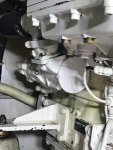
They are Jabsco bolt on pumps to MAN i6 13 L 2876 le 401 rated @700 h Fitted in 2003 .
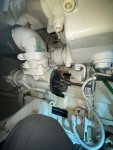
82438B4B-287D-4CCE-A993-7DCBB70D1D25.jpeg
Gear driven , a little ver d gris on the inlet elbow , very slight corrosion between the impeller case and gear case .Perfectly dry a in use no drips .
^^
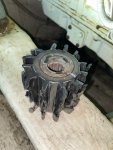
A87B0F24-92A2-4A99-A43D-3C1050733101.jpeg
At least 6 y old ? ^^^ As I said running T+ Ps all normal .
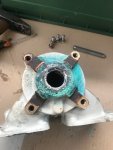
5247F3A6-0DD5-4E00-BD8E-332BEAF04CCD.jpeg
D5058BBB-897A-4A6D-A7CC-09875CDCF6AA.jpeg
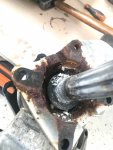
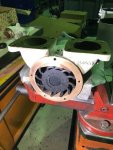
Splitting the unit the seal between the gear shaft and pump chamber’s gone and badly corroded the housing .^^
7482406E-2129-4692-931A-81BB02388929.jpeg
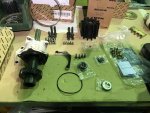
MAN do a repair kit ^^
5B0AEE87-B483-4720-AFA5-97D93803E1A6.jpeg
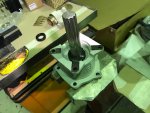
repainted body ^^
C45C3E10-00BB-4161-BF15-001CD8D8E34A.jpeg
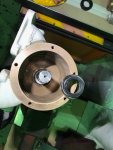
New seal ^^
F788D55D-509A-4A1F-8D3F-222F21312833.jpeg
8EC916AE-F40E-45DA-8E8A-F9999CB100CE.jpeg
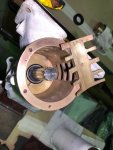
reassembled kit+impeller .
23239DDF-94E0-451A-888A-165F3630D04B.jpeg
Back on the boat ^^
Plus new charge air cooler drain plugs + copper crush washers .Apparently they start weeping so i am told .

So it’s just something at 18 y old or sooner worth thinking about for the bigger engined Jabsco guys on here .Cosmetically you would hardly know .It was the fart pipe flow .
 
I thought these were annual service items, or certainly the plastic impellers.
MAN, recommends the impeller(s)only be inspected yearly or every 1000 hours.
They are €382 + tax each and about 1 hrs labour for two .
Its generally recommend change every year , but they were at least 6 y old + so I guess I saved a grand each year all in . €6-7 k.
Remember T + Ps all normal .

Don,t know what the time is removing and rebuilding the pumps .This inc bearings, seals , bolts and all the gaskets as well as the rubber impeller .
Anywhere after 10 yrs I would suggest get them rebuilt .Thinking aloud the seal between the gear shaft in its case and pump barrel .Depends on the relative pressures the direction of travel of the two fluids .
Presume the oil pressure exceeds the inlet pump pressure so oil leaks out into the sea water which is fine ?
You do not want it the other way ......sea water entering the lub circuit .

The dip stick levels never alter from one oil change to another thankfully .
 
a little ver d gris on the inlet elbow , very slight corrosion between the impeller case and gear case
...
Splitting the unit the seal between the gear shaft and pump chamber’s gone and badly corroded the housing
Looks like you still didn't install the BodgeFlow.
Go ahead, you know it makes sense! :D
 
Looks like you still didn't install the BodgeFlow.
Go ahead, you know it makes sense! :D
It wouldn’t have changed the outcome a seal is a seal and they go .

Incidentally I checked my screens @ 1000 rpm oil pressure was 2.9 bar , inlet water pump pressure 1.0 bar .

So running any Dir of travel if the seals were very bad is out of the engine fluid wise .Nice to know .As I said although there are many reasons for the dip stick level to drop they never have done anyhow .

Its when stopped potentially seepage back in from seawater is on the face of it a possibility.
How ever the pump is located just above the WL .The strainer lids are about 1-2 cm above the WL too .
So in theory at rest the system drains down .How ever if you look at the pump housing body the pump exit is at 12 o clock so the vanes stay submerged, ie the seals are constantly wet primed ready to go .Makes sense .

Any seepage which was slight but over many years was hardly visible externally .What was , was deep in a crevice anyhow .Very much doubt a 5/10 min fresh water run would have penetrated in there anyhow .
If it did as I say a seal is a seal they age anyhow .Also in the rebuild kit I think that shaft gets new bearings as well as seals and gaskets .
I guess every now and then it’s just good practice to pull them and rebuild for piece of mind .
Its just general maintenance, keeping on top of everything .Something others perhaps should think about over a winter period , chalk it up on that everlasting to do list . :unsure:
This boats never let me down .

* Has anybody else ever considered the relative heights of the strainer lid relative to the WL , the water pumps relative to the strainers and finally the drain down after shut down of all of the seawater side ?
Or am I on my own ? Reason I ask a bit nerdy I know guilty as charged but I have put a stethoscope on all the coolant system and listened to fluids draining off .
It all seems to drain down when at rest empty out .Except the pump body which is made of an inert metal anyhow .( see the pic of the copper coloured internals ) So makes no sense to me with this to risk getting into a fresh water on /off , engine on / off muddle and winding up with fresh water going backwards into the turbo risking seeping further through an open exhaust valve into a cylinder ........with this particular MAN set up .There are no hidden pencil anodes to limp along .

Those with pencil anodes littered all over the place ( MAN use a separate large anode on the transom ) AND cooling systems that do NOT drain down when the motors are at rest may benefit from a fresh water flush before long lay ups .
Especially those in this group that unfortunately have well documented past form of coolant components corrosion.
 
Last edited:
Was the damage to the impellor caused by the puller
Don,t know .
T+P s were all normal and symmetrical .That’s the port engine .I have no pics of the STB side .
The only tell tale from my POV was differing fart pipe water flow at the dock , tickover .
When running they both seemed pretty symmetrical , I did lean over and view @ 30 knots .

He,s had a lot of pipes off doing the exhausts so presumably if there were any loose rubber bits he has dug them out ??

I thought I have got guys on the boat working with the exhausts so to save me struggling with the wrong puller after finding out the twin screwdriver method does not work , the pinching the vanes doesn’t work , the gasket ends up weeping afterwards etc etc I thought I’d ask them .
Happy with the resultant rebuilds and end results .Without bench workshop , bearing pullers seal presses facilities glad I made the call .

Just a msg to other guys with large bolt on gear operated jabscos = at some stage they need a overhaul as part of the routine .
 
PF, I'd suggest you replace the impellers a bit sooner :-p
I've tried once a year, pointless it was like new, now trying 3yrs :-)

btw, the 1bar@1000rpm is seawater pressure right? not coolant!
I'm asking as my IVECOs are at .25bar at 600rpm and around .5bar at 1000rpm. Yanmar geny is .2bar at 800rpm and .5bar at 3000rpm.

anyone recommend a impeller puller similar to the one shown in the pic above, but being an amateur that's not happy with the twin screwdriver trick and not happy with damaging the housing lip I'd like to get something decent.
BUT and it's a big but, I'd probably not spent more than 50-60euro for a tool, so no 300quid options plz!

cheers

V.
 
PF, I'd suggest you replace the impellers a bit sooner :p
I've tried once a year, pointless it was like new, now trying 3yrs :)

btw, the 1bar@1000rpm is seawater pressure right? not coolant!
I'm asking as my IVECOs are at .25bar at 600rpm and around .5bar at 1000rpm. Yanmar geny is .2bar at 800rpm and .5bar at 3000rpm.

anyone recommend a impeller puller similar to the one shown in the pic above, but being an amateur that's not happy with the twin screwdriver trick and not happy with damaging the housing lip I'd like to get something decent.
BUT and it's a big but, I'd probably not spent more than 50-60euro for a tool, so no 300quid options plz!

cheers

V.
Yes it’s seawater inlet pressure somewhere in the pump/ pipage ?
We have expansion tank pressure for the closed water coolant side .
Oil pressure is always higher than the sea water , that’s the best way round for obvious reasons .

As far as changing neglect yup guilty as charged .I have a pair of spares as well .
The hesitation was based on your train of thought unknowingly how old if I could not budge them ! Boat incapacitated.
I always had something on or about to happen so did not want to risk a incapacitated boat .Remember all T+P s normal .It was jur the tickover fart pipe flow difference between the sides that stimulated a reaction .
Additionally i passed the serial numbers and a poor pic of the face plate to a U.K. MAN dealer to get a gasket kit .
Turns out in a Sod’s law way , the parts guy was unsure which gasket .Something to do with the hole spacing of the bolts they are not evenly spaced .
So better a MAN man with a van load of correct pullers and gaskets in the winter down time .I have a parts ref number now on the invoice .Now it’s been shifted and I know which gasket I will do it more regularly, 400 hrs or 2/3 years .

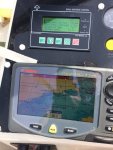
1FAA5403-E70E-4558-935B-AFDF888A2E07.jpeg
seawater pump P ^^^ 2.7 bar

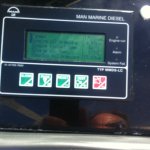
7C437EB0-73C5-4D21-AFDC-6F3EBFA4B00F.jpeg
Oil P 4.9 bar so if the pump seals fail the dip stick level drops it did not btw .

Knowing all this is kinda handy but does not change the outcome of some time down the line having to pull the pumps and having to rebuild .
 
thanks, I thought that the "legs" must be long enough to reach the end of the impeller and grab it from the back. So I can get the 50070-020 myself as well. If only I can find someone willing NOT to use the now useless local post service down here...
 
Looks like you still didn't install the BodgeFlow.
Go ahead, you know it makes sense! :D
Hi P,
could you please link me to the best thread regarding the setting up of the BF system, and any info relating to “things you would now do, since the system has been in place for this many years”, cheers

PS....all the best to you both, hope you have a great season ahead :cool:
 
Hi C, and many thanks.
LIkewise, all the very best also to you all, I hope all is going well down under!

The BF topic was discussed in more than one occasion, but I think you can find the more detailed explanations here, from post #41 onward.
Feel free to ask for any further doubts you might have, anyhow.

Having by now used the flushing system for 3+ years, I can't really think of anything I would do differently in hindsight.
Ok, if I should be picky, it could have been worth making a direct connection also for the engines, to suck fresh water from the onboard tank.
In fact, for all other parts (airco chiller, genset and shaft seals) I had some hoses plumbed to a manifold connected to the fresh water circuit, so flushing each bit is just a matter of closing its seacock and opening the fresh water valve.
For the engines instead, I must deploy a hose and connect it to the dockside tap.
But that's firmly in the "first world problems" category - it makes a difference of 3 minutes, if that... :)
 
I thought these were annual service items, or certainly the plastic impellers.


Yanmar service change on my 4JH4-HTE impeller is 1,000 hours.

Changed it last year, 1053 hours, just the corner of one blade broken off, stuck in the heat exchanger.

A fellow Island Packet owner used the OE Yanmar impeller for 24 years. He did not motor much, being a very good sailor. He removed it each winter and dropped it into a pot of water and refitted it when fitting out.

He only replaced when shamed into it by his fellow club members!
 
Hi C, and many thanks.
LIkewise, all the very best also to you all, I hope all is going well down under!

The BF topic was discussed in more than one occasion, but I think you can find the more detailed explanations here, from post #41 onward.
Feel free to ask for any further doubts you might have, anyhow.

Having by now used the flushing system for 3+ years, I can't really think of anything I would do differently in hindsight.
Ok, if I should be picky, it could have been worth making a direct connection also for the engines, to suck fresh water from the onboard tank.
In fact, for all other parts (airco chiller, genset and shaft seals) I had some hoses plumbed to a manifold connected to the fresh water circuit, so flushing each bit is just a matter of closing its seacock and opening the fresh water valve.
For the engines instead, I must deploy a hose and connect it to the dockside tap.
But that's firmly in the "first world problems" category - it makes a difference of 3 minutes, if that... :)
Many thanks for the reply P, I’ve probably asked you before for the same info, but now I’ve worked through the more pressing maintenance issues I can now sort through some lower on the list.
 
+1 on what P said above.
I've only done the main engines with three way valves before the strainers (and obvs after the main seacock)
Tank water comes _BEFORE_ the pressostatic pump, so comes with hydrostatic only.
Problem is that I forget to do it due to testing various things and thinking don't bother now, will do it after I check this sensor or that issue. And that day never comes :rolleyes:
 
Hey P, just rebuilt a similar Jasbco gear driven pump with the same face seal and now have both leaking after 2 hours of run time. It’s a larger leak, so

Was there a mandrel you used to insert the white carbon ring that fits in the housing?

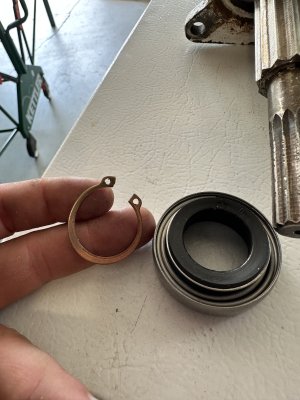
And did the snap ring go directly against the rubber on the shaft seal? When I disassembled the pump, the ring was distortedIMG_1732.jpeg
 
Hey P, just rebuilt a similar Jasbco gear driven pump with the same face seal and now have both leaking after 2 hours of run time. It’s a larger leak, so

Was there a mandrel you used to insert the white carbon ring that fits in the housing?

And did the snap ring go directly against the rubber on the shaft seal? When I disassembled the pump, the ring was distortedView attachment 158777
I paid a official MAN engineer to remove them take to work shop use the rebuild kit , refit and test .
They have been fine since with another 200 hrs .

Sorry to hear your woes , but it’s exactly this newbie with book in lap ( or imagine of u tube vid in vivid memory) that I wanted to avoid . The fag factor of redoing it all etc .

Once watched a tv doc on 747 pilots .There was a captain with 20000 hrs on jumbos , mid 50 s age with 25 yrs on them .A second officer in his late twenties on 5000 hrs , but not 747 s .He done the conversion etc .Point is this junior after 5 attempts couldn’t land it at Hong kong .They had the time arrived a hr early for the 2 nd to try .In the end senior dropped down first attempt.Turned round to junior and said “ once you have done your first thousand it’s easy “

So that’s what I was figuring with the Jabsco pump rebuild.
 
Top