Mainsheet Twist

JimC

Well-Known Member
Joined
30 Aug 2001
Messages
1,570
Location
Lancashire
Visit site
This is how my mainsheet looks after a few days use.

Mainsheet twist.jpg

No matter how often I un-thread it, get the twist out of the rope, and re-thread it it always ends up like this, to the point where there is too much friction for the sail to draw the rope out in light winds.

In the PBO test of my boat, a Hunter Channel 31, the tester commented on the unwieldiness of the 6 part purchase and said "an endless 3:1 / 6:1 arrangement would provide the necessary power while helping to avoid tangles."

I don't know anything about these arrangements, is this the "German system" that's sometimes mentioned? Can anyone enlighten me?
 
Last edited:
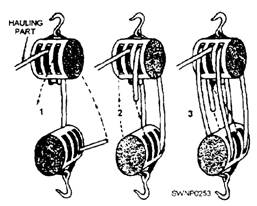
My mainsheet has a six part tackle and jammer and it doesn’t twist up. There’s a special order to reeving it, which is not the obvious - the blocks should be at 90° to each other - and this stops the twist. I can’t describe it here but I’m sure google will show you.

Pete
 
This is how my mainsheet looks after a few days use.

View attachment 73427

No matter how often I un-thread it, get the twist out of the rope, and re-thread it it always ends up like this, to the point where there is too much friction for the sail to draw the rope out in light winds.

In the PBO test of my boat, a Hunter Channel 31, the tester commented on the unwieldiness of the 6 part purchase and said "an endless 3:1 / 6:1 arrangement would provide the necessary power while helping to avoid tangles."

I don't know anything about these arrangements, is this the "German system" that's sometimes mentioned? Can anyone enlighten me?

This is how it done. Also lock both blocks in the one position also helps to stop twisting

image246.jpg


6-1-cam_reeving-diagram-lg.jpg
 
Last edited by a moderator:
Some rope is more prone to winding up the blocks than others, but definitely lock the upper block.
 
Hi Jim,

Same boat, same mainsheet tackle but slightly different set up it comes down to a traveller. Never had twists.

Is it as simple as you have a swivelling attachment to the cockpit sole U bolt rather than a fixed (eg non rotating / swivelling) attachment??

My attachment to the traveller car has a degree of movement (maybe 90 degrees) but certainly wont turn through 360 degrees. However when I have taken it off to wash it, I manage to get it very twisted and have to completely re-reeve it as no amount of reversing the twisting sorts it out!
 
I have a main that is 4:1 from the traveller. I have a winch to control and it seems that simply putting the line on the winch gives it a twist and eventually the lines to and from the traveller twist. So when I get fed up with the mainsheet I roll the mainsheet to untwist the line, and the mess between traveller and boom becomes 4 parallel lines once again.

TudorSailor
 
This is how it done. Also lock both blocks in the one position also helps to stop twisting QUOTE]

Thanks Roger, I'll try that before going to the Easymatic which I'm sure is very good but may be overkill for my problem.

Roger Shaw nailed it. Reeve it correctly and fix the upper block.

It would not hurt to stream the line out before re-reeving, but in fact, if the other steps are taken, the twists will work them selves out.
 
" Rigging a non toppling 3 part purchase " was part of the Board of Trade AB's ticket even into the 80's .
"worm and parcel with the lay - turn and serve the other way "
" Describe difference between a Brig and a Brigantine."
Identify the traditional fathom markers on a lead line .
All useful stuff for chipping rust on a supertanker or parking trucks on a Ro- Ro!
 
Poor quality rope with loose outer coverings definitely tends to twist more than rope with tighter outer covering. +1 for locking the top block, but obviously the bottom one needs to rotate as the helmsman/crew will want to adjust from either side of the boat. i have a 31 ft boat & my main is quite big & i find little need for a 6:1 purchase. 4:1 seems quite enough, although perhaps a fine tune on the tail may be nice. I do have a traveler with 4:1 on the car which is nice & smooth though, so I can dump the main easily.
 
I have a similar system with triple blocks. For some reason, the sheet which has not twisted for the last ten years has started to do so. All I need to do to correct it is to coil the long tail end in the reverse direction to usual and then feed it into the system, just a matter of unclipping the sheet from the traveller and shortening/extending the loops a couple of times.
 
This is how it done. Also lock both blocks in the one position also helps to stop twisting

image246.jpg


6-1-cam_reeving-diagram-lg.jpg


That’s true and an excellent diagram of how to reeve a 6:1 pulley without bights of the line chafing against each other from the get-go. But that’s not the OP’s problem. The OP’s sheeting system starts out fine but becomes twisted with use.

I have the same problem. It’s because every time you coil the main sheet to stow it or just to tidy the cockpit, you introduce some twist. When you next let the main out, the section of sheet you’ve just twisted shifts from aft of your winch or clutch to between the blocks. After a few uses the twist accumulates and forces the blocks to twist, like supertwists developing in a rope that you keep on twisting more and more. This then causes the bights of rope that run into and out of a block to rub against each other.

The solution is to twist the rope, from the cockpit end, the other way and manipulate those twists up the block system towards the boom bitter end to cancel out the twists that have accumulated in the sheet. In practice, because the twists have accumulated towards the boom end of the sheet, I find it more intuitive and quicker to undo the shackle at that end and untwist the rope before re-attaching the shackle.

it’s hard to see whether there’s a swivel between the soft shackle on the OP’s coachroof and his lower block. But having one (which I do) wouldn’t stop the twists developing - it would just give you a short- term fix by enabling you to straighten the block when rope twist has started to rotate it and make the sheet start to chafe against itself.

To the OP: no, what’s being described there is not a ‘German’ mainsheet system. Your source is referring to this sort of thing - https://www.mauriprosailing.com/mm5/Harken/images/pi/Oct-17/HAR332.jpg - with the two (very long) ends spliced together. Pulling on one side gives you 3:1 purchase on the boom; pulling on the other gives you 6:1 for fine trimming closehauled; and the two ends are spliced into an infinite loop so that trimming all the way in on one end doesn’t run you out of rope at the other.

A German mainsheet system runs the middle of the mainsheet around a block at the boom end, leads both sides of the sheet through boom-to-coachroof blocks (like a regular bridle system to give you 3:1 or so purchase) forward to the gooseneck, and then runs one end aft down each side deck to a winch on each side of the cockpit. The point of this is to gives you mainsheet control from both sides of the cockpit. Sometimes the two ends are spliced into an infinite loop running across or under the cockpit for the reason above. This system, like a regular mainsheet arrangement, only gives you one leverage ratio, whilst the one referred to by your source gives you a choice of two.
 
Last edited:
...
I have the same problem. It’s because every time you coil the main sheet to stow it or just to tidy the cockpit, you introduce some twist. When you next let the main out, the section of sheet you’ve just twisted shifts from aft of your winch or clutch to between the blocks. After a few uses the twist accumulates and forces the blocks to twist, like supertwists developing in a rope that you keep on twisting more and more. This then causes the bights of rope that run into and out of a block to rub against each other.

The solution is to twist the rope, from the cockpit end, the other way and manipulate those twists up the block system towards the boom bitter end to cancel out the twists that have accumulated in the sheet. In practice, because the twists have accumulated towards the boom end of the sheet, I find it more intuitive and quicker to undo the shackle at that end and untwist the rope before re-attaching the shackle....
As you say, coiling and just random movement of the rope introduces twist into the rope in the tackle.
This results in a torque on each of the 6 strands of the tackle.
If that torque is allowed to rotate the upper block, it will do so more in one direction than in the other, due to the asymmetry.
If the upper block resists the torque, then the twists will come back out of the tackle into the tail of the mainsheet.
If it doesn't, every movement of the sheet ratchets a little more twist into the string between the blocks.
If the upper block must swivel, or is pulling on another line, the solution is to use blocks which allow the 6:1 tackle to have symmetry. e.g.
https://www.mylorchandlery.co.uk/sm...MI3vve8cbu3QIVAobVCh3FPQzFEAQYASABEgIpUfD_BwE
 
If the OP has a loose fit mainsail & no lazy bag (Helpful if he has a lazy bag with conveniently placed reefing slots) perhaps placing a webbing loop over the boom & placing one block onto that may help. This would split the roves. However, that may prevent the bottom block from rotating altogether which would be no use as he could not operate it from either tack or from aft or forward if they were too far apart. He could alternatively use a 4:1 system & on the tail fit a short 4:1 light trimming tackle to that to allow precise trimming .(see Harken's cascade systems) This would make the final part easy to pull in. That would cut down the length of mainsheet needed, reduce friction etc. One only needs 4:1 on the final bit when close hauled........... This would be cheaper than paying an arm & a leg for an easimatic block, especially when it is time to replace the mainsheet. There are certain ropes that are less inclined to twist. The doubled jibsheet on my squib was a pain until I borrowed some from another squib & found that they did not tangle. I forget what ones I changed to but it finally solved the problem.
 
Last edited:
Top