Mainsheet to winch?

Iliade

Well-Known Member
Joined
27 Apr 2005
Messages
2,265
Location
Shoreham - up the river without a paddle.
www.airworks.co.uk
This thread may have brought an epiphany: My coachroof mounted fiddle block mainsheet is too tall to permit the main to be sheeted in as hard as I would like. The main halyard has been led back to the coachroof with a jammer and winch, which typically gets used once or twice a trip. Perhaps I can lose the fiddle blocks and run the mainsheet to the winch instead? It is pretty difficult to operate it from the helm already, so I already just use the autopilot while trimming.
 
So are you proposing a single line mainsheet from boom down to traveller block and across to the winch? If so, your traveller will be inoperable whilst mainsheet under tension and sailing. Maybe I'm not understanding what you mean though.
 
May be easierto just change one or more of the fiddle blocks for multiple single blocks?
Most dinghies with centre sheeting have 4:1, with two single blocks on the boom.
You might want 6:1?
There are many ways of rigging a mainsheet, but it's easy to run up a big bill of Harken blocks etc.
 
So are you proposing a single line mainsheet from boom down to traveller block and across to the winch? If so, your traveller will be inoperable whilst mainsheet under tension and sailing. Maybe I'm not understanding what you mean though.
My traveller is inoperable while sailing anyway, it it a dreadful pegboard type. Sometimes I just use a handybilly to haul it upwind, but usually adjust it during or ahead of the tack/gybe and put up with that setting until the next turn.
 
May be easierto just change one or more of the fiddle blocks for multiple single blocks?
Most dinghies with centre sheeting have 4:1, with two single blocks on the boom.
You might want 6:1?
There are many ways of rigging a mainsheet, but it's easy to run up a big bill of Harken blocks etc.
Harken's bill is the main reason I haven't done this - nearly the price of a new mainsail for a double ended system and it is still tight on space! I have three block anchor points on the boom but am currently using the original single point system.
 
So are you proposing a single line mainsheet from boom down to traveller block and across to the winch? If so, your traveller will be inoperable whilst mainsheet under tension and sailing. Maybe I'm not understanding what you mean though.
Our mainsheet goes to a lever jammer then the winch, but you are right that the traveller wouldn’t work if it went directly. It goes forward from the boom to the mast then down to a lower block and back along with the other lines to the jammer. That way (which seems to be very common) you have complete control of the main via an extra two blocks and the traveler works fine.
 
Harken's bill is the main reason I haven't done this - nearly the price of a new mainsail for a double ended system and it is still tight on space! I have three block anchor points on the boom but am currently using the original single point system.
If you keep your eyes open on e.g. ebay, it's possible to pick up decent blocks at sensible prices.
I have a 3 inch Harken ratchet block on my laser, which I got for £25.
Sometimes you can acquire seized blocks for next to nothing and refurbish them.
The other thing to consider is whether the boom and gooseneck etc are strong enough to do more of the work with the kicker, which might make the sheet an easier problem?
Or you could raise the boom either with a shorter leach, higher gooseneck, block under the mast....
Or a lower profile traveller track?
 
My traveller is inoperable while sailing anyway, it it a dreadful pegboard type. Sometimes I just use a handybilly to haul it upwind, but usually adjust it during or ahead of the tack/gybe and put up with that setting until the next turn.
Sounds like the traveller is the problem. Get rid of the pegs and buy a couple of jamming cleats!
 
Oh yes, the traveller is definitely a problem! A shiny new one is on the snag list, but said list is very long...
I have seen boats that have no traveller but with a double mainsheet, similar to the diagram in this video.
If you have winches both sides of the coachroof you could use plain blocks and lead the two ends to them, but on a smaller boat the setup shown with cleated blocks looks OK.
If your traveller is not useable fixing blocks at each end and using a pair of mainsheets that can be pulled in from either side looks like a possible solution. I have also seen a "german mainsheet" system that has no traveller but a single continuous mainsheet but I'm not sure how it works.
 
Last edited:
If I understand correctly the so called German main sheeting uses a double ended sheet each end of which go forward along the boom to the gooseneck then down to the deck then back to winces on the cabin top. The actual sheet tackle can be any form going down to a traveler or single point either at the transom or mid cockpit with or without purchase. Main sheet is operated at the front of the cockpit a bit like halyards.
If OP has main sheet block at the bottom with one sheve above the other then perhaps this could be changed to side by side sheaves in a double block one having a cam cleat. ol'will
 
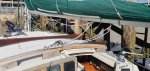
Nice photo now it all seems clearer. I would suggest that you set up decent tackle to the traveler on each side. 3 or 4 purchase that can be reached from the tiller position. Then when hard on the wind you pull the traveler up to windward side. This will give more room for the main sheet tackle under the boom and pull the boom more easily to centre line. You may end up with less down pull on the boom but that may not be a priority.
The photo seems to show an adequate system although I think a better arrangement uses 2 free ends of sheet so one each side for more convenience. However 2 traveler tackles will give you a lot of scope for releasing main sail pressure by dumping the traveler in a gust. I would not go for expensive clutch but rather simply around a winch and a cam cleat. ol'will
 
View attachment 100685
Thank you all. I think I will go with this for the time being: 4:1 (less the angular losses), down the boom to the mast then back to the companionway clutch and winch.

Can anyone spot anything wrong with this idea before I start tapping into the mast?
Why would you need to tap into the mast? My blocks hang off the gooseneck fitting.
 
Because there is already a turning block on the wheelhouse roof.
I could replace that with an upstanding block, but that would leave the mainsheet rope coming diagonally down from the gooseneck to the starboard side of the coachroof which would offend my eye (despite being more efficient ;0)

Hmm...
 
Top