Mainsheet Rigging Options Pros/Cons

mattnj

Well-Known Member
Joined
26 Jul 2007
Messages
1,362
www.red-data.co.uk
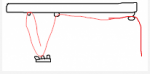
if you have 2 boom attachment points and 2 or 3 attachment points on the traveller (option for both) , whats the best cruising setup for number/type of blocks/fiddles etc?
boom.png
 
Depends on many things.
Firstly, how big a boat? How big is the main?
Secondly how do you like to sail?
Thirdly how easy is the traveller to 'play'?
it goes on...

The boat I sail on, being an ex/sometime racer, has a 6:1 with a 4:1 fine tune. That's nice for cruising too, as the fine tune is easy to use with one hand while steering with the other. But it's a lot of £££ of Harken.
 
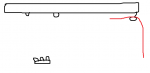
43ft, yes it goes to a winch, traveller on roof, furthest attachment point back is probably 50-60% of the way down boom, it was originally done like this...trying to "improve" the setup, wanted 2 attachment points for redundancy.
boom2.png
 
43ft, yes it goes to a winch, traveller on roof, furthest attachment point back is probably 50-60% of the way down boom, it was originally done like this...trying to "improve" the setup, wanted 2 attachment points for redundancy.
View attachment 72772

So what exactly is the problem with the current setup?

Ours is similar, except a 4:1 rather than 3:1. Importantly ours is a split “german mainsheet” type coming back to two winches by the helm. Personally I would never want it to come to a single winch under the spray hood, that some boats have, which is a nightmare to dump from the helm
 
Nothing wrong as such...traveller is shot so changing it and blocks...now would be time to change...I don't like the look of a single point on traveller....so thought id change to 2 or 3 and redesign.
 
Nothing wrong as such...traveller is shot so changing it and blocks...now would be time to change...I don't like the look of a single point on traveller....so thought id change to 2 or 3 and redesign.

how long has it been like this for ?
if the single point on the traveler has not broken yet, why fix it ?
the sheet is likely to be plenty strong enough, check it out on line re strength if you are concerned. most sheets are only 'thick' so you can hold it in your hands.
 
how long has it been like this for ?
if the single point on the traveler has not broken yet, why fix it ?
the sheet is likely to be plenty strong enough, check it out on line re strength if you are concerned. most sheets are only 'thick' so you can hold it in your hands.

Thanks, but you aren't really helping with my question, its been like it since it was made (15 years) and there is several known instances of the pin breaking on this boat and setup with potentially major consequences, I have ordered a newer traveller, which has the options for 1/2/3 attachment points on traveller, so it seems sensible to attach to more than one point....so my question remains exactly the same.

lots or people on here replying to questions with more questions, often not helpful at all.
 
With a 3:1 on the traveller, you can only have either a block with a becket or a block and the rope end fixed to the traveller independently.
So the best you can do is to reduce the load on the block by 1/3.
But, the traveller should simply be strong enough. Mostly these things fail to move smoothly when overloaded, with much less load than it takes to break them.
Maybe the real issue is that the pin wears before breaking? Or the pin is not properly in shear because the fitting is a poor match with the traveller? If the pin is supported at the ends and loaded in the middle, it will be much weaker than if all the bearing surfaces are close together.
Soemtimes adding a shackle or rigging link can allow the pin to work as it should.

I would look at the working loads of all the bits and try to see exactly what has gone wrong on other boats.
Some photos might help?
 
I guess my question wasnt explained very well....
old traveller (as per top pic) had a single point...it is very worn, stiff and crusty, so I have ordered a complete new traveller....

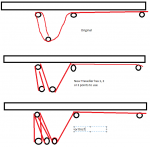
The new traveller has a higher load capacity and 3 attachment points if needed...so what combination of blocks/fiddles/beckets should I use? should the becket/fixed point end on boom or traveller? couple of options I have sketched out below (badly!) ....

boom3.png

so 2 single blocks on 2 attachment points on traveller, and a single with becket on boom?
or
3 single blocks on traveller, double block and becket on boom?
or
2 single blocks on traveller, double on boom and attach end to mid point on traveller?
or
some other combination! (seems to be plenty of options!)...
or
keep with standard and just use a single attachment point on traveller? (is their advantages to this?)
 
Last edited:
If the original purchase was adequate then stick with 3:1, so becket on the traveller.

If the attachment points on the traveller are adequately spaced and you are set on reducing loads on each point then secure the end of the sheet to aft traveller attachment, up to the boom, back to block on the traveller, then up and forwards.

If you want more purchase (will need a longer sheet) then the 2nd option in your latest diagram is good. The 3rd option is clearly OTT (but can be achieved without crossing the lines as in the diagram - this is left as an exercise for the reader).

Edit to add: minimum wear on the traveller will be achieved by loading it symmetrically. Thus lots of strands pulling aft and only one pulling forward is not ideal. Additionally if loading it on multiple points, try to load symmetrically such that neither side (fore or aft) is being pulled upwards more than the other. The easiest way to achieve this would be to have all the load through the central point...
 
Last edited:
If wear is the problem, you can prevent a lot of that by tying the boom over to one side a little, so the mainsheet isn't constantly moving when the boat's not in use.

Things like this are normally amply strong until wear gets excessive. As you've gone up a size from something that's lasted 15 years, you probably have nothing to worry about.
A tiny amount of lube will reduce wear remarkably.
 
Top