
Main sheet attachment to traveller block?

CJ13

Well-Known Member
Joined
10 Jan 2008
Messages
717
Visit site
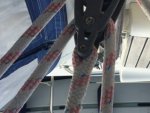
I plan to replace our main sheet.
The existing block looks to be riveted together and the main sheet attached by eye splice. I don’t think I can splice braid in place, so unless I’m missing something the new attachment will be using a halyard knot or similar.
Any bright ideas out there?
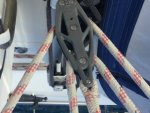
 

Attachments

  • 876A6E97-1540-4526-8DB8-16DF62668814.jpeg
    876A6E97-1540-4526-8DB8-16DF62668814.jpeg
    32.4 KB · Views: 61
  • 0175A6A1-677A-4A26-813F-AC3C53934151.jpeg
    0175A6A1-677A-4A26-813F-AC3C53934151.jpeg
    28.9 KB · Views: 61
I plan to replace our main sheet.
The existing block looks to be riveted together and the main sheet attached by eye splice. I don’t think I can splice braid in place, so unless I’m missing something the new attachment will be using a halyard knot or similar.
Any bright ideas out there?
I've never noticed a block where the becket is rivetted, odd and annoying. Could you not bring the block home so that you can sit in front of a pc and YouTube video to learn how to splice in the warmth of your home?
 
I've seen a bowline used, but that was in a sailing school where pragmatic solutions were often required to keep the fleet operational:)
Indeed. When I replace my main sheet I replaced the splice with a bowline and with the vague thought of putting a splice in. But then I thought that if that end got worn I could just cut off a bit and do another bowline.
 
Perhaps the problem is that the boat is mounted upside down?;)
Your options appear to be:
Remove the fitting and take it to a rigger
Learn how to splice
Use a halyard knot
Have an eye made and shackle it to the block - if you really must.

A halyard knot will be a bit bulkier and according to the fitting may occasional snag and be a nuisance, but could be a useful temporary measure.
 
I've always used a bowline.

How else can you end for end the sheet to even out the wear?

Just need to keep an eye on the whipping lest it gets loose and drawn into the block...
 
A halyard knot is quite strong and impossible to untie once loaded. It places more bulk by the becket. This line is probably hand tensioned, or at most lightly winched, so it it would be my very last choice. Is it just because it seems sailorly? It has no good characteristics for this job.

Bowline or sewn splice if the bowline rubs on something, which it probably won't. There is no need to be splice-happy unless pretty is important. There is no functional reason to splice, and I like being able to unreave lines.

Yes, I know how to splice and I do, when strength or space demand it.
 
A halyard knot is quite strong and impossible to untie once loaded. It places more bulk by the becket. This line is probably hand tensioned, or at most lightly winched, so it it would be my very last choice. Is it just because it seems sailorly? It has no good characteristics for this job.

Bowline or sewn splice if the bowline rubs on something, which it probably won't. There is no need to be splice-happy unless pretty is important. There is no functional reason to splice, and I like being able to unreave lines.

Yes, I know how to splice and I do, when strength or space demand it.
Thank goodness there’s somebody else out there who thinks that. I can’t bear them on jibsheets either and my real bugbear is on mooring lines. I want to be able to slip under load from either end - a good example being when I left a concrete fuel pontoon needing to gun the engine a bit to get away from springing off into a crosswind and with two other boats hovering to come in. The spring ran through beautifully then the end jammed in a chipped crack in the concrete and if I had had a spliced loop on then the boat would have crashed round hitting one approaching boat then probably the quay.
 
Top