Longshaft outboard mounting height on a yacht

Even Chance

Well-Known Member
Joined
15 Jun 2010
Messages
628
Location
Caithness
Visit site
Hi folks,
Scenario:-
Temporary outboard mount for a longshaft Suzuki DT8 on the transom of a Stella yacht whilst a new inboard is found. The mount is the alloy height adjustable type with a DIY stainless bracket made to compensate for the angle of the transom.
What height should the top of the mounting board for the engine be at above the waterline? Ive seen 20" quoted for the transom height in power boats for a longshaft.

Any ideas?
 
Nearly right Long shafts are usually 21" from top of bracket to waterline. This should be covered in the hanbook for the engine, showing which part of the engine should be on the static waterline - usually just above the cavitation plate. Too deep and you may have problems with exhaust back pressure, too high and the prop will come out of the water too easily as the boat moves. You may still find the prop comes out of the water if, for example somebody is on the foredeck when the boat is pitching.
 
I am sure 20" or 508mm is the correct figurre.

15" (381mm) for a short shaft

Long shaft Seagulls I think you will find are 21"


However you will have trouble I suspect with the prop lifting out of the water in much of a sea , or with anyone on the foredeck.
Usually people use a longshaft but mount them deeper to overcome this problem although if too deep difficult starting may result.

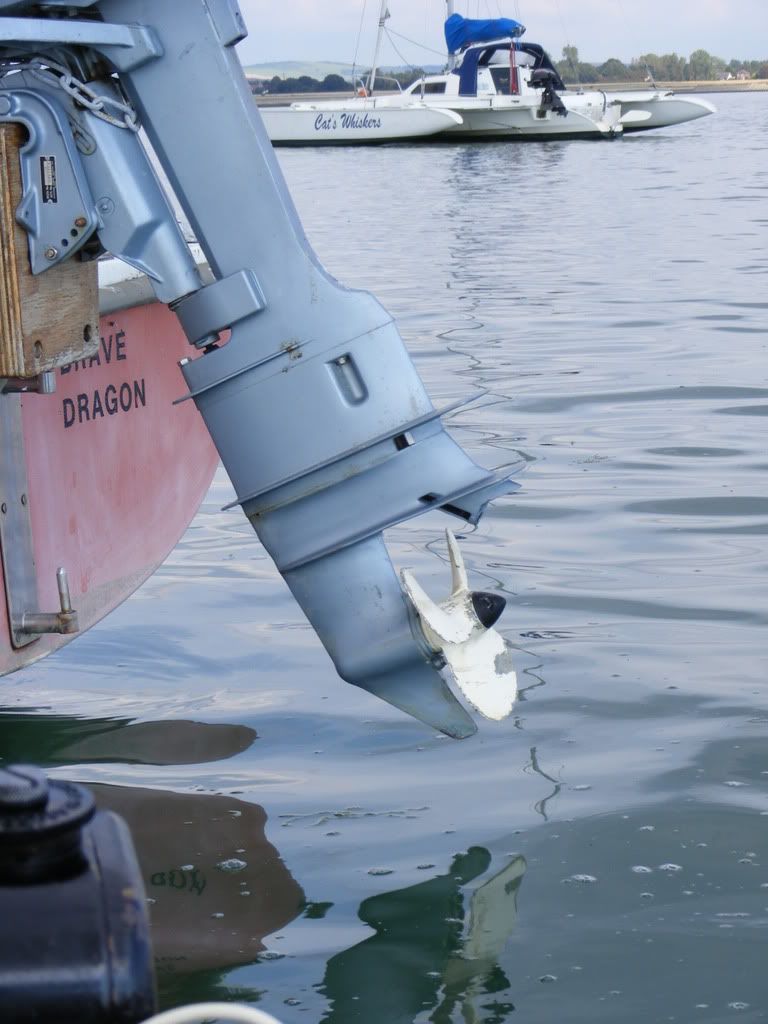
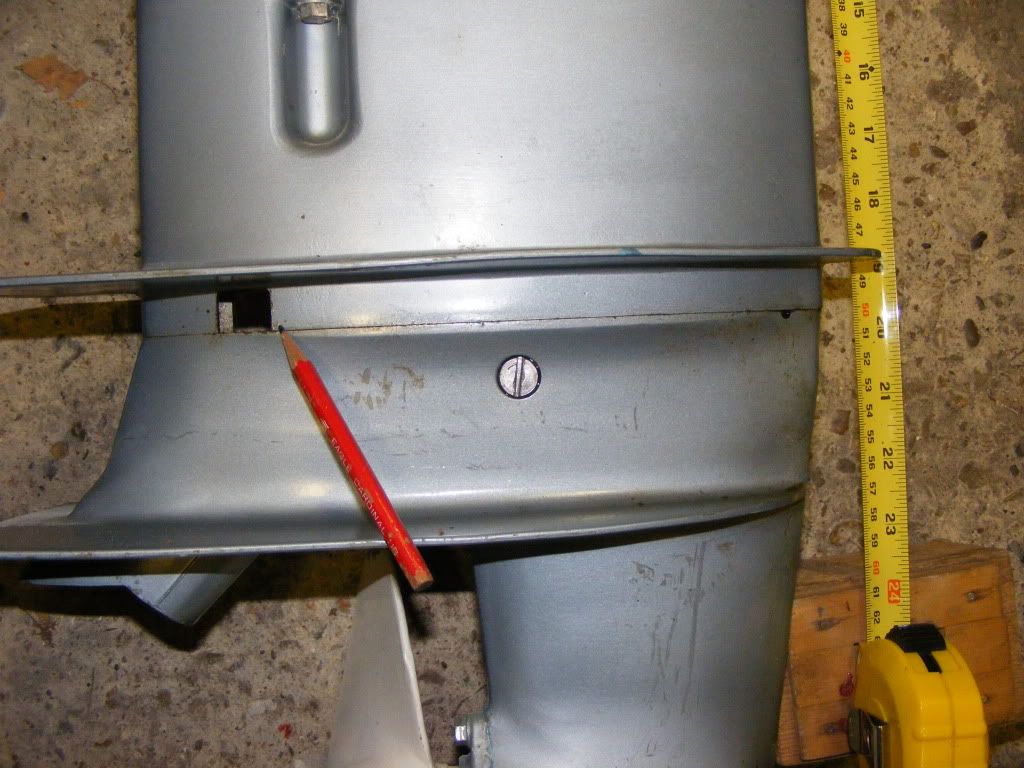
The ideal is special version of a long shaft with the exhaust outlet higher than standard. The pictures below show the bottom end of an Evinrude Yachtwin. The square holes below the upper AV plate are the exhaust outlets. This means the engine can be mounted deeper without excess back pressure on the exhaust.. In fact it can be mounted at the same height as a 15" shaft model.

The normal exhaust outlet behind the prop is blanked off. So when going astern gases are not sucked into the prop. Full thrust is as a result available astern as well as ahead

Sail versions usually also have finer pitch props than the standard engines

 
Can't see the problem if the bracket is adjustable. Use it as deep as you can unless some issues regarding back pressure arise.
Because of the different shapes of yacht sterns it's difficult to suggest a "proper" immersion depth. The suggestions in books and websites are inevitably for planing boats where the transom is likely to be the deepest part of the hull.
 
It is not quite a simple as measuring how deeply the leg is immersed. You need to measure the depth of the transom, including the part that is underwater.

I have a dinghy where the transom height above the water allows a short shaft outboard to be mounted so that the cavitation plate is nicely covered. However, the propeller is completely masked by the portion of the transom under the water and the boat goes nowhere. The propeller needs to be exposed to a clear flow of water under the hull to eperate effectively.

Shaft lengths are normally considered to be 15" short, 20" long and 25" extra long. This measurement needs to match the depth of the transom from the edge where the motor is mounted to the bottom, preferably including the keel if it extends back as far as the transom.
 
You could always try the engine on an inflatable first- which is really low to the water. Because when I fitted a suzuki 10hp 2str to my last boat , I had it rediculously low, so low that the leg/ Skeg only just cleared the sea when fully tilted. This was absolutely deliberate and rarely did the prop cavitate, even when motorsailing healed over or bouncy entrances... Electric start always started on the first touch of the button ..so bzck pressure possibly wasn't an issue.
You may well find that pulling the string cleanly is a limiting factor . And don't be surprised if those lifting brackets bend under full load- you may want to allow for this when Installing.
My two happorth from experience( and I had a lifting bracket/ correctly height mounted Johnson 10 2st before).
 
It is not quite a simple as measuring how deeply the leg is immersed. You need to measure the depth of the transom, including the part that is underwater.

I have a dinghy where the transom height above the water allows a short shaft outboard to be mounted so that the cavitation plate is nicely covered. However, the propeller is completely masked by the portion of the transom under the water and the boat goes nowhere. The propeller needs to be exposed to a clear flow of water under the hull to eperate effectively.

Shaft lengths are normally considered to be 15" short, 20" long and 25" extra long. This measurement needs to match the depth of the transom from the edge where the motor is mounted to the bottom, preferably including the keel if it extends back as far as the transom.


The OP is takling about an outboard for a Stella yacht. A 26ft yacht with a long deep keel and a transom hung rudder It has draft of 3'10" ... What you are suggesting may well apply to a dinghy or a power boat but it ceratinly does not apply to the boat in question.

Stella.jpg
 
Last edited:
I realise the the transom in this case is angled, but I feel the the principle still applies. Just getting the anti-cavitation plate submerged may not be sufficient. Obviously, the keel is depth is unimportant when the engine is mounted off-centre.
 
Personal view as deep as possible without swamping engine and to allow for easy operation. :rolleyes:

In the case of pushing big heavy hull you want as much thrust as possible like rowing you do not get that on the surface...

I would expect a long shaft to be designed to handle the increased back pressures caused by the extra depth...

Although I am sure some one will be disagreeing with all of above :D
 
Personal view as deep as possible without swamping engine and to allow for easy operation. :rolleyes:

In the case of pushing big heavy hull you want as much thrust as possible like rowing you do not get that on the surface...

I would expect a long shaft to be designed to handle the increased back pressures caused by the extra depth...

Although I am sure some one will be disagreeing with all of above :D

The ordinary long shaft models are designed for higher transom tops NOT for deeper immersion. 15" for short/standard shaft, 20" for long shaft and 25" for extra long shaft.

This is the guide to which LS probably referred earlier but it is not applicable to sailing boat hulls . It relates really to power boats which will plane .... http://smalloutboards.com/shaft.htm

.
 
Last edited:
Interesting.

so my boat is completely wrong then?

My adjustable height OB bracket measures 19" from the waterline to the top of the bracket where it bolts to the transom.

Fine you might say, except my OB is a short shaft.

But it still goes deep enough to work and push the boat along.

And yes it will pop put of the water if someone goes on the foredeck.

BUT when fully raised, my OB is only a couple of inches above the water. So a long shaft would be left dragging in the water all the time (unless you tilted it on it's mounting as well)
 
Interesting.

so my boat is completely wrong then?

My adjustable height OB bracket measures 19" from the waterline to the top of the bracket where it bolts to the transom.

Fine you might say, except my OB is a short shaft.

But it still goes deep enough to work and push the boat along.

And yes it will pop put of the water if someone goes on the foredeck.

BUT when fully raised, my OB is only a couple of inches above the water. So a long shaft would be left dragging in the water all the time (unless you tilted it on it's mounting as well)

If you fit a 15" shaft outboard on a mounting bracket the top off which is 19" above the water in its normal running position I'd be surprised if the prop was totally submerged, certainly not the AV plate.

Looking at the second picture in my earlier post you will see a tape measure. that is measuring down from the position of the mounting bracket top.
24" (ie 19 +5) on that tape would be the equivalent of what you say you are doing!

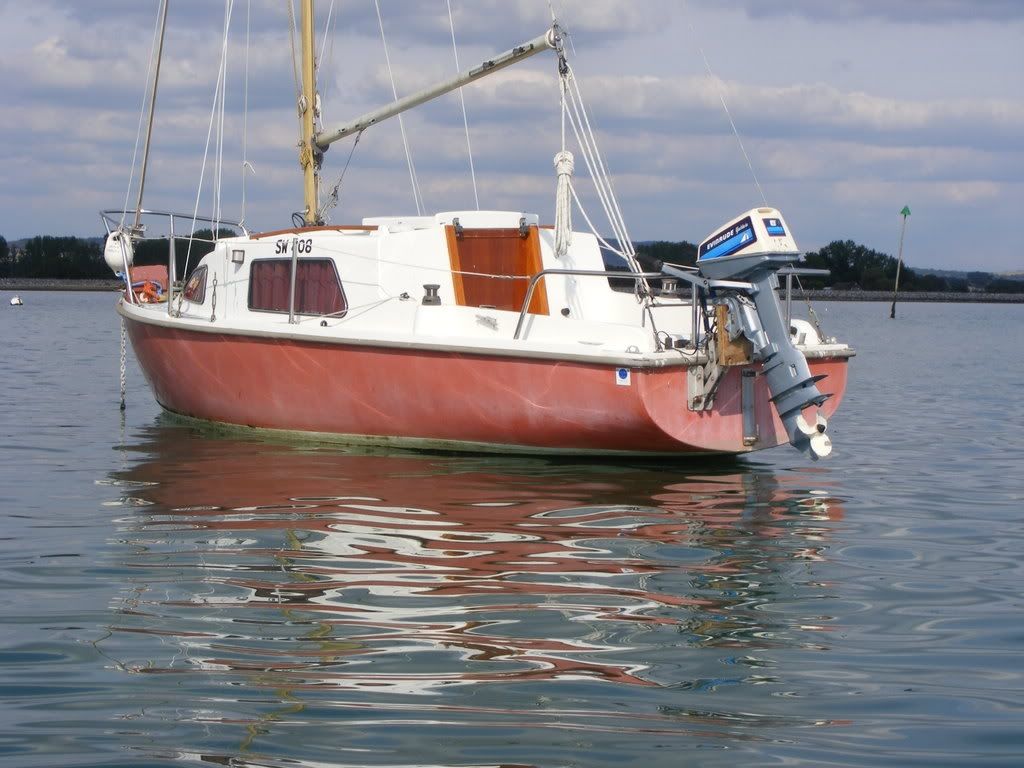
I do have to tilt my engine slightly to lift it clear of the water as you can see in the other picture but it is mounted on bracket which is approx 15" above the water when lowered.

 
Last edited:
The ordinary long shaft models are designed for higher transom tops NOT for deeper immersion. 15" for short/standard shaft, 20" for long shaft and 25" for extra long shaft.

This is the guide to which LS probably referred earlier but it is not applicable to sailing boat hulls . It relates really to power boats which will plane .... http://smalloutboards.com/shaft.htm

.

In the article you reference:
"Q. Can I use a long shaft motor on a boat that is rated for a short shaft?
A. Yes, it will work but you will notice a little more drag and a little less top end performance, but it is ok to do this and it will work fine. You may not want to do this if you are operating in shallow water."

If it does no harm to the engine and supplies more thrust when in operation, if nothing else by not coming out of the water and cavitating when some one goes forward or pitching heavily.

There is no problem?

My experience of using long-shafts on boats designed for short shafts is the extra loading on the transom that has concerned me. An extra 5-10" of leverage can make significant difference. I do not think this will become a concern on a Stella as long as the bracket has a suitable backing block.
 
There is no problem?
What I was objecting to was the statement made earlier, "I would expect a long shaft to be designed to handle the increased back pressures caused by the extra depth..." implying that there is something different about a long shaft engine to enable it to handle the extra back pressure.
There isn't. The differences are purely the lengths of the drive shaft, the water tube and the shift rod and of course the extension to the housing.

There is no reason for there to be any differnces. Its designed for a higher transom, not to be immersed deeper
 
Last edited:
The big advantage of an LS motor as a sailboat auxilliary is that it raises the power head making it easier to operate the controls and keeps the powerhead clear of the water when the boat is pitching or a wave comes up from astern.
 
O/B too deep in the water

What I was objecting to was the statement made earlier, "I would expect a long shaft to be designed to handle the increased back pressures caused by the extra depth..." implying that there is something different about a long shaft engine to enable it to handle the extra back pressure.
There isn't. The differences are purely the lengths of the drive shaft, the water tube and the shift rod and of course the extension to the housing.

There is no reason for there to be any differnces. Its designed for a higher transom, not to be immersed deeper

Hi Vic. I appreciate that an O/B submerged too deep will have additional back pressure on the engine but what is the effect or symptoms. with my adjustable bracket I have run my old Johnson 6 LS very deep and I don't think I have noticed any loss of power. (though I virtually never use full power anyway) Is that the end effect of too much back pressure? regards olewill
 
Hi Vic. I appreciate that an O/B submerged too deep will have additional back pressure on the engine but what is the effect or symptoms. with my adjustable bracket I have run my old Johnson 6 LS very deep and I don't think I have noticed any loss of power. (though I virtually never use full power anyway) Is that the end effect of too much back pressure? regards olewill

The possibility of difficult starting is the reason usually given for not submerging below the normal depth. There's bound to be a small loss of power too but probably not great enough to notice ~~ maybe if one had an outboard that was barely adequate one would.

Its something that does not bother me anyway because the Yachtwin has the modified exhaust system and is more than adequately powerful for my boat.
 
Top