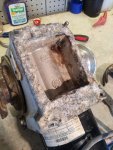
Lofrans winch body corrosion.

Mudisox

Well-Known Member
Joined
4 Jan 2004
Messages
1,788
Location
Dartmouth
Visit site
My cayman anchor winch was loosened when last used and so I dismounted it, finding considerable corrosion of the Aluminium body. It is exposed both from the sea above deck and the chain locker with wet chain only approx 100mm below.
However It has lasted 20+ years and the previous owner must have also had the same problem using GRP/epoxy to build it up where it had corroded, but was then mounted on a plastic board on top of an oak board, which was then sealant to solid GRP deck and through s/s bolts backed up below.
I have cleaned off the old "epoxy glue"and the corroded salts will be pressure washed back to clean alloy.
Do I repeat the same process, building up the 'wasted away' aluminium with " epoxy paste" [ It lasted for 20+ after all] ,] or bite on the bullet and get a new part with the associated delay in getting it from Italy, the hassle of stripping the winch insides and the remounting?
Was the Oak board a problem?
Will Duralac sufficiently insulate the cleaned Aluminium prior to epoxy build up?
Will attaching an anode to the underside backing help.?{ Bolts are s/s.]
Picture is too large but can send by PM.
 
My cayman anchor winch was loosened when last used and so I dismounted it, finding considerable corrosion of the Aluminium body. It is exposed both from the sea above deck and the chain locker with wet chain only approx 100mm below.
However It has lasted 20+ years and the previous owner must have also had the same problem using GRP/epoxy to build it up where it had corroded, but was then mounted on a plastic board on top of an oak board, which was then sealant to solid GRP deck and through s/s bolts backed up below.
I have cleaned off the old "epoxy glue"and the corroded salts will be pressure washed back to clean alloy.
Do I repeat the same process, building up the 'wasted away' aluminium with " epoxy paste" [ It lasted for 20+ after all] ,] or bite on the bullet and get a new part with the associated delay in getting it from Italy, the hassle of stripping the winch insides and the remounting?
Was the Oak board a problem?
Will Duralac sufficiently insulate the cleaned Aluminium prior to epoxy build up?
Will attaching an anode to the underside backing help.?{ Bolts are s/s.]
Picture is too large but can send by PM.
My previous Lofrans windlass was sat on a teak deck. The base corroded after about 20 years. I stripped the windlass but there was quite a bit of wear and no oil in it!! The new Lofrans is sat in a new grp painted plinth. Hopefully no corrosion as no longer sat on wet wood. It's been in 10 years. So far so good
 
My previous Lofrans windlass was sat on a teak deck. The base corroded after about 20 years. I stripped the windlass but there was quite a bit of wear and no oil in it!! The new Lofrans is sat in a new grp painted plinth. Hopefully no corrosion as no longer sat on wet wood. It's been in 10 years. So far so good

Can you get someone to weld some more material to the casing?
 
  • Like
Reactions: vas
I would repair it with lashings of Duralac, and a good epoxy, something designed for repairing engines.
Not sure if epoxy will stick to Duralac, it is meant to go between the aluminium and stainless.
 
Repair it with epoxy and then coat with an etch primer. The wood/plastic base should not be a problem, but the corrosion often starts with water getting round the fastenings. So take all the fastenings out and use Duralec on assembly. A non setting sealer such as butyl of polysulphide (so you can remove it later) paying attention to sealing the holes where the fastenings go through the pad. Probably not worth taking apart to fit a new casing if my experience is anything to go by. The other fastenings were so corroded in that it was impossible to get them out. a new one is not hugely expensive in the scheme of things a nd preventative measures such as the above should ensure a long life.
 
Can you get someone to weld some more material to the casing?
You cannot successfully weld to corroded aluminium. Any old aluminium with contamination on the surface or in the aluminium just blows and splatters. It's not going to happen. We replaced the whole windlass. At 20 years my view was it had had a good innings. Time for a new one
 
My previous Lofrans windlass was sat on a teak deck. The base corroded after about 20 years. I stripped the windlass but there was quite a bit of wear and no oil in it!! The new Lofrans is sat in a new grp painted plinth. Hopefully no corrosion as no longer sat on wet wood. It's been in 10 years. So far so good
Depending on the model, it may not need oil in it. The non electric models certainly don't.
 
You are meant to service windlass annually, or so I am instructed with my Maxwell. Its hardly onerous clean the whole thing pay specific attention to the shaft and grease the shaft. Check the oil in the gear box, our has a little sight glass that also doubles as the filler point. As Tranona says use copious Duralac on the stainless bolts that commonly are seated in the aluminium casting.

What is amazing is that most people ignore them until its too late but 20 years is about par for the course. I'd retire it and buy a new one, noting that you must use Duralac when you assemble. I am sure you could make some repairs - but they may fail when you least expect them to fail. And if the windlass is in the state you describe I'd expect the motor to look very questionable.

Jonathan
 
The mechanics and electrics in the Cayman 88 that the OP has are pretty robust and lull one into a false sense of security. However the one I had did its 7 seasons of chartering in Greece where the windlass gets more use in a year than most private owners do in a lifetime plus another 4 years before it started making noises. The big weakness as reported here is the aluminium casing. Lofrans bed the windlass on foam which is useless as it holds water, but do suggest annual removal and cleaning. Many replace the foam with a solid usually plastic pad which reduces this problem, but any damp still causes unseen corrosion. The steps suggested here of protecting the bottom mounting face and resetting the screws go a long way towards extending the life of what is an excellent windlass.
 
The mechanics and electrics in the Cayman 88 that the OP has are pretty robust and lull one into a false sense of security. However the one I had did its 7 seasons of chartering in Greece where the windlass gets more use in a year than most private owners do in a lifetime plus another 4 years before it started making noises. The big weakness as reported here is the aluminium casing. Lofrans bed the windlass on foam which is useless as it holds water, but do suggest annual removal and cleaning. Many replace the foam with a solid usually plastic pad which reduces this problem, but any damp still causes unseen corrosion. The steps suggested here of protecting the bottom mounting face and resetting the screws go a long way towards extending the life of what is an excellent windlass.

My uneducated view of windlass is that they are a marvel of marine engineering, dead simple, all basically the same general design - and all, nearly all, incorporating an aluminium casting that is the root cause of windlass failure. Not quite true - the original installer had not heard of Duralac nor aluminium corrosion in marine environment - hence corroded stainless bolts and rotting aluminium. Windlass are also located and installed without any thought for the owner wanting to service the windlass. Despite the inadequacies, abuse and absence of servicing they seem to last for about 20 years - which I find, positively, extraordinary.

Jonathan
 
I've only had one windlass a Lofrans Royale manual one. It's a fine robust simple piece of kit but it's essential to strip it down every year to avoid having the stainless fixings seize into the alloy casing. Duralac is good but won't last. Manual winches aren't very popular these days but are very reliable and I'm an advocate of 'Slow boating' and the gentle morning workout is good for me.
 
I've only had one windlass a Lofrans Royale manual one. It's a fine robust simple piece of kit but it's essential to strip it down every year to avoid having the stainless fixings seize into the alloy casing. Duralac is good but won't last. Manual winches aren't very popular these days but are very reliable and I'm an advocate of 'Slow boating' and the gentle morning workout is good for me.
I'm in the comfy position of being just about to fit a brand new Lofrans Tiges on deck. I plan to strip it down, and apply something to make it easy to take apart in the distant future.
Given this luxury, what is the best stuff to use, if Duralac doesn't last? Any tips, cheers.
(I'm a big fan of anhydrous lanolin, but does it stop the electrolytic corrosion between ally and stainless?)
 
Difficult to completely insulate the threads of the fastenings from the aluminium but Duralac is probably the best you can do as you want to be able to remove them at some point.
 
Difficult to completely insulate the threads of the fastenings from the aluminium but Duralac is probably the best you can do as you want to be able to remove them at some point.

I agree with Tranona. But as long as the access is reasonable it not difficult to simply remove the shaft and then take the whole thing apart and renew the Duralac - its the task for a warm sunny afternoon. Its not like removing diesel engine, more like servicing a sheet winch (well sort of). There is a grease sometimes mention on YBW that apparently has some of the characterises of Duralac (without the mess) but I've never used it - wait and someone might make a mention.

I am not intimate with the Lofrans Royale (and I bet the installation instructions do not mention Duralac) But when you instal - coat all the stainless bolts with whatever (or Duralac). I'd also coat the motor with something rubbery - the stuff used to seal the underside of cars in the UK from the rigours of salt in winter. It seems obvious, but not to installations I have seen, - but make sure the fall of the chain is as far from the motor as possible. You will find the motor casing (mild steel) has holes at the end - don't cover them up - they are there to cool the motor.

I found one installation where chain actually fell onto one side of the motor - the chain would wear through the motor before it had time to corrode

Jonathan
 
I am not intimate with the Lofrans Royale (and I bet the installation instructions do not mention Duralac) But when you instal - coat all the stainless bolts with whatever (or Duralac). I'd also coat the motor with something rubbery - the stuff used to seal the underside of cars in the UK from the rigours of salt in winter. It seems obvious, but not to installations I have seen, - but make sure the fall of the chain is as far from the motor as possible. You will find the motor casing (mild steel) has holes at the end - don't cover them up - they are there to cool the motor.

I found one installation where chain actually fell onto one side of the motor - the chain would wear through the motor before it had time to corrode

Jonathan

The Royale is a manual horizontal axis windlass - as simple as you can get but does need taking apart and cleaning regularly otherwise it seizes up. The Cayman 88 that started this thread is a very different animal and is an above deck horizontal axis with a fully encased motor and gears so does not suffer from what you described (vertical axis below decks motor). That is what makes it so attractive and why it often gets neglected, but its big weakness is the unpainted aluminium base which when installed new is often on a rubber pad. Because it is so reliable people tend to ignore it and only discover the corrosion 5 years or so down the line when they finally think they ought to check it! this is what it looks like lofrans.com/product/71-horizontal-windlasses/5004-cayman-88
 
Tronona' s experience of hard use is similar to mine with lots of setting and raising the anchor as a much used committee boat, sometimes 4-5 times a day in 20+ metres. I rarely go into Marinas when cruising, preferring small ports normally in Brittany.
I have decided to go down the route of=JB Weld and plenty of duralac with the body bedded on two bonded chopping boards.

If only I could reduce the photo size. hurray
 

Attachments

  • IMG_20220425_103054 2.jpg
    IMG_20220425_103054 2.jpg
    479.3 KB · Views: 20
Last edited:
Top