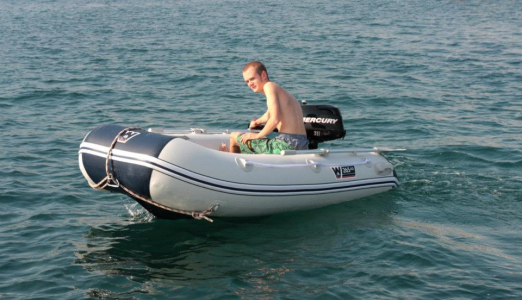
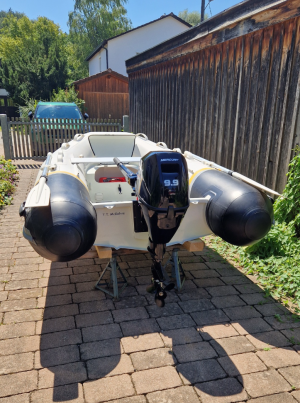
Little ribs vs alu floor tenders

lustyd

Well-Known Member
Joined
27 Jul 2010
Messages
14,972
Visit site
We currently have a 2.7m aluminium floor tender with 2.5hp 4 stroke. It lives upside down on the front of the boat and is fine as a tender.
A shop very close by is selling aluminium hull 2.7m ribs for what seems a very good price so I’m tempted to swap ours in for a rib. Aside from what I assume would be better handling, the Waveline RIB improves upon many aspects of our current Cadet tender.

We don’t have space for a bigger tender, and I won’t change the engine. Does anyone have any experience of both of these types of tender and any thoughts to offer on whether it’s a good idea?
 
My 2,7m aluminium RIB needed a 6hp to plane with one up, the replacement 9,9hp planes with 2 up. RIBs are more directionally stable and better when turning, but with 2,5hp I doubt it will make much difference, the RIB may even be slower.

We chartered a boat in Thailand with 3,5hp on a RIB ... biggest problem was draught, didn't go fast enough to get a benefit from the hull shape ... we ended up dragging a very heavy RIB, long distances over sand on multiple occasions .. if you use it where there are shallow sandy beaches with big tidal range, then stick with your aluminium floor IMO.

If you plan an engine upgrade and want to plane at 16 knots then go for it, you will see a benefit.

EDIT: Just had a look at the Zodiac Cadet ALU ... it's a flat alu floor on an inflatable "keel"? so the handling should be fine up to the 8hp max. I used to have an Airdeck (inflatable rib like floor) and the handling was OK at 6hp but the Aluminium RIB has more bite, tracks straighter and turns better. As they are more robust, around rocky beaches you don't worry any more about punctures, you worry about dents and damage to the powder coating instead :ROFLMAO: ... but obviously an Alu RIB is more robust.

The HUGE disadvantage is the weight. My new one is just over 10kgs heavier and is more unforgiving when it bangs against things bringing it abord. Used to be a one-man job just hauling up on the spinnaker halyard - now two-man with my wife on the electric winch and me fending it off the hull and guard-rails, and stopping it banging into the mast. It lives on davits when we are abord, but in our home marina, with stern-to mooring, it has to go on the foredeck when we leave the boat.

PS: As a kid on my dads boat, I got a flat-floored Avon Redcrest planing with a Seagull on the back and a broom handle stuck in the tiller arm. Those were the days.
 
Last edited:
I probably should have also mentioned the RIB is quite a bit lighter than the Cadet Alu. We’d fit wheels and have them now so dragging along isn’t too big a deal but draft is something I hadn’t considered at all.

I don’t really want to deal with a heavier outboard so perhaps will stick with the tender. The modern Cadet is a horrid dinghy though so might be worth it just to get rowlocks, valves, drain and seats that do their job properly even if the actual usage is similar.
 
My current Plastimo 2.7m fortunately is getting to the stage it needs replaced, it's like steering porridge even with two in it.. It does however work well with my current E-propulsion outboard. My solution will be a Highfield ultralight 2.9 at just over 40kg and a 10hp outboard but I will keep the E-propulsion for short distances in good weather.
 
A plus for the aluminium rib is dealing with waves and would assume an aluminium rib will last longer than a material and aluminium floor boat.
 
We have a 3D Tender Featherlight 2.65m aluminium rib tender weighing in at 26kg. Definitely larger than a similar sized airdeck or aluminium floor flubber. The large tubes and deep hull make it feel very safe and secure. Keeps you much drier when the going gets choppy. Easily dragged up the stoniest shoreline without worrying about slicing the bottom open. It doesn’t fit on our front deck, won’t roll up and fit in a cockpit locker so we ‘lash’ it across the stern or, dare I mention it, tow it. Happily moves us around with a Yam 2hp 2S, absolutely flies with a Yam 8hp 2S. It was an expensive purchase for us, even more so when we replaced the first one that got stolen and wasn’t insured, but well worth it in our minds.
 
I am not a liveaboard, so my tenders get about 6 weeks intensive use per year in the northern Adriatic, the rest of the time they sit on the foredeck upside down. We prefer to anchor away from the charter fleets, so a fast tender was a must.

The two tenders I've had in the last 14 years are a Wetline 265AD (no longer in production) and a ZAR mini RIB9 DL

The Wetline was PVC and had a high-pressure floor which inflated to make a V shape, so relatively directionally stable, fine with the 6hp Mercury 4-Stroke on the back and a fuel tank lashed to straps on the floor. The 6hp engine was not up to the job, it would plane 1-up with shopping but was not that great for a cruising couple. The dinghy was relatively light and I could haul it onto the foredeck with a spinnaker halyard myself. It retired after about 8 years because the floor valves started leaking - I fixed them, and sold it and the 6hp with the mothership in 2021, having replaced it with the ZAR in 2019 which I kept for the next boat. Overall, it was cheap, light, and lasted longer than I expected.

1763803656175.png

The ZAR mini is a PVC/aluminium, powder-coated RIB with a raised floor and a locker in the bow where the fuel tank, pump, and other stuff sits - the fuel hose runs under the floor to the engine. I replaced the 6hp with a 9,9hp Mercury 4 Stroke, so it planes 2-up with shopping. It is much heavier than the Wetline, but definitely more robust, directionally stable and handles better on the plane. Downside - I need to use the electric winch on the spinnaker halyard to get it on deck when we get back to the marina, but it normally lives on davits.

1763805160275.png

I prefer the RIB even though it is heavier - only complaint is that the tubes are quite large so the interior space is more limited than in other RIBs.

Bear in mind, my use-case is as a fast 2 (small) person shopping trolley/taxi which is only used 6 weeks of the year in the Adriatic.
 
The obvious arguments against - are if you need to put it in a car, or deflate to store in a locker. If you were doing that regularly presumably you wouldn’t have an Ali deck version - and as liveaboards you don’t have an end of season - but do you want it on the foredeck for any bigger passages you have planned?

The draft will be slightly higher perhaps but that might actually be more of an issue on the foredeck if it now fouls the foot of foresail?
 
but do you want it on the foredeck for any bigger passages you have planned?
We already keep the dinghy on the foredeck on long passages. Far better than towing, but does make it a pain to put the spinnaker pole out. The RIB looks like it might be a couple of inches higher but otherwise very similar upside down.
 
We have a Ribeye 290 aluminium rib. Absolutely love it. We keep ours on the foredeck when the boat is left, and it's light and easy to hoist onto the deck. We have a Tohatsu 3.5 outboard, which we find perfectly adequate, but it won't plane (we only use it to hop ashore). We did have a 6hp, and you could just about get it to plane with 1-up, but swapped out for the Tohatsu due to the weight advantage when lugging the outboard about. My mate has the same rib with a 10hp outboard, and it goes like stink.
 
If you are planning to cross to the Caribbean at some point, the rib makes total sense. You may even invest in a larger 2 stroke when there. The large engine rib combo in the Caribbean is the norm. It's your car since you are only at anchor there. Marinas are too hot and the anchorages are free
 
Top